


Quick Summary / Snapshot
If you’ve ever wondered how computers can find patterns without being told what to look for, this guide is for you. Unsupervised learning basics explained means understanding a type of machine learning where computers analyze unlabeled data and discover hidden relationships on their own.
In this guide, you’ll understand the core concepts of unsupervised learning, explore how it analyzes data, discover its main techniques, see where it is applied in everyday industries, and learn why it plays a vital role in today’s AI-driven world.Everything is explained in simple English with practical examples so even beginners can understand the topic easily.
Introduction
If you are searching for unsupervised learning basics explained, you probably want a simple explanation instead of difficult technical terms. The good news is that unsupervised learning is much easier to understand than many people think. Unlike traditional machine learning methods that require labeled data, unsupervised learning allows computers to discover patterns, similarities, and relationships without any predefined answers.
Think about opening a box full of mixed colored marbles. Nobody tells you how to sort them, but you naturally group similar colors together. A computer using unsupervised learning works in a similar way. It studies data, finds similarities, and creates meaningful groups automatically.
Today, companies use this technology to understand customer behavior, recommend products, detect unusual activities, organize large datasets, and improve business decisions. Because modern businesses collect huge amounts of data every day, learning the basics of unsupervised learning has become valuable for students, developers, data analysts, and business owners alike.
What Is Unsupervised Learning?

Unsupervised learning is a branch of machine learning where an algorithm learns from unlabeled data. Since there are no correct answers provided, the system must discover hidden structures and relationships by itself.
Instead of asking,
“What is the correct answer?”
the algorithm asks,
“Which data points look similar?”
This makes unsupervised learning perfect for discovering information that humans may not notice immediately.
Simple Definition
Unsupervised learning is a machine learning technique that automatically finds patterns, groups, or relationships in data without using labeled examples.
A Simple Real-Life Example
Imagine a supermarket has information about 50,000 customers.
The data includes:
- Age
- Shopping frequency
- Total spending
- Favorite products
However, the supermarket doesn’t know which customers belong to which category.
An unsupervised learning algorithm analyzes all the information and automatically creates groups such as:
- Budget shoppers
- Premium buyers
- Weekend customers
- Frequent visitors
- Seasonal shoppers
Nobody manually created these groups.
The computer discovered them by analyzing similarities in customer behavior.
This is one of the most common uses of unsupervised learning in business.
Why Is Unsupervised Learning Important?

Every day, organizations generate massive amounts of data.
Collecting data is no longer the biggest challenge; turning that data into useful insights is what truly matters.
Unsupervised learning helps businesses:
- Discover hidden customer groups
- Find unusual behavior
- Organize complex datasets
- Improve recommendations
- Detect trends before competitors
Without these techniques, much valuable information would remain hidden inside large databases.
How Does Unsupervised Learning Work?
Unlike supervised learning, unsupervised learning works without labeled data or predefined results.
The learning process usually follows these steps.
Step 1: Collect Raw Data
The system gathers information from different sources.
Examples include:
- Customer purchases
- Website visits
- Mobile app usage
- Medical records
- Sensor readings
At this stage, the data has no categories.
Step 2: Analyze Similarities
The algorithm compares every data point with others.
It checks different characteristics such as:
- Distance
- Similarity
- Behavior
- Features
- Statistical relationships
The goal is to identify data that naturally belongs together.
Step 3: Create Groups
After comparing the information, the algorithm forms clusters.
Each cluster contains items that share common characteristics.
For example:
Cluster A
- Young customers
- Online shopping
- Small purchases
Cluster B
- Older customers
- High spending
- Luxury products
These groups help businesses make better marketing decisions.
Step 4: Generate Insights
Finally, analysts study these groups to answer questions like:
- Which customers spend the most?
- Which products are bought together?
- Which users may leave soon?
- Which patterns were previously unknown?
These insights support better business strategies.
Main Types of Unsupervised Learning
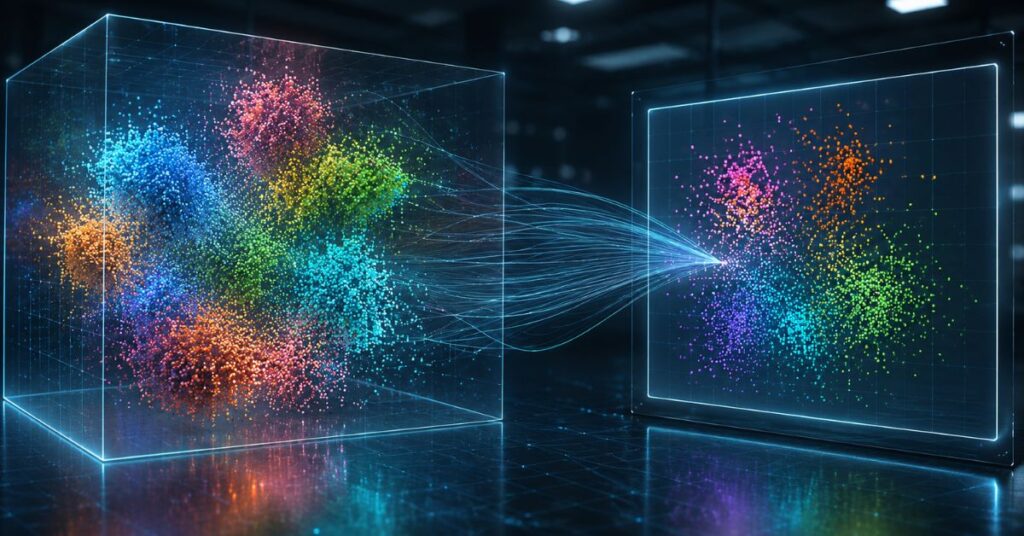
Although many algorithms exist, most unsupervised learning techniques fall into two major categories.
Clustering
Clustering means grouping similar data together.
The algorithm looks for similarities and automatically creates meaningful categories.
Example
Suppose a music streaming platform has millions of users.
Instead of manually organizing listeners, the algorithm creates groups like:
- Classical music lovers
- Pop fans
- Rock listeners
- Podcast listeners
- Jazz enthusiasts
Each group helps improve music recommendations.
Where Clustering Is Used
- Customer segmentation
- Healthcare analysis
- Marketing campaigns
- Social media analysis
- Image recognition
- Fraud detection
Because clustering reveals hidden patterns, it is one of the most popular unsupervised learning techniques.
Dimensionality Reduction
Modern datasets often contain hundreds or even thousands of variables.
Too many variables make analysis slower and more difficult.
Dimensionality reduction removes unnecessary information while keeping the most valuable patterns.
Think of it like compressing a large photo without losing its important details.
Benefits
- Faster machine learning models
- Better visualization
- Reduced storage
- Improved performance
- Easier data analysis
This technique is widely used before building advanced AI models.
Common Algorithms Used in Unsupervised Learning
Different problems require different algorithms. Some focus on grouping data, while others simplify large datasets.
The table below gives a beginner-friendly overview.
| Algorithm | Main Purpose | Best Use Case |
| K-Means Clustering | Groups similar data | Customer segmentation |
| Hierarchical Clustering | Creates tree-like clusters | Biological research |
| DBSCAN | Finds clusters with irregular shapes | Location analysis |
| Principal Component Analysis (PCA) | Reduces dimensions | Data visualization |
| t-SNE | Visualizes complex datasets | Machine learning research |
Each algorithm has its own strengths, and choosing the right one depends on the type of data and the problem being solved.
Clustering vs Dimensionality Reduction
Many beginners confuse these two concepts.
A simple way to understand the difference is explained below.
Clustering
Its goal is to create groups.
Example:
Thousands of customers become five customer categories.
Dimensionality Reduction
Its goal is to simplify information.
Example:
A dataset with 300 columns becomes only 20 important columns while keeping most useful information.
Although both belong to unsupervised learning, they solve different problems.
Author’s Practical Note
When I first started learning machine learning, I also believed every algorithm needed correct answers before it could learn. After working through practical datasets, I realized that some of the most useful business insights actually come from unlabeled data. Customer groups, shopping habits, and hidden trends often appear only after applying unsupervised learning techniques. That’s why understanding these basics is valuable before moving to advanced AI topics.
Real-World Applications of Unsupervised Learning
One of the biggest reasons businesses invest in Artificial Intelligence (AI) is the ability to discover information hidden inside large datasets. Once you understand unsupervised learning basics explained, it becomes easier to see why this technology is used across many industries.
Unlike traditional methods that require labeled data, unsupervised learning helps organizations identify patterns automatically. These insights improve decision making, save time, and reveal opportunities that might otherwise remain unnoticed.
Customer Segmentation
Customer segmentation is one of the most common applications of unsupervised learning.
Every customer behaves differently. Some buy frequently, while others shop only during seasonal sales. Instead of manually creating customer groups, businesses use clustering algorithms to identify customers with similar buying habits.
Example
An online clothing store may automatically create groups such as:
- Regular customers
- Luxury buyers
- Seasonal shoppers
- Discount-focused customers
- New visitors
After identifying these groups, the company can send personalized offers to each category. This improves customer satisfaction and increases sales.
Recommendation Systems
Have you ever wondered how streaming platforms or online stores recommend movies or products you may like?
Many recommendation systems use unsupervised learning to discover users with similar interests.
For example, if several users watch the same types of movies or purchase similar products, the system learns these patterns and recommends new content accordingly.
This creates a more personalized user experience.
Fraud Detection
Banks and financial companies process millions of transactions every day.
Instead of checking every transaction manually, unsupervised learning identifies unusual behavior that differs from normal customer activity.
For example:
- A credit card suddenly used in another country
- Multiple large transactions within a few minutes
- An unusual login location
These activities are flagged for further investigation, helping reduce fraud.
Healthcare and Medical Research
Hospitals, clinics, and healthcare providers collect vast amounts of patient information every day.Doctors and researchers use unsupervised learning to discover hidden relationships between symptoms, diseases, treatments, and patient outcomes.
This can help researchers:
- Find similar patient groups
- Improve disease prediction
- Support medical research
- Identify hidden health trends
Although doctors make the final decisions, machine learning provides valuable insights.
Image Recognition
Millions of images are uploaded every day.
Instead of manually organizing them, unsupervised learning groups similar images together based on visual characteristics.
This technology helps in:
- Photo organization
- Face grouping
- Image search
- Object recognition
- Digital asset management
Marketing and Business Analytics
Marketing teams constantly analyze customer behavior.
Using unsupervised learning, they can discover:
- Popular products
- Customer interests
- Buying patterns
- Seasonal demand
- Shopping trends
With a better understanding of customer behavior, businesses can develop marketing campaigns that deliver stronger results.
Advantages of Unsupervised Learning
Learning unsupervised learning basics explained also means understanding why this approach has become so valuable.
Below are some of its biggest advantages.
1. No Labeled Data Required
Preparing labeled datasets takes time and money.
Since unsupervised learning works with unlabeled data, organizations can analyze information much faster.
2. Finds Hidden Patterns
Humans cannot always recognize complex relationships inside large datasets.
Machine learning algorithms can discover patterns that would otherwise remain hidden.
3. Handles Large Amounts of Data
Modern businesses collect millions of records every day.
Unsupervised learning can efficiently analyze these large datasets and organize them into meaningful groups.
4. Supports Better Decision-Making
Businesses can make smarter decisions based on actual customer behavior instead of assumptions.
This improves marketing, product development, and customer service.
5. Saves Time
Instead of manually sorting data, algorithms automatically organize information.
This allows analysts to focus on interpreting results rather than preparing data.
Limitations of Unsupervised Learning

While unsupervised learning is powerful, it also has some limitations.
Understanding these helps you choose the right approach for different projects.
Results Can Be Difficult to Interpret
The algorithm creates groups, but humans still need to understand what those groups actually represent.
Sometimes clusters may not have an obvious meaning.
No Guaranteed Correct Answer
Since there are no labels, the algorithm cannot verify whether its findings are completely accurate.
Human expertise is still important.
Performance Depends on Data Quality
Poor-quality data often produces poor-quality results.
Missing values, duplicate records, or incorrect information can reduce accuracy.
Choosing the Right Algorithm Can Be Challenging
Different algorithms produce different results.
Selecting the most suitable algorithm requires experience and experimentation.
Unsupervised Learning vs Supervised Learning
Many beginners confuse these two machine learning approaches.
The comparison below makes the difference easy to understand.
| Feature | Unsupervised Learning | Supervised Learning |
| Data Type | Unlabeled Data | Labeled Data |
| Goal | Find hidden patterns | Predict known outcomes |
| Human Guidance | Very little | Required during training |
| Output | Groups, relationships, patterns | Predictions or classifications |
| Example | Customer segmentation | Spam email detection |
| Popular Algorithms | K-Means, DBSCAN, PCA | Decision Trees, Random Forest, Logistic Regression |
A simple way to remember this difference is:
- Supervised learning answers a question you already know.
- It uncovers hidden patterns and insights that may not be obvious at first.
Real-Life Example
Imagine a supermarket with 100,000 customers.
The management wants to improve sales but has no information about customer categories.
Instead of manually reviewing every customer’s purchase history, the company applies an unsupervised learning algorithm.
Within minutes, the system creates several customer groups based on shopping behavior.
The marketing team discovers that:
- Young customers buy snacks and drinks together.
- Families purchase household items every month.
- Premium customers spend more on organic products.
- Weekend shoppers mainly buy discounted products.
Using these insights, the supermarket creates personalized offers for each customer group.
As a result, customers receive more relevant promotions, and the business improves its marketing strategy without manually analyzing thousands of records.
This is a practical example of how unsupervised learning basics explained can be applied in the real world.
Common Mistakes Beginners Make
Many people understand the theory but make avoidable mistakes when working with unsupervised learning.
Using Poor-Quality Data
Incomplete or incorrect data often leads to misleading results.
Always clean your dataset before applying any algorithm.
Choosing the Wrong Algorithm
Different clustering algorithms perform better with different types of datasets.
Compare different algorithms before making conclusions.
Ignoring Data Scaling
Features with larger values can dominate the results.
Normalizing or scaling data usually improves clustering performance.
Expecting Perfect Clusters
Real-world data is rarely perfect.
Some overlap between groups is completely normal.
Misinterpreting Results
Algorithms only identify patterns.
Human analysis is still required to understand what those patterns actually mean.
Using Too Many Features
Adding unnecessary variables can reduce accuracy.
Focus only on relevant features that contribute to meaningful analysis.
Skipping Result Validation
Always visualize clusters or evaluate them using appropriate techniques before making business decisions.
Never assume the first output is automatically correct.
Best Practices for Using Unsupervised Learning Successfully

Understanding unsupervised learning basics explained is only the first step. To get meaningful results, you also need to follow good practices while working with data and machine learning algorithms. Even the best algorithm cannot produce useful insights if the data is poor or the process is incorrect.
Below are some proven practices followed by data analysts and machine learning professionals.
Start with Clean and Organized Data
Data quality has a direct impact on the results of any machine learning model.
Before applying an algorithm, make sure to:
- Remove duplicate records.
- Handle missing values carefully.
- Correct obvious errors.
- Standardize data formats.
- Remove irrelevant information.
Clean data helps algorithms discover more accurate and meaningful patterns.
Choose the Right Algorithm
Every dataset is different. There is no single algorithm that works best in every situation.
For example:
- K-Means works well when clusters are clearly separated.
- DBSCAN is useful for identifying irregularly shaped clusters.
- Hierarchical Clustering is suitable when you want to understand relationships between groups.
- PCA is commonly used to reduce the number of features while preserving important information.
Testing multiple algorithms often produces better results than relying on only one.
Visualize Your Results
Visualization makes it easier to understand patterns created by machine learning algorithms.
Common visualization methods include:
- Scatter plots
- Cluster diagrams
- Heatmaps
- Dimensionality reduction charts
- Interactive dashboards
Visual analysis helps verify whether the identified clusters make practical sense.
Combine Human Knowledge with Machine Learning
Algorithms can identify patterns, but they cannot fully understand business goals or real-world context.
Always review machine learning results with domain experts before making important decisions.
For example, a retail company should involve marketing professionals when interpreting customer segments.
Keep Testing and Improving
Machine learning is an ongoing process rather than a one-time task.
As new data becomes available:
- Retrain models.
- Compare results over time.
- Evaluate business impact.
- Update datasets regularly.
Continuous improvement leads to better long-term performance.
The Future of Unsupervised Learning

The importance of unsupervised learning continues to grow as organizations collect larger amounts of data every day.
Several trends are shaping its future.
More Business Automation
Businesses are increasingly using AI to automate customer analysis, inventory planning, and market research. Unsupervised learning plays a key role in discovering insights without manual effort.
Improved Healthcare Solutions
Researchers are using machine learning to identify disease patterns, support drug discovery, and improve patient care through data-driven insights.
Cybersecurity Enhancements
Security systems use unsupervised learning to detect unusual network activity and identify potential cyber threats before they cause serious damage.
Smarter Recommendation Systems
Streaming services, online stores, and social media platforms continue improving recommendations by analyzing user behavior and preferences.
As AI technology advances, unsupervised learning will become even more valuable across industries.
Learning Roadmap for Beginners
If you want to move beyond unsupervised learning basics explained, follow this simple learning path:
- Learn the basics of machine learning.
- Understand data preprocessing and cleaning.
- Practice with small datasets.
- Learn clustering algorithms such as K-Means and DBSCAN.
- Explore dimensionality reduction techniques like PCA.
- Build small projects using real datasets.
- Learn data visualization to interpret results.
- Study advanced machine learning topics after mastering the fundamentals.
Following this roadmap helps build a strong foundation without feeling overwhelmed.
Disclaimer
The information shared in this guide is provided to help readers understand the topic more clearly.While every effort has been made to provide accurate and up-to-date information, machine learning is a rapidly evolving field. Different datasets and business requirements may produce different results. Always test algorithms with your own data and consult reliable technical documentation before using machine learning models in production environments.
Author Note
When I first explored machine learning, the idea of computers learning without labeled answers seemed confusing. However, after working with practical datasets, I realized that many valuable business insights come from discovering patterns rather than predicting known outcomes. That experience inspired this guide, which explains the topic in simple English so beginners can understand the core concepts without unnecessary technical language.
Conclusion
Learning unsupervised learning basics explained gives you a strong foundation for understanding one of the most important areas of machine learning. Instead of relying on labeled data, unsupervised learning helps computers discover hidden patterns, relationships, and groups automatically. These capabilities make it useful for customer segmentation, fraud detection, recommendation systems, healthcare, marketing, and many other real-world applications.
As you continue learning, focus on understanding the data before choosing an algorithm. Clean datasets, thoughtful analysis, and regular practice are far more valuable than simply memorizing algorithm names. Working on practical projects and exploring real datasets will help you build the confidence and skills needed to use unsupervised learning effectively.
(FAQs)
1. What is unsupervised learning in simple words?
Unsupervised learning is a type of machine learning where a computer analyzes unlabeled data and automatically discovers hidden patterns, similarities, or groups without being given the correct answers.
2. Why is unsupervised learning important?
It helps businesses and researchers understand large amounts of data, discover customer segments, detect unusual behavior, and reveal insights that may not be visible through manual analysis.
3. What are the main types of unsupervised learning?
The two main types are clustering, which groups similar data points together, and dimensionality reduction, which simplifies large datasets while keeping important information.
4. How does supervised learning differ from unsupervised learning?
Supervised learning uses labeled data to predict known outcomes, while unsupervised learning works with unlabeled data to identify hidden structures and relationships.
5. Where is unsupervised learning used in real life?
It is widely used in customer segmentation, recommendation systems, fraud detection, healthcare research, image recognition, cybersecurity, and business analytics.
6. Is unsupervised learning difficult for beginners?
Not necessarily. Once you understand the basic concepts and practice with simple datasets, learning becomes much easier. Starting with real world examples is one of the best ways to build confidence.
7. What should I learn after understanding unsupervised learning basics explained?
After mastering the basics, you can explore supervised learning, deep learning, neural networks, natural language processing (NLP), and practical machine learning projects using Python and real datasets.