

Quick Summary / Snapshot
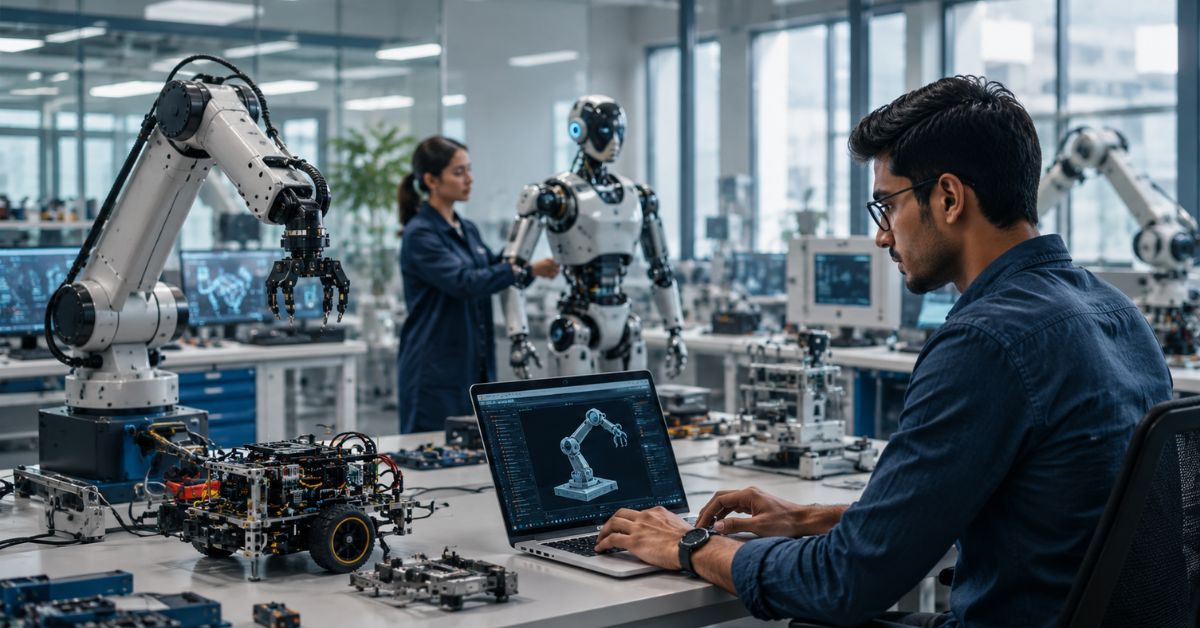
If you are thinking about a career in robotics, this guide will help you understand everything you need to know. The robotics engineering future scope is growing because industries are using automation, artificial intelligence, and smart machines to improve productivity. Robotics engineers now work in healthcare, manufacturing, agriculture, defense, logistics, space research, and many other fields. In this guide, you will learn about career opportunities, required skills, salary expectations, industry trends, challenges, and practical tips to build a successful career.
Introduction
The robotics engineering future scope is becoming stronger as technology changes the way people work and live. Companies across the world are investing in intelligent robots to improve speed, accuracy, and safety. From factories and hospitals to warehouses and space missions, robotics is creating new career opportunities for skilled engineers. This growing demand makes robotics engineering one of the most exciting fields for students who enjoy technology, problem solving, and innovation.
Robotics engineering combines mechanical engineering, electronics, computer science, artificial intelligence, and programming to design and develop smart machines. These machines can perform tasks that are difficult, repetitive, or dangerous for humans. As industries continue to adopt automation, the demand for robotics engineers is expected to increase, making this profession a promising choice for long-term career growth.
Whether you are a student planning your future, a graduate exploring career options, or a professional considering a career change, understanding the robotics engineering future scope can help you make an informed decision. This guide explains the industry’s growth, career paths, essential skills, and future trends in simple language so you can confidently plan your journey.
What Is Robotics Engineering?
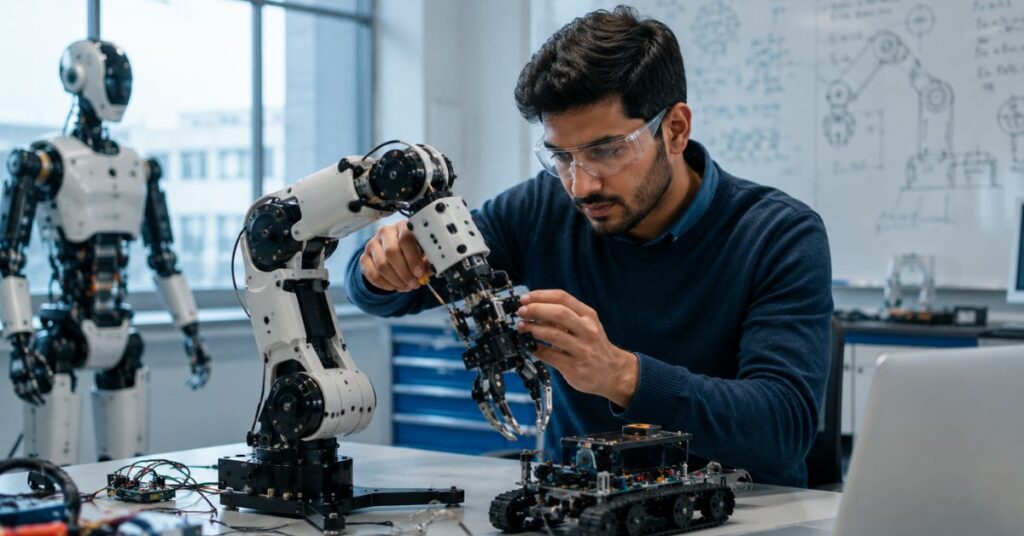
Robotics engineering is an engineering discipline that focuses on creating, developing, programming, and improving robotic systems. These robots are designed to perform tasks on their own or with very little human assistance, making work faster, safer, and more efficient across different industries. Modern robots use sensors, artificial intelligence (AI), machine learning, and advanced software to make decisions and complete tasks accurately.
Unlike traditional machines, robots can interact with their surroundings, collect data, and respond to different situations. Robotics engineers work on both the hardware and software of these intelligent systems to ensure they perform efficiently and safely.
What Does a Robotics Engineer Do?
A robotics engineer performs many important tasks throughout the development of a robotic system. Their responsibilities may include:
- Designing robotic systems for different industries.
- Writing and testing software that controls robots.
- Building and assembling robotic components.
- Installing sensors, cameras, and controllers.
- Testing robot performance and fixing technical issues.
- Improving existing robotic systems to increase efficiency.
- Working with AI, automation, and machine vision technologies.
The work changes depending on the industry, but the main goal is always to develop robots that solve real world problems.
Where Are Robots Used Today?
Robots are no longer limited to manufacturing plants. They are becoming part of everyday life and are helping businesses improve productivity and safety.
Some common industries using robotics include:
- Manufacturing and industrial automation
- Healthcare and robotic surgery
- Agriculture and smart farming
- Logistics and warehouse automation
- Aerospace and space exploration
- Defense and security
- Construction and infrastructure
- Education and research
- Hospitality and customer service
The growing use of robots in these industries clearly shows why the robotics engineering future scope continues to expand every year.
Why Is the Robotics Engineering Future Scope Growing?
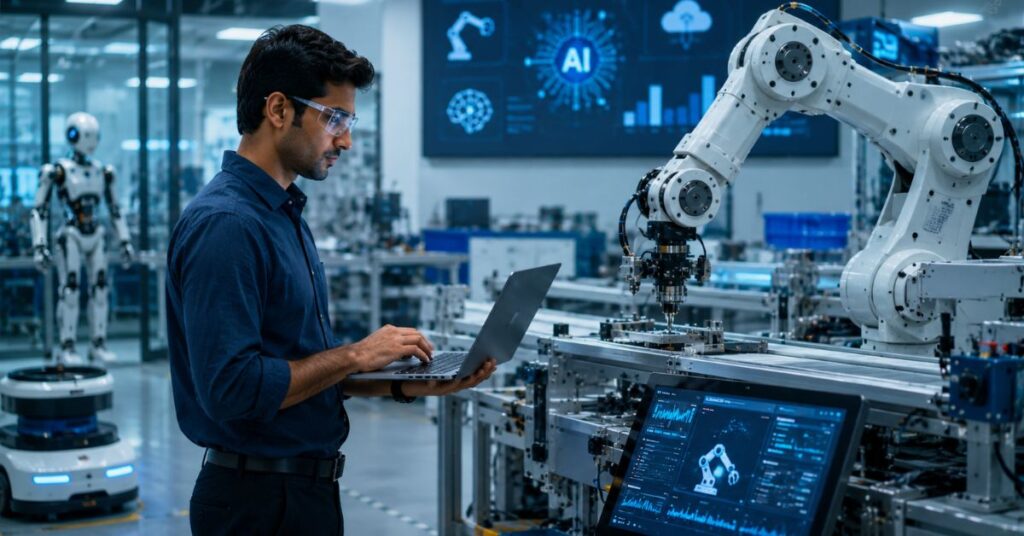
The robotics engineering future scope is growing because industries need faster, smarter, and more reliable solutions. Businesses want to reduce human error, improve product quality, lower operational costs, and increase production speed. Robotics helps achieve all of these goals.
Governments, technology companies, and research organizations are also investing heavily in robotics and automation. As new technologies develop, robotics engineers will continue to play an important role in creating innovative solutions.
Increasing Demand for Automation
Automation allows businesses to complete repetitive tasks with greater speed and accuracy. Instead of relying entirely on manual work, companies now use robotic systems that can operate continuously with minimal downtime.
This shift creates a strong demand for robotics engineers who can design, maintain, and improve automated systems.
Rapid Growth of Artificial Intelligence
Artificial intelligence has transformed modern robotics. AI allows robots to recognize objects, learn from data, make decisions, and adapt to changing environments.
As AI technology becomes more advanced, robotics engineers must combine programming, machine learning, and automation skills to build intelligent robotic systems.
Expansion of Smart Industries
Many industries are becoming smarter by connecting robots with cloud computing, sensors, and the Internet of Things (IoT). Smart factories, automated warehouses, and intelligent healthcare systems are increasing the demand for skilled robotics professionals.
This digital transformation is one of the biggest reasons why the robotics engineering future scope remains highly promising.
Key Factors Driving the Growth of Robotics Engineering
The following table explains the major factors contributing to the growth of robotics engineering and how they create new career opportunities.
| Growth Factor | How It Impacts Robotics Engineering |
| Artificial Intelligence | Makes robots smarter and more efficient. |
| Industrial Automation | Increases demand for robotic systems in factories. |
| Healthcare Technology | Expands the use of surgical and rehabilitation robots. |
| Smart Manufacturing | Improves production speed and product quality. |
| Warehouse Automation | Creates jobs in logistics and supply chain robotics. |
| Agricultural Innovation | Encourages the use of robots in farming and harvesting. |
| Space Exploration | Increases demand for advanced robotic research. |
| Rising Investment | Governments and private companies continue funding robotics projects. |
These factors show that the robotics engineering future scope is supported by long-term technological development rather than short-term market trends.
Career Opportunities in Robotics Engineering
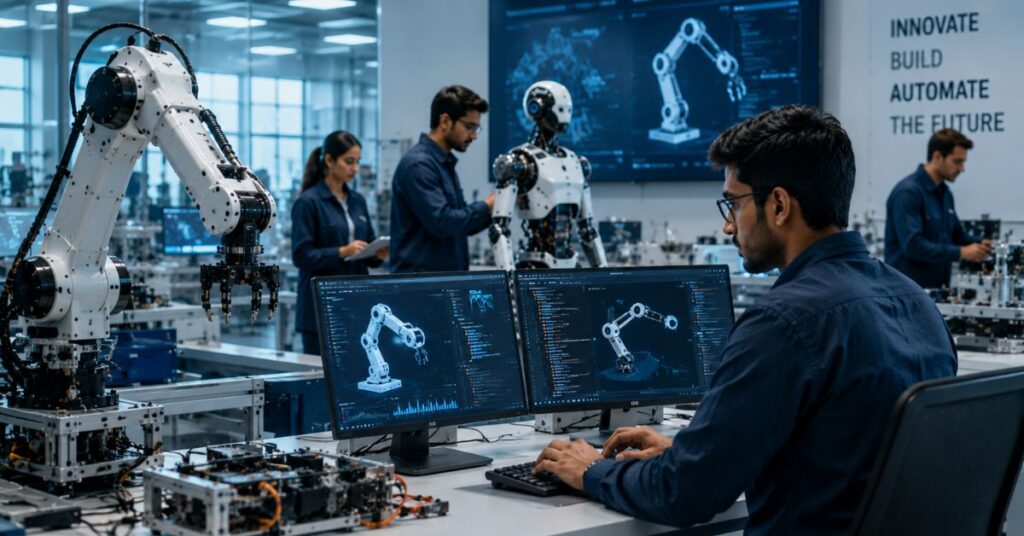
One of the biggest reasons students choose this field is the wide range of career options available. The robotics engineering future scope is expanding because almost every industry is adopting automation and intelligent machines. As technology advances, companies need professionals who can design, program, test, and maintain robotic systems.
Whether you want to work in research, manufacturing, healthcare, or artificial intelligence, robotics engineering offers many rewarding career paths.
Robotics Design Engineer
A robotics design engineer creates the structure and mechanical parts of robots. They select suitable materials, prepare 3D models, and ensure the robot performs efficiently under different conditions.
This role requires knowledge of mechanical engineering, CAD software, and product design.
Robotics Software Engineer
Software engineers develop the programs that control robotic systems. They write code that helps robots move, recognize objects, and complete tasks accurately.
Programming languages such as Python and C++ are commonly used in this role.
Automation Engineer
Automation engineers develop systems that reduce manual work in factories and production plants. They integrate robots with industrial machines to improve productivity and reduce errors.
This career is in high demand as more industries move toward smart manufacturing.
Artificial Intelligence Engineer
AI engineers build intelligent algorithms that allow robots to learn from data and make decisions without constant human control.
As AI becomes more advanced, this career continues to grow rapidly.
Robotics Research Engineer
Research engineers develop new robotic technologies for universities, laboratories, and technology companies. They work on innovative projects involving humanoid robots, autonomous systems, and advanced automation.
This role is ideal for people who enjoy solving complex technical problems.
Field Service Engineer
Field service engineers install robotic systems at customer sites. They also perform maintenance, repairs, software updates, and troubleshooting to keep robots operating efficiently.
Companies value professionals who can quickly solve technical issues.
Industries Hiring Robotics Engineers
The robotics engineering future scope continues to grow because robotics is no longer limited to factories. Many industries now depend on automation to improve efficiency, reduce costs, and increase safety.
Manufacturing Industry
The manufacturing sector employs more robotics engineers than any other industry, making it one of the leading career destinations for professionals in this field. Industrial robots perform welding, painting, packaging, assembly, and quality inspection with high precision.
Factories continue investing in automation to increase production and maintain consistent product quality.
Healthcare Industry
Hospitals use robotic systems for surgeries, rehabilitation, medical imaging, and patient care. Robotics engineers help develop technologies that improve treatment accuracy and patient safety.
Medical robotics is one of the fastest-growing areas in engineering.
Agriculture
Modern farming uses robots for planting, harvesting, crop monitoring, and pesticide spraying. These technologies help farmers increase productivity while reducing labor costs.
Agricultural robotics is becoming more important as food demand continues to rise.
Logistics and Warehousing
Large warehouses use robots to sort packages, move inventory, and prepare customer orders. Automated systems help businesses deliver products faster and with fewer errors.
The rapid growth of e-commerce has increased demand for robotics professionals in this sector.
Aerospace and Space Exploration
Space agencies and aerospace companies use robots for satellite maintenance, planetary exploration, and dangerous missions that humans cannot safely perform.
Robotics engineers contribute to designing reliable systems that operate in extreme environments.
Defense and Security
Military organizations use robots for surveillance, bomb disposal, border security, and disaster response. These robots reduce risks by performing dangerous tasks remotely.
The need for advanced defense technology continues to create new opportunities for robotics engineers.
Skills Required to Build a Successful Career in Robotics Engineering
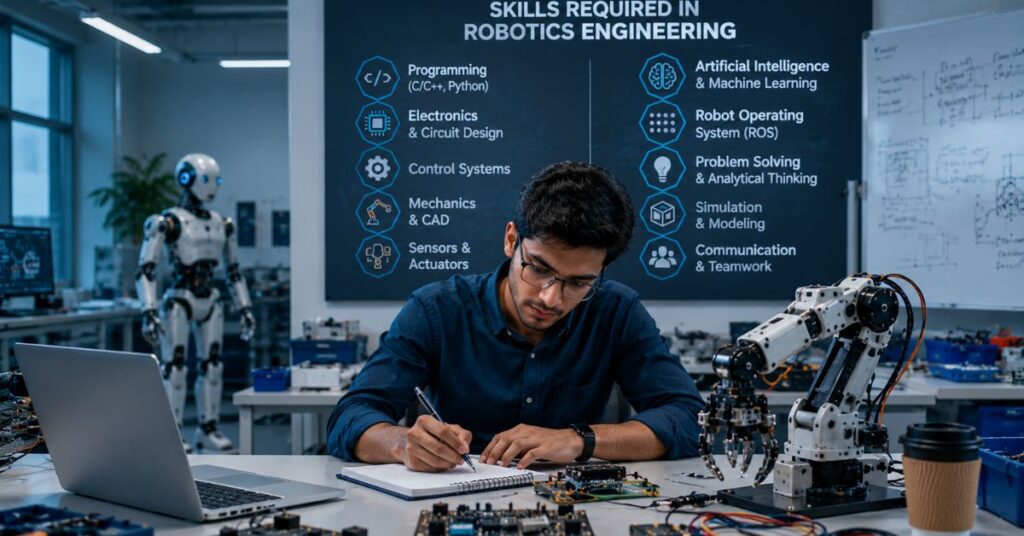
To benefit from the robotics engineering future scope, students should develop both technical and soft skills. Employers look for professionals who can solve problems, work in teams, and adapt to new technologies.
Technical Skills
Important technical skills include:
- Programming (Python, C++, Java)
- Artificial Intelligence fundamentals
- Machine Learning basics
- Embedded Systems
- Electronics and Circuit Design
- Mechanical Engineering concepts
- Control Systems
- Computer Vision
- Internet of Things (IoT)
- CAD and 3D Design Software
- PLC Programming
- Robot Operating System (ROS)
Soft Skills
Technical knowledge alone is not enough. Strong soft skills help robotics engineers succeed in professional environments.
Key soft skills include:
- Problem solving ability
- Critical thinking
- Creativity
- Communication skills
- Teamwork
- Time management
- Adaptability
- Continuous learning mindset
Engineers who regularly update their knowledge and learn new technologies usually enjoy better career growth and more job opportunities.
Future Trends in Robotics Engineering
The robotics engineering future scope is expected to become even stronger as technology continues to evolve. Robots are becoming smarter, faster, and more affordable, allowing businesses of all sizes to use automation. Future innovations will create new jobs while also changing how existing industries operate.
Students who learn modern technologies today will have better career opportunities in the coming years.
Artificial Intelligence and Machine Learning
Artificial intelligence (AI) allows robots to learn from data, recognize patterns, and make decisions with minimal human involvement. Machine learning helps robots improve their performance over time without being programmed for every situation.
As AI becomes more powerful, robotics engineers will need strong programming and data analysis skills.
Humanoid Robots
Humanoid robots are designed to look and behave like humans. They are already being tested in customer service, healthcare, education, and research. In the future, they may assist elderly people, support healthcare workers, and perform tasks in dangerous environments.
Collaborative Robots (Cobots)
Unlike traditional industrial robots, collaborative robots work safely alongside humans. They help employees complete repetitive tasks while improving productivity and reducing physical strain.
Small and medium-sized businesses are increasingly adopting cobots because they are easier to install and operate.
Autonomous Vehicles and Drones
Self-driving vehicles and intelligent drones rely heavily on robotics technology. These systems are used for transportation, delivery services, agriculture, mapping, inspection, and emergency response.
This field is expected to generate many new opportunities for robotics engineers.
Healthcare Robotics
Medical robots continue to improve surgical precision, rehabilitation, patient monitoring, and hospital automation. As healthcare technology advances, robotics engineers will play an important role in developing life-saving innovations.
Robotics Engineering Salary Expectations
Salary depends on education, skills, experience, company, and country. Professionals with expertise in artificial intelligence, automation, and robotics software often receive higher salaries than entry level engineers.
| Experience Level | Typical Career Stage |
| Entry Level | Graduate Engineer or Junior Robotics Engineer |
| Mid-Level | Robotics Engineer, Automation Engineer, AI Engineer |
| Senior Level | Robotics Project Manager, Robotics Consultant, Technical Lead |
| Expert Level | Research Scientist, Robotics Architect, Director of Robotics |
Instead of focusing only on salary, students should build practical skills, complete projects, and gain internship experience. Skilled professionals usually receive better career opportunities and faster promotions.
Challenges in Robotics Engineering

Although the robotics engineering future scope is highly promising, every profession has challenges. Understanding these challenges helps students prepare for a successful career.
Continuous Learning
Technology changes quickly. Robotics engineers must regularly learn new programming languages, software tools, and AI technologies to stay competitive.
Complex Problem Solving
Robots combine mechanical, electrical, and software systems. Finding and fixing technical issues often requires patience and analytical thinking.
High Initial Development Costs
Designing advanced robotic systems requires expensive equipment, testing facilities, and research. Companies often invest heavily before launching new robotic products.
Safety and Ethical Considerations
Engineers must ensure robots operate safely around people. They also need to consider privacy, security, and ethical concerns when developing intelligent systems.
Real-Life Example: How Robotics Is Changing Manufacturing
A large automobile manufacturing company introduced robotic arms to automate welding and assembly tasks. Before automation, workers spent many hours performing repetitive jobs, and production errors occasionally occurred.
After installing robotic systems, production became faster, product quality improved, and workplace injuries decreased because robots handled dangerous tasks. Human workers shifted to supervising machines, quality control, and maintenance instead of repetitive manual labor.
This example shows that the robotics engineering future scope is not only about replacing manual work. It is about creating smarter workplaces where humans and robots work together to achieve better results.
Common Mistakes Students Make While Choosing Robotics Engineering

Many students are interested in robotics but make decisions based on misconceptions. Avoiding these mistakes can help you build a stronger career.
Choosing Robotics Only Because It Is Trending
Some students select robotics simply because it is popular. Instead, choose this field if you genuinely enjoy technology, programming, and problem-solving.
Ignoring Programming Skills
Programming is one of the most important parts of robotics. Students who avoid coding often struggle during higher studies and professional work.
Not Building Practical Projects
Reading books alone is not enough. Building small robots, participating in competitions, and completing personal projects improve both confidence and technical skills.
Skipping Internships
Practical industry experience is valuable. Internships help students understand real-world engineering challenges and improve their chances of getting hired.
Stopping Learning After Graduation
Robotics is constantly evolving. Engineers who continue learning new technologies remain competitive and enjoy better long term career growth.
Conclusion
The robotics engineering future scope is bright because industries around the world continue to invest in automation, artificial intelligence, and intelligent machines. From manufacturing and healthcare to agriculture, logistics, aerospace, and defense, robotics engineers are solving real-world problems and creating technologies that improve efficiency, safety, and productivity. Students who develop strong technical skills, gain practical experience, and keep learning new technologies will find excellent career opportunities in this field.
Choosing robotics engineering is not only about getting a good job it is about becoming part of a rapidly growing industry that is shaping the future. Focus on learning programming, electronics, mechanical design, and AI while building practical projects and gaining industry exposure. With the right mindset and continuous learning, you can build a successful and rewarding career in robotics engineering.
Disclaimer
The information shared in this article is for educational and informational purposes only. Career opportunities, salaries, technologies, and industry trends may vary depending on your country, qualifications, experience, employer, and market demand. Always refer to official university websites, trusted industry reports, and employers before making education or career decisions.
Author Note
This guide is based on current robotics industry practices, engineering concepts, and career trends. The goal is to provide readers with clear, practical, and easy to understand information instead of unnecessary technical jargon. As technology evolves, updating your knowledge and hands on skills will remain the key to long term success in robotics engineering.
(FAQs)
1. Is robotics engineering a good career?
Yes. Robotics engineering offers excellent career opportunities because industries are rapidly adopting automation and artificial intelligence. Skilled robotics engineers are needed in manufacturing, healthcare, logistics, agriculture, aerospace, and many other sectors.
2. What skills are required to become a robotics engineer?
You should learn programming, electronics, mechanical engineering, artificial intelligence, embedded systems, control systems, and problem solving skills. Communication and teamwork are also important for professional success.
3. Does robotics engineering have a good future?
Yes. The robotics engineering future scope is expected to continue growing as businesses invest in smart factories, autonomous systems, AI-powered robots, and advanced automation technologies.
4. Which industries hire robotics engineers?
Robotics engineers work in manufacturing, healthcare, agriculture, logistics, defense, aerospace, automotive companies, research organizations, and technology firms.
5. Is coding necessary for robotics engineering?
Yes. Programming is one of the core skills in robotics. Languages such as Python and C++ are widely used for developing and controlling robotic systems.
6. Can robotics engineers work with artificial intelligence?
Absolutely. Many modern robotic systems use artificial intelligence and machine learning to improve decision-making, object recognition, navigation, and automation. AI knowledge increases career opportunities.
7. How can students prepare for a career in robotics engineering?
Students should build a strong foundation in mathematics, physics, programming, and electronics. They should also complete robotics projects, participate in competitions, earn certifications, and gain internship experience to improve practical skills and employability.