


Quick Summary (Snapshot)
Unsupervised Learning Basics Explained shows how artificial intelligence finds hidden patterns in unlabeled data. This article explains clustering, algorithms, real-life applications, and key concepts in simple English.
In this article, Unsupervised Learning Basics Explained will help you understand how this machine learning technique works in simple English. You will learn what unsupervised learning is, why it is important, how it discovers hidden patterns, the most popular algorithms, real-world applications, advantages, limitations, common mistakes, and practical examples. By the end of this article, you will have a clear understanding of why unsupervised learning has become an essential part of modern artificial intelligence.
Introduction
Unsupervised Learning Basics Explained helps you understand how artificial intelligence discovers hidden patterns in unlabeled data. This machine learning method allows computers to organize similar information, identify relationships, and generate useful insights without predefined labels. Learning these concepts gives beginners and professionals a strong foundation for understanding modern AI technologies.
Today, businesses collect massive amounts of data from online shopping, healthcare, banking, social media, and mobile applications. Much of this information has no labels, making manual analysis difficult and time-consuming. Unsupervised learning solves this problem by automatically grouping related data, detecting hidden trends, and revealing valuable insights. Whether you are a student, business owner, or AI enthusiast, Unsupervised Learning Basics Explained will help you understand how machines turn raw data into meaningful information.
What Is Unsupervised Learning?
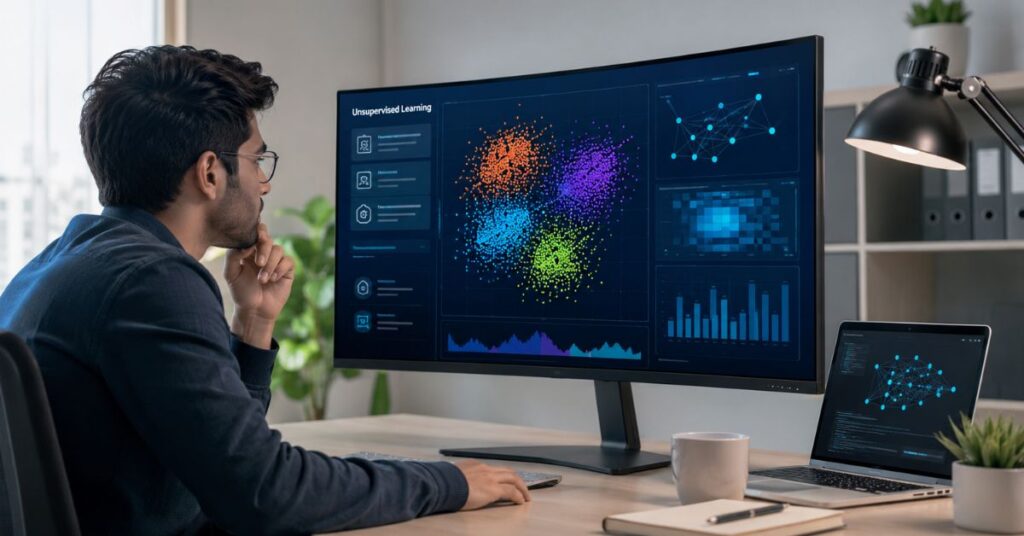
Unsupervised learning is a machine learning technique in which a computer learns from unlabeled data. Unlike supervised learning, where every example already contains the correct answer, unsupervised learning receives only raw information. The algorithm studies that information, compares different data points, and discovers natural relationships without human guidance.
Think about entering a library where thousands of books are scattered across the floor without categories. Nobody tells you which books belong together. You naturally begin grouping them based on topics, authors, languages, or sizes. An unsupervised learning algorithm performs a similar task with digital data. It looks for similarities and differences until meaningful groups begin to appear.
This ability makes unsupervised learning especially useful when dealing with large datasets. Instead of spending months labeling millions of records, organizations can allow AI to organize information automatically and identify valuable insights.
Today, companies use unsupervised learning in customer segmentation, fraud detection, product recommendations, medical research, cybersecurity, financial analysis, image recognition, and many other industries. As data continues to grow rapidly, this technology helps organizations understand information more efficiently than manual analysis.
Why Is It Called “Unsupervised”?
The word unsupervised means the algorithm works without a teacher. No one provides the correct answers during training. Instead, the computer observes the available data and discovers patterns through mathematical calculations.
For example, imagine giving thousands of customer purchase records to an AI model. The records do not contain labels such as “frequent buyer” or “occasional buyer.” The algorithm studies shopping habits and automatically creates groups of customers with similar behaviors.
Because there are no predefined categories, the computer depends entirely on the relationships it finds within the data.
Main Characteristics of Unsupervised Learning
Unsupervised learning has several unique characteristics that make it different from other machine learning techniques.
- It works with unlabeled datasets.
- It automatically identifies hidden patterns.
- It groups similar records together.
- It detects unusual or abnormal behavior.
- It reduces the complexity of large datasets.
- It helps discover information that may not be obvious to humans.
These characteristics allow organizations to analyze large amounts of information quickly and make better business decisions.
Why Businesses Use Unsupervised Learning
Many organizations collect huge amounts of customer and operational data every day. Without AI, finding useful information inside that data becomes difficult.
Businesses use unsupervised learning because it helps them:
- Understand customer behavior.
- Discover buying patterns.
- Detect suspicious financial transactions.
- Improve recommendation systems.
- Organize products into meaningful categories.
- Identify hidden business opportunities.
Instead of making decisions based only on assumptions, companies can use data-driven insights generated through unsupervised learning.
Why Is Unsupervised Learning Important in Artificial Intelligence?

Artificial intelligence depends heavily on data. However, not all data comes with labels or clear answers. In fact, most real world information is completely unorganized. This is one of the biggest reasons why unsupervised learning has become so important.
Imagine a company collecting millions of customer reviews. Reading every review manually would require thousands of working hours. An unsupervised learning algorithm can automatically identify common topics, group similar opinions, and reveal customer preferences without anyone labeling each review individually.
This saves time while producing valuable insights.
It Helps Discover Hidden Patterns
One of the greatest strengths of unsupervised learning is its ability to reveal relationships that humans may never notice.
For example, a supermarket might discover that customers who buy coffee often purchase biscuits during weekends. Since nobody programmed this relationship into the system, the algorithm discovered it independently.
Businesses can then use this information to improve product placement, promotions, and sales strategies.
It Reduces Manual Work
Labeling data is expensive and time-consuming.
Medical researchers, financial analysts, and online retailers often manage millions of records. Instead of labeling every piece of information manually, they use unsupervised learning to organize the data automatically.
This allows experts to spend more time making decisions instead of preparing datasets.
It Supports Better Decision-Making
Modern organizations rely on data when making important decisions.
Unsupervised learning helps decision makers understand customer groups, market trends, operational risks, and business opportunities.
Rather than relying on guesswork, companies make choices based on patterns discovered within real world data.
It Improves AI Systems
Many advanced AI applications combine supervised and unsupervised learning.
For example:
- Recommendation systems first group similar users through unsupervised learning.
- Fraud detection systems identify unusual transaction patterns.
- Healthcare researchers discover patient groups with similar medical conditions.
- Cybersecurity systems recognize abnormal network behavior before attacks become serious.
These applications demonstrate why unsupervised learning has become one of the most valuable technologies in artificial intelligence.
How Does Unsupervised Learning Work?

Understanding Unsupervised Learning Basics Explained becomes much easier when you know how the learning process happens behind the scenes. Unlike supervised learning, where the model learns from labeled examples, unsupervised learning receives only raw data. It analyzes that data, searches for relationships, and creates meaningful patterns without human instructions.
Although different algorithms work in different ways, most unsupervised learning models follow a similar process. Each step plays an important role in finding useful information hidden inside large datasets.
Step 1: Collect Raw Data
Understanding Unsupervised Learning Basics Explained helps beginners build a strong foundation in machine learning and artificial intelligence.Every machine learning project begins with data collection. This data may come from websites, mobile applications, online stores, hospitals, banks, sensors, or social media platforms.
Unlike supervised learning, the collected data does not contain labels or predefined categories. For example, an online shopping website may have millions of purchase records but no labels showing which customers are loyal or occasional buyers.
The more relevant and accurate the data is, the better the algorithm can identify meaningful patterns.
Step 2: Prepare and Clean the Data
Raw data is rarely perfect. It often contains duplicate records, missing values, incorrect entries, or inconsistent formatting.
Before training starts, data scientists clean the dataset by removing unnecessary information, correcting errors, and organizing records into a consistent format.
Clean data helps the algorithm produce more reliable and accurate results. If poor-quality data is used, the discovered patterns may also become unreliable.
Step 3: Search for Similarities
After the data is prepared, the algorithm begins comparing every record with others.
Instead of looking for correct answers, it measures how similar or different the data points are. Depending on the algorithm, it may compare customer age, purchase history, income, location, browsing behavior, or many other features.
Records with similar characteristics gradually move closer together, while different records remain separate.
This process allows the model to discover relationships that humans may not notice easily.
Step 4: Form Meaningful Groups from Similar Data
Once the similarities are detected, the algorithm arranges related records into logical clusters to expose valuable patterns hidden in the data.
Some algorithms create groups called clusters, where similar records belong to the same category. Other algorithms reduce the complexity of large datasets or identify relationships between different items.
For example, an online retailer may discover three customer groups:
- Customers who mainly buy electronics.
- Customers who frequently purchase clothing.
- Customers who shop only during seasonal sales.
Nobody manually created these groups. The algorithm discovered them automatically.
Step 5: Analyze the Results
Although the algorithm discovers useful patterns, human expertise is still needed to understand and apply the results.
Business analysts, researchers, or data scientists review the discovered patterns and decide how to use them.
For example, a marketing team may create different advertising campaigns for each customer group. A hospital may use patient clusters to improve treatment planning. A bank may investigate unusual financial transactions identified by the algorithm.
The final goal is not simply finding patterns but using those patterns to make better decisions.
Why This Process Matters
This learning process allows organizations to work with huge amounts of data that would be impossible to analyze manually.
Instead of spending weeks organizing information, businesses can quickly identify customer behavior, market trends, unusual activities, and hidden opportunities.
As datasets continue to grow every year, this ability becomes even more valuable.
Types of Unsupervised Learning
Although people often think of unsupervised learning as one technique, it actually includes several methods. Each method solves a different type of problem and helps organizations understand data in unique ways.
Knowing these types will help you understand where and when unsupervised learning is used in real world AI projects.
1. Clustering
Clustering is the most popular type of unsupervised learning.
It is designed to identify and group data points that share similar characteristics.The algorithm compares records and automatically places similar ones into the same cluster.
For example, an online shopping website may group customers according to their buying habits without knowing anything about them beforehand.
Businesses use clustering for:
- Customer segmentation
- Market research
- Product categorization
- Social network analysis
- Image organization
Because clustering discovers natural groups, it helps companies understand their customers much better.
2. Association Rule Learning
Association rule learning identifies relationships between different items.
Instead of grouping customers, it discovers which products or events frequently occur together.
A common example is a supermarket. If many customers buy bread and butter together, the algorithm identifies this relationship automatically.
Online stores use this information to recommend related products and increase sales.
Popular recommendation systems often rely on association rule learning to improve customer experience.
3. Dimensionality Reduction
Large datasets often contain hundreds or even thousands of features.
Working with so much information can slow down machine learning models.
Dimensionality reduction removes unnecessary information while keeping the most important patterns.
This makes data easier to analyze, reduces processing time, and improves visualization.
Researchers commonly use this method before training advanced AI models.
Which Type Should You Choose?
The right type depends on your objective.
- Use clustering when you want to group similar records.
- Use association rule learning when you want to discover relationships between items.
- Use dimensionality reduction when your dataset contains too many features and needs simplification.
Each method solves different business problems, and many organizations combine multiple techniques to achieve better results.
Most Popular Unsupervised Learning Algorithms

Unsupervised learning becomes useful because of the algorithms that process data and discover hidden patterns. Each algorithm follows a different approach, so choosing the right one depends on the type of data and the problem you want to solve.
Some algorithms focus on grouping similar records, while others simplify complex datasets or identify relationships between different items. Understanding these algorithms will help you see how Unsupervised Learning Basics Explained works in real world AI applications.
K-Means Clustering
Among clustering methods, K-Means stands out as one of the most commonly applied algorithms. Its main purpose is to divide data into a specific number of groups, called clusters.
The algorithm compares every data point and places similar records into the same cluster. It then calculates the center of each cluster and keeps adjusting the groups until similar data points stay together.
For example, an online clothing store may use K-Means to divide customers into different shopping groups. One group may consist of people who mostly buy sportswear, another may prefer formal clothing, while another may shop only during discounts.
The concepts covered in Unsupervised Learning Basics Explained are widely used in modern AI applications across different industries.Businesses like K-Means because it is simple, fast, and works well with large datasets. However, the number of clusters must be chosen before training starts, which may not always be easy.
Hierarchical Clustering
Hierarchical clustering creates groups in the form of a tree structure instead of fixed clusters.
The algorithm starts by treating every data point as an individual group. It then combines the most similar groups step by step until a complete hierarchy is formed.
This method helps analysts understand how different groups are connected instead of only seeing the final clusters.
Researchers often use hierarchical clustering in biology, healthcare, and scientific studies because it clearly shows relationships between different samples.
Although it produces meaningful visual results, it usually requires more processing time than K-Means when working with very large datasets.
DBSCAN (Density-Based Spatial Clustering)
DBSCAN forms clusters by identifying regions where data points are densely packed. Unlike methods that create fixed-size groups, it detects naturally occurring clusters while treating isolated data points as noise or outliers.
This makes DBSCAN especially useful for anomaly detection.
For example, a bank can use DBSCAN to identify suspicious financial transactions that differ significantly from normal customer activity. These unusual transactions may indicate fraud or security risks.
Unlike K-Means, DBSCAN does not require you to decide the number of clusters beforehand.
Principal Component Analysis (PCA)
Principal Component Analysis, commonly known as PCA, is a dimensionality reduction algorithm.
Modern datasets often contain hundreds of variables. Many of these variables provide similar information.
PCA reduces unnecessary complexity while preserving the most important information.
For example, imagine a medical dataset containing hundreds of patient measurements. PCA can reduce the number of variables without losing valuable patterns.
This helps machine learning models train faster while making the data easier to visualize and understand.
Apriori Algorithm
The Apriori algorithm focuses on discovering relationships between items.
Rather than organizing similar records into clusters, it discovers items or events that commonly appear together within the data.
For example, a supermarket may discover that customers who purchase breakfast cereal often buy milk during the same shopping trip.
This information helps businesses improve product placement, promotional offers, and recommendation systems.
Many e-commerce platforms use similar techniques to recommend products based on customer buying behavior.
Comparison of Popular Unsupervised Learning Algorithms
The following table highlights the key differences between the most commonly used unsupervised learning algorithms.This article on Unsupervised Learning Basics Explained provides practical knowledge that can help students, developers, and AI enthusiasts understand machine learning more confidently.
| Algorithm | Main Purpose | Best Used For | Strength | Limitation |
| K-Means | Group similar records | Customer segmentation | Fast and simple | Requires the number of clusters in advance |
| Hierarchical Clustering | Build cluster hierarchy | Scientific research | Easy to visualize relationships | Slower with large datasets |
| DBSCAN | Detect dense groups | Fraud detection, anomaly detection | Finds unusual records automatically | Sensitive to parameter settings |
| PCA | Reduce data dimensions | Data visualization, preprocessing | Simplifies complex datasets | May reduce interpretability |
| Apriori | Discover item relationships | Market basket analysis | Excellent for recommendations | Can become slow with very large datasets |
This comparison shows that no single algorithm is best for every situation. The right choice depends on the type of data, project goals, and business requirements.
Real-Life Example of Unsupervised Learning
Imagine a large online shopping company with more than one million customers.
The company knows what people purchased, how often they shop, how much money they spend, and which product categories they prefer. However, the company has never labeled customers as “premium,” “regular,” or “seasonal.”
An unsupervised learning algorithm analyzes all customer records and automatically discovers several natural groups.
One group contains customers who regularly buy expensive electronics.
Another group includes shoppers who only purchase products during holiday sales.
A third group contains customers who frequently buy children’s products.
Without any manual labeling, the company now understands different customer behaviors.
The marketing team can create personalized promotions for each customer group instead of sending the same advertisement to everyone.
As a result, customers receive more relevant offers, the shopping experience improves, and the business increases its sales.
This example demonstrates why unsupervised learning is valuable in industries that collect large amounts of customer data.
Advantages of Unsupervised Learning

Unsupervised learning offers several benefits that make it an important part of modern artificial intelligence.
No Labeled Data Is Required
One of the biggest advantages is that the algorithm learns from raw, unlabeled data.
Since labeling large datasets requires significant time and cost, organizations can begin analysis much faster.
Finds Hidden Patterns
The algorithm can discover relationships that humans might never notice.
These hidden patterns often lead to valuable business insights and smarter decision-making.
Handles Large Volumes of Data
Modern companies generate millions of records every day.
Unsupervised learning processes these large datasets efficiently and organizes information into meaningful structures.
Supports Better Business Decisions
Businesses use discovered patterns to improve customer service, marketing strategies, fraud detection, inventory management, and product recommendations.
Instead of relying on assumptions, organizations make decisions based on real data.
Improves Other Machine Learning Models
Many advanced AI systems combine unsupervised learning with supervised learning.
By organizing data before model training, unsupervised learning often improves overall machine learning performance.
Limitations of Unsupervised Learning
Although unsupervised learning is powerful, it also has several limitations.
Results Can Be Difficult to Interpret
The algorithm creates groups based on mathematical relationships.
However, humans still need to understand what those groups actually represent.
Sometimes the discovered patterns may not have practical business value.
Accuracy Is Harder to Measure
Since there are no correct answers available, evaluating performance becomes more challenging than supervised learning.
Experts often need additional analysis to verify whether the discovered patterns are meaningful.
Sensitive to Data Quality
Poor quality data leads to poor quality results.
Missing values, duplicate records, and incorrect information can reduce the accuracy of clustering and pattern detection.
Proper data cleaning remains an essential part of every unsupervised learning project.
Different Algorithms Produce Different Results
The same dataset may produce different clusters depending on the algorithm being used.
Choosing the wrong algorithm can lead to misleading conclusions.
For this reason, experienced data scientists often compare multiple algorithms before selecting the final solution.
Unsupervised Learning vs Supervised Learning

After reading Unsupervised Learning Basics Explained, you will better understand how machines organize unlabeled data into meaningful patterns.Many beginners confuse supervised learning with unsupervised learning because both are machine learning techniques. However, they solve different types of problems and work with different kinds of data.
The biggest difference is that supervised learning learns from labeled data, while unsupervised learning works with unlabeled data. In supervised learning, the model already knows the correct answers during training. In unsupervised learning, the model receives only raw data and must discover patterns without guidance.
Understanding this difference helps you choose the right learning method for a specific project.
| Feature | Supervised Learning | Unsupervised Learning |
| Data Type | Labeled data | Unlabeled data |
| Goal | Predict known outcomes | Discover hidden patterns |
| Human Guidance | Required | Not required |
| Main Tasks | Classification and Regression | Clustering and Association |
| Accuracy Measurement | Easy | More challenging |
| Common Use Cases | Spam detection, price prediction, image classification | Customer segmentation, recommendation systems, fraud detection |
| Example | Predicting house prices | Grouping customers based on buying behavior |
Both methods are valuable. Many advanced AI systems combine supervised and unsupervised learning to achieve better performance.
Where Is Unsupervised Learning Used in Real Life?
Many people think unsupervised learning exists only in research labs, but it is already part of many services we use every day.
Online Shopping
E-commerce websites analyze customer behavior to recommend products that match shopping interests.
If two customers have similar buying habits, the system can recommend products that one customer purchased to the other.
This improves the shopping experience and increases sales.
Banking and Finance
Banks analyze millions of transactions every day.
Unsupervised learning helps identify unusual spending patterns that may indicate fraud, money laundering, or stolen credit cards.
Instead of checking every transaction manually, banks investigate only suspicious activities identified by AI.
Healthcare
Hospitals and researchers use unsupervised learning to group patients with similar symptoms or medical histories.
These groups help researchers study diseases more effectively and discover treatment patterns that may improve patient care.
Cybersecurity
Modern cybersecurity systems constantly monitor network activity.
If a user’s behavior suddenly changes, such as logging in from a new country or downloading an unusually large amount of data, the system can detect the abnormal activity and alert security teams.
Social Media
Social media platforms analyze user interests, likes, comments, and viewing history.
The discovered patterns help personalize content, recommend friends, and suggest videos that users are more likely to enjoy.
Common Mistakes Beginners Make

Learning Unsupervised Learning Basics Explained becomes much easier when you avoid common mistakes that many beginners make.
Expecting Perfect Results
Some beginners believe the algorithm will always create perfect clusters.One of the biggest benefits of Unsupervised Learning Basics Explained is learning how AI identifies relationships without predefined labels.
In reality, results depend on the quality of the data and the algorithm being used. Different algorithms may produce different groupings.
Ignoring Data Cleaning
Many beginners start training models without cleaning their datasets.
Duplicate records, missing values, and incorrect information reduce the quality of discovered patterns.
Good data preparation is one of the most important steps in machine learning.
Choosing the Wrong Algorithm
Every algorithm has strengths and weaknesses.
Using K-Means for data that contains irregular cluster shapes, for example, may produce poor results.
Always choose an algorithm based on the nature of your data rather than popularity.
Forgetting Business Goals
Finding clusters is not the final objective.
The real purpose is to solve a business problem or answer an important question.
Always connect discovered patterns with practical decision-making.
Ignoring Result Evaluation
Although unsupervised learning has no predefined answers, the results should still be evaluated carefully.
Experts often visualize clusters, compare algorithms, and validate findings before making business decisions.
Best Practices for Better Results

Following a few best practices can significantly improve the performance of unsupervised learning models.
Use High-Quality Data
Better data produces better insights.
Always remove duplicate records, correct errors, and handle missing values before training.
Select the Right Algorithm
Understand the strengths of each algorithm before making a choice.
No single algorithm works best for every dataset.
Understand Your Data
Spend time exploring your dataset before training.
Knowing the characteristics of your data helps you choose appropriate techniques and interpret results correctly.
Validate Your Findings
Do not rely only on algorithm output.
Review discovered patterns with domain experts and confirm that they make practical sense.
Keep Learning
Machine learning evolves quickly.
Learning new algorithms, tools, and techniques will help you build better AI solutions over time.
Conclusion
Understanding Unsupervised Learning Basics Explained is an important step toward learning modern artificial intelligence. Unlike supervised learning, this approach allows computers to analyze unlabeled data, discover hidden relationships, and organize information without human guidance. From customer segmentation and fraud detection to healthcare research and recommendation systems, unsupervised learning helps organizations uncover valuable insights hidden inside massive datasets.
As the amount of digital data continues to grow, the importance of unsupervised learning will continue to increase. Whether you are starting your machine learning journey or improving your AI knowledge, learning these concepts will help you understand how intelligent systems make sense of complex information. Focus on mastering the fundamentals, practice with real datasets, and choose algorithms based on your project goals. With the right approach, unsupervised learning can become one of the most valuable skills in your AI journey.
Disclaimer
This article is intended solely for educational and informational purposes.Machine learning technologies continue to evolve, and different algorithms may perform differently depending on the quality, size, and type of data used. Always test models with your own datasets and consult official documentation or experienced professionals before making technical or business decisions based on machine learning results.
Author Note
While researching machine learning topics, one lesson stands out consistently: understanding the basic concepts is more valuable than memorizing complex algorithms. Building a strong foundation in unsupervised learning makes it easier to explore advanced AI techniques later. Focus on learning how algorithms think, practice with real-world datasets, and improve your skills step by step. Consistent practice is the key to becoming confident in machine learning.
(FAQs)
1. What is unsupervised learning in simple words?
Unsupervised learning is a machine learning method where a computer learns from unlabeled data and automatically discovers hidden patterns, similarities, or relationships without being given the correct answers.
2. What is the difference between supervised and unsupervised learning?
Supervised learning uses labeled data to make predictions, while unsupervised learning works with unlabeled data to identify patterns, groups, or relationships.
3. What are the most common unsupervised learning algorithms?
Some of the most popular algorithms include K-Means Clustering, Hierarchical Clustering, DBSCAN, Principal Component Analysis (PCA), and the Apriori algorithm.
4. Where is unsupervised learning used?
It is widely used in customer segmentation, fraud detection, recommendation systems, healthcare research, cybersecurity, image processing, market basket analysis, and social media analytics.
5. Why is unsupervised learning important?
It helps organizations analyze large amounts of unlabeled data, discover hidden insights, reduce manual work, and support better business decisions.
6. Can beginners learn unsupervised learning?
Yes. Beginners can start by understanding basic machine learning concepts, learning how clustering works, and practicing with small datasets before moving to advanced algorithms.
7. What skills are needed to learn unsupervised learning?
A basic understanding of mathematics, statistics, Python programming, and machine learning concepts is helpful. Familiarity with data analysis tools can also make learning easier.