

Quick Summary / Snapshot
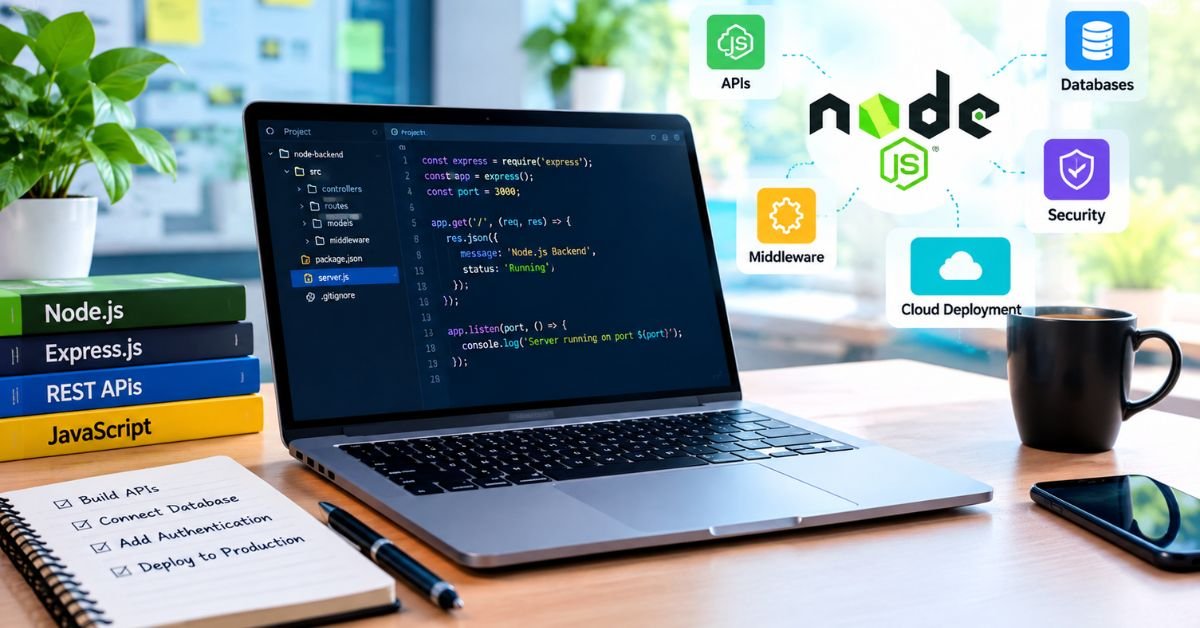
Node.js backend development uses JavaScript on the server to build APIs, web applications, real time services, and other backend systems. Its event driven, non blocking approach makes it especially useful for applications that handle many network requests at the same time.
In 2026, building a good Node.js backend involves much more than creating routes and connecting a database. A production ready application also needs secure authentication, input validation, clean architecture, proper error handling, testing, monitoring, efficient database queries, and a sensible deployment strategy. This guide explains how these pieces work together and when Node.js is the right choice.
What Is Node.js Backend Development?
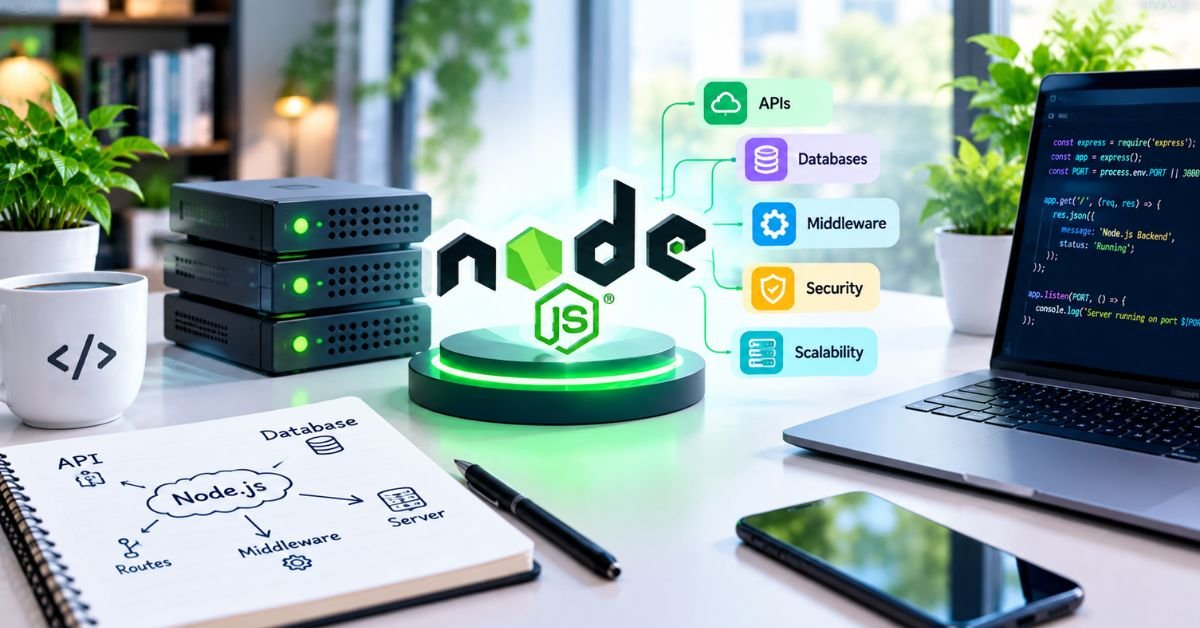
Node.js backend development means using Node.js to run JavaScript outside the browser and handle the server side part of an application. Instead of JavaScript being limited to buttons, forms, and other browser interactions, Node.js allows developers to use it for receiving requests, processing data, communicating with databases, and returning responses to websites or mobile applications.
Node.js is built around an event driven model and non blocking input/output. This allows the server to start handling another operation while waiting for tasks such as database or network operations to finish. That behavior can be useful for APIs and applications that deal with many simultaneous connections. However, developers still need to avoid CPU-heavy work that blocks the event loop because asynchronous I/O does not automatically make every type of workload fast.
A typical backend request may follow this path:
- A user performs an action in a website or mobile app.
- The client sends an HTTP request to the Node.js server.
- Middleware checks the request and applies required rules.
- A route sends the request to the appropriate controller or handler.
- Business logic processes the operation.
- The backend communicates with a database or external service.
- The server sends a structured response back to the client.
This separation allows the frontend and backend to work together without placing all application logic inside the browser.
Why Node.js Is Still Relevant for Backend Development in 2026
Node.js remains useful because modern applications often need fast API communication, real-time features, external service integrations, and efficient handling of many concurrent connections. Developers can also use JavaScript across the frontend and backend, reducing the need to switch between completely different programming languages for common web development tasks.
The ecosystem has also matured considerably. Developers can choose from lightweight frameworks, structured application frameworks, TypeScript based projects, database libraries, testing tools, logging systems, and cloud deployment options. The important point in 2026 is not simply choosing Node.js because it is popular; it is choosing an architecture and toolset that match the application’s actual requirements.
Fast I/O for Web Applications
Node.js can work well for applications where much of the server’s time is spent waiting for databases, APIs, files, or other network operations.
- Useful for API heavy applications
- Suitable for many concurrent network connections
- Works well with asynchronous operations
- Can support real time communication
- Requires care with CPU-intensive tasks
One Language Across the Stack
Using JavaScript or TypeScript on both sides of a web application can simplify development.
- Shared language between frontend and backend
- Easier code sharing in suitable projects
- Common tooling across the application
- Large developer ecosystem
- TypeScript can add stronger type checking
A Mature Ecosystem
The Node.js ecosystem provides tools for almost every common backend requirement.
Developers can use packages for routing, validation, authentication, testing, database access, logging, and many other tasks. The challenge is selecting dependable dependencies instead of installing packages simply because they are available.
How Node.js Backend Development Works
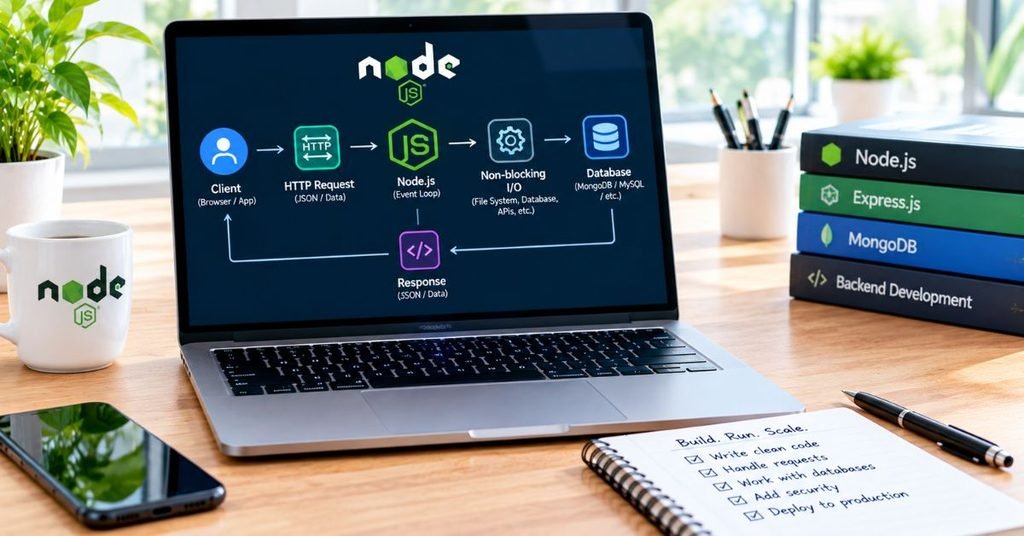
A Node.js backend usually acts as the middle layer between the client and the application’s data or services. The client does not normally communicate directly with a private database. Instead, it sends a request to an API, and the backend decides what the user is allowed to do and what information should be returned.
For example, imagine a customer opening an online store and requesting a product page. The browser might send a request such as GET /products/123. The Node.js application receives that request, checks the route, runs the required logic, retrieves the product from the database, and returns the result as JSON. The frontend then uses that response to display the product.
A clean backend often separates responsibilities instead of placing everything inside one route.
Routes
Routes determine which part of the application should handle a particular request.
- Define API endpoints
- Match HTTP methods such as GET, POST, PUT, and DELETE
- Direct requests to the appropriate handlers
- Keep API structure understandable
Middleware
Middleware runs between the incoming request and the final request handler.
- Authentication checks
- Request validation
- Logging
- Rate limiting
- Security-related processing
- Error handling
Controllers and Services
Controllers can handle the request and response while services contain reusable business logic.
This separation makes larger applications easier to maintain because developers do not need to put authentication, database queries, calculations, and response formatting into one huge function.
Database Layer
The backend communicates with a database through a suitable driver, ORM, query builder, or database library. The choice depends on the application’s data model and requirements rather than simply following a trend.
For example, a system with strongly connected relational data may benefit from PostgreSQL, while a document oriented application may find MongoDB more suitable.
Core Technologies Used With Node.js Backend Development
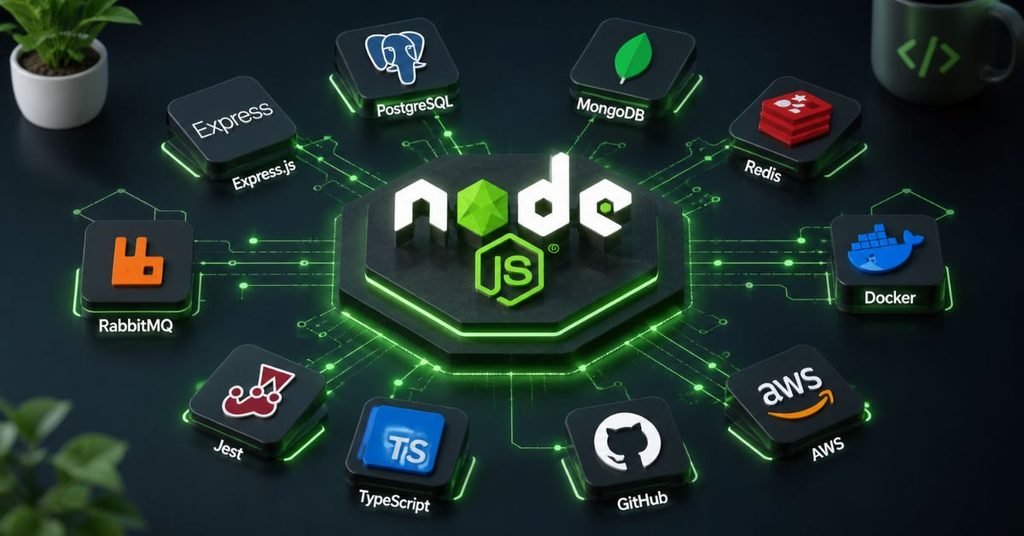
Node.js itself provides the runtime, but a complete backend normally uses additional technologies. Choosing them carefully can have a major effect on maintainability, security, and development speed.
Express.js
Express is a lightweight and flexible framework commonly used to create Node.js APIs and web servers.
- Simple routing
- Large ecosystem
- Flexible project structure
- Good choice for developers who want control over architecture
Its flexibility also means developers need to make more architectural decisions themselves.
NestJS
NestJS provides a more structured approach for building larger server-side applications.
- Modular architecture
- Strong support for TypeScript
- Dependency injection
- Useful structure for large teams and applications
Its additional abstraction can be helpful for complex systems but may feel heavier for a small API.
Fastify
Fastify is designed with a focus on low overhead and efficient server development.
It can be useful when performance matters and the project benefits from its plugin and schema-oriented approach. The best framework still depends on the application’s requirements rather than benchmark numbers alone.
MongoDB and PostgreSQL
The database should match the application’s data needs.
MongoDB uses a document-oriented model and can be useful for applications where flexible document structures make sense. PostgreSQL is a relational database with strong support for structured relationships, SQL queries, transactions, and complex data operations.
There is no universal winner. The correct choice depends on the application’s data model, consistency requirements, query patterns, team knowledge, and operational needs.
Essential Features of a Production Ready Node.js Backend
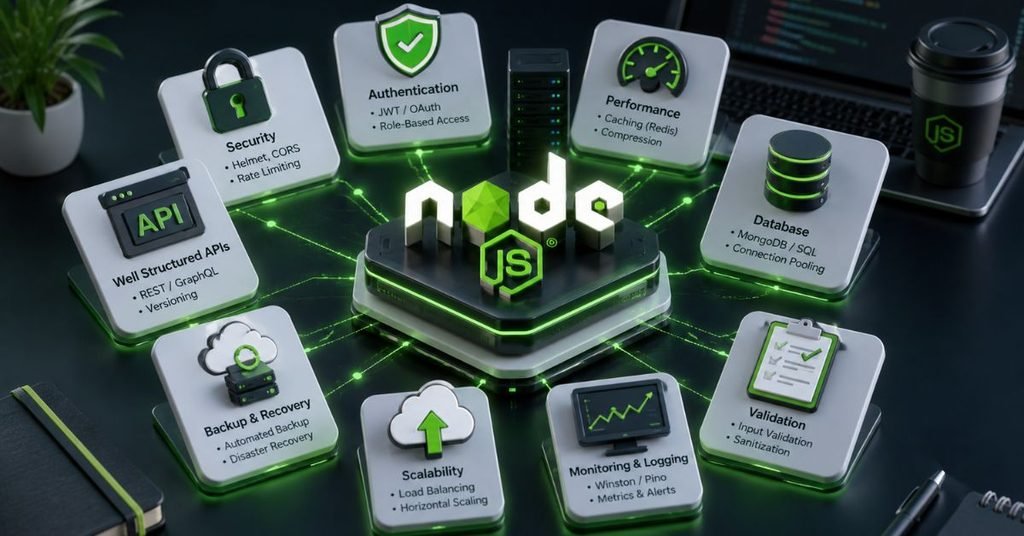
A basic Node.js server can be created quickly, but a production application needs more than working endpoints. Node.js backend development should include a clear structure that makes the application easier to secure, test, update, and scale as its users and data increase.
The best approach is to separate different responsibilities instead of putting everything inside a few large files. Routes can manage endpoints, controllers can coordinate requests, services can handle business rules, and database modules can manage data access. This structure reduces confusion and makes future changes safer.
Clean Project Architecture
A well-organized project makes it easier to understand where new features belong.
A practical structure may include:
- Routes for API endpoints
- Controllers for request and response handling
- Services for business logic
- Models or repositories for database operations
- Middleware for shared request processing
- Configuration for environment-specific settings
- Tests for important application behavior
The exact folder structure can vary. What matters most is keeping responsibilities separated and avoiding a single file that controls the entire application.
RESTful API Design
A backend often communicates with websites, mobile apps, or other services through APIs. A consistent API design makes these interactions easier to understand and maintain.
For example:
- GET /products can retrieve products
- GET /products/25 can retrieve one product
- POST /products can create a product
- PUT /products/25 can update a product
- DELETE /products/25 can remove a product
Good API design also requires predictable response formats, suitable HTTP status codes, validation, and clear error messages.
Input Validation
Never assume that data received from a client is safe or correctly formatted. A backend should validate incoming data before using it in business logic or database operations.
Validation can check:
- Required fields
- Email formats
- Password requirements
- Numeric ranges
- Allowed values
- String length
- Unexpected fields
Validation improves reliability and also reduces security risks caused by accepting uncontrolled input.
Centralized Error Handling
Errors are unavoidable in real applications. Databases can become unavailable, external services can fail, and users can send invalid requests.
Instead of creating different error-handling behavior for every endpoint, a centralized approach can provide consistent responses. Production systems should also avoid exposing internal stack traces, database details, or secrets to users.
Authentication and Authorization
Authentication answers “Who is this user?”, while authorization answers “What is this user allowed to do?”
A secure backend should keep these responsibilities separate.
For example, a logged-in customer may be allowed to view their orders but should not be allowed to delete another customer’s account. An administrator may have additional permissions.
Common approaches include:
- Session-based authentication
- Token-based authentication
- JWT-based systems
- Role-based access control
- Permission-based access control
The right method depends on the application architecture.
Secure Environment Variables
Passwords, database credentials, API keys, and other secrets should not be placed directly into source code.
Environment variables or an appropriate secrets-management system can keep sensitive configuration separate from application code.
Developers should also make sure secret files are excluded from version control and are not accidentally included in public repositories.
Logging and Monitoring
A backend needs visibility into what is happening after deployment.
Useful logging can help identify:
- Failed requests
- Slow operations
- Authentication problems
- Database failures
- Unexpected application errors
- External API failures
Monitoring goes one step further by tracking application health and performance. This becomes especially important when an application handles real users and cannot be watched manually.
Node.js Backend Security Practices
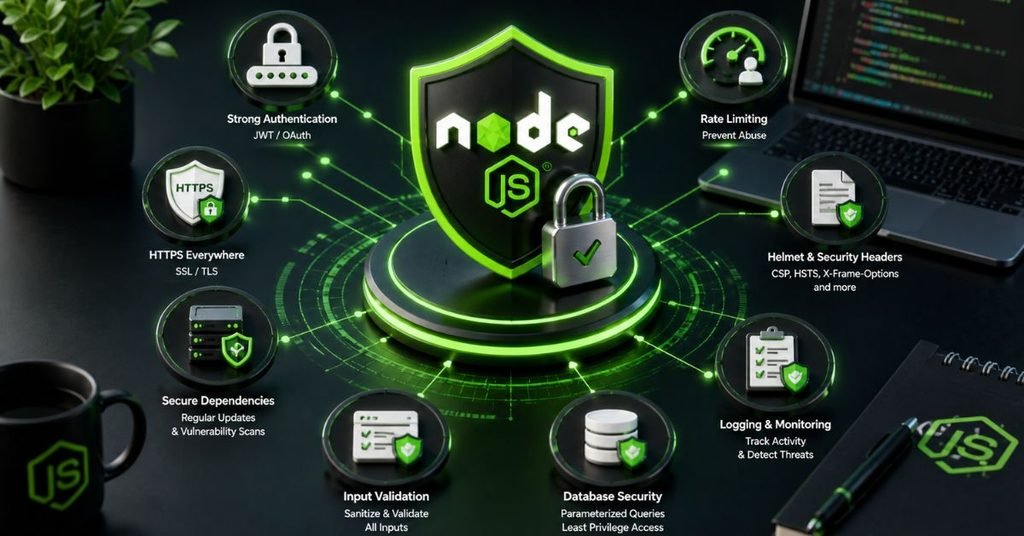
Security should be designed into the backend rather than added after an application is already deployed. A secure Node.js application validates input, protects authentication credentials, limits unnecessary access, and avoids exposing internal information through API responses.
Developers should also treat dependencies as part of the security surface. A package that is no longer maintained or contains a known vulnerability can create problems even when the application’s own code appears secure. Regular dependency review and updates should therefore be part of the maintenance process.
Protect User Data
Only collect and store information that the application actually needs.
- Hash passwords using an appropriate password-hashing algorithm
- Never store passwords as plain text
- Protect private user information
- Restrict database permissions
- Avoid placing sensitive data in logs
- Use HTTPS in production
Control API Access
Public APIs can receive unwanted or excessive requests.
Useful protections include:
- Rate limiting
- Authentication
- Authorization
- Request validation
- Appropriate CORS configuration
- Security headers
- Request-size limits
These measures do not make an application automatically secure, but they reduce several common attack surfaces.
Keep Dependencies Under Control
Node.js projects can contain many third party packages. Adding a package for every small task can make maintenance harder.
Before installing a dependency, consider:
- Is it actually necessary?
- Is it actively maintained?
- Does it have a reasonable security history?
- Does the project really need it?
- Can the functionality be implemented safely without another dependency?
A smaller and well-maintained dependency set is generally easier to manage.
Performance and Scalability

Node.js can handle many concurrent I/O operations efficiently, but developers still need to design the application carefully. A slow database query, inefficient algorithm, excessive memory use, or CPU-heavy operation can become a bottleneck even when the server uses asynchronous APIs.
Performance work should begin with measurement rather than assumptions. Monitoring response times and identifying slow endpoints can show where optimization will actually make a difference.
Avoid Blocking the Event Loop
The event loop is central to Node.js performance.
Heavy synchronous operations can prevent other requests from being processed efficiently.
Avoid unnecessary:
- Synchronous file operations
- Large CPU-intensive calculations
- Extremely expensive loops
- Blocking third-party operations
For workloads that genuinely require substantial CPU processing, developers may need worker threads, separate services, queues, or another architecture.
Optimize Database Queries
Database performance can become the bottleneck before Node.js itself becomes a problem.
Developers should:
- Select only required fields
- Add appropriate indexes
- Avoid unnecessary repeated queries
- Use pagination for large datasets
- Monitor slow queries
- Reuse database connections appropriately
A fast API cannot compensate for a poorly designed database query.
Use Caching Carefully
Caching can reduce repeated database or external API work.
For example, product categories that change rarely may be cached instead of being retrieved from the database for every request.
However, caching introduces another problem: keeping cached information fresh. Developers should therefore use caching only where the performance benefit justifies the additional complexity.
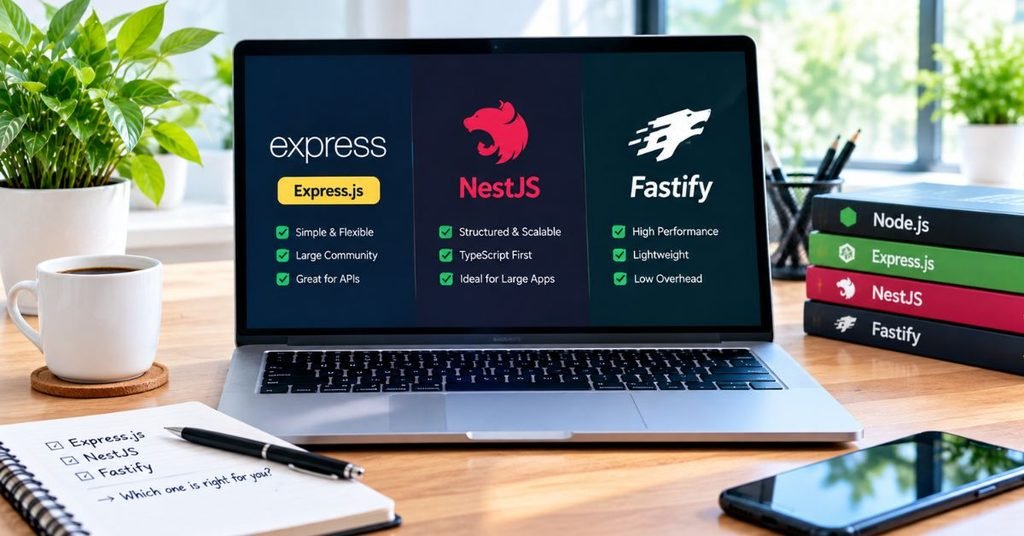
Node.js Backend Development: Express.js vs NestJS vs Fastify
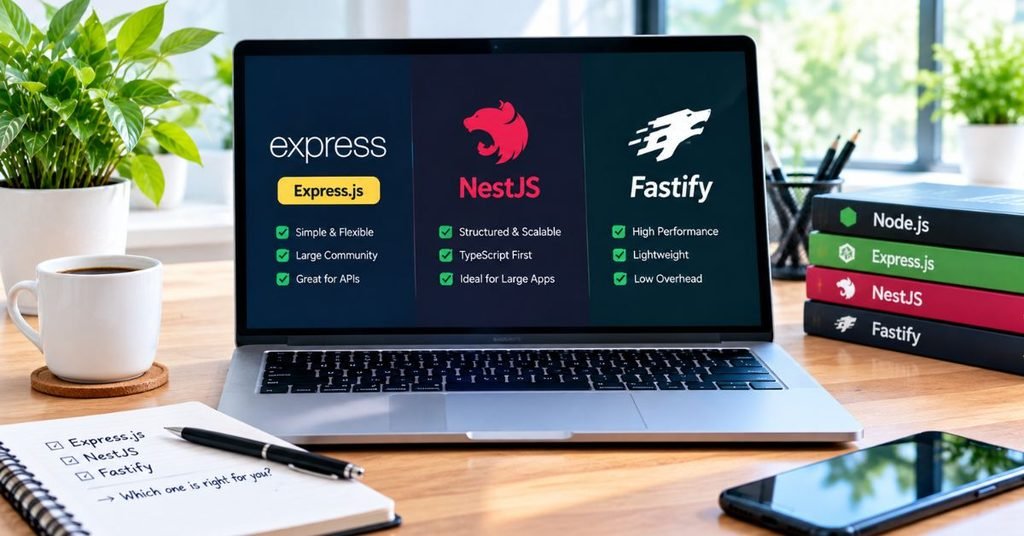
Different projects need different levels of structure and flexibility. Choosing a framework should depend on application size, team requirements, performance goals, ecosystem needs, and maintainability.
| Technology | Best For | Main Strength | Possible Limitation |
| Express.js | Flexible APIs and web servers | Simple and mature | Developers must design more structure |
| NestJS | Large structured applications | Strong architecture and TypeScript support | More abstraction |
| Fastify | Performance-focused APIs | Low overhead and schema support | Different ecosystem and conventions |
For a small API, Express may provide everything the project needs without unnecessary complexity. A larger application with many modules and developers may benefit from NestJS’s structured approach. Fastify can be attractive when low overhead and performance-oriented design are important.
There is no framework that wins every project. The best decision comes from the application’s actual requirements.
When Should You Choose Node.js for Backend Development?
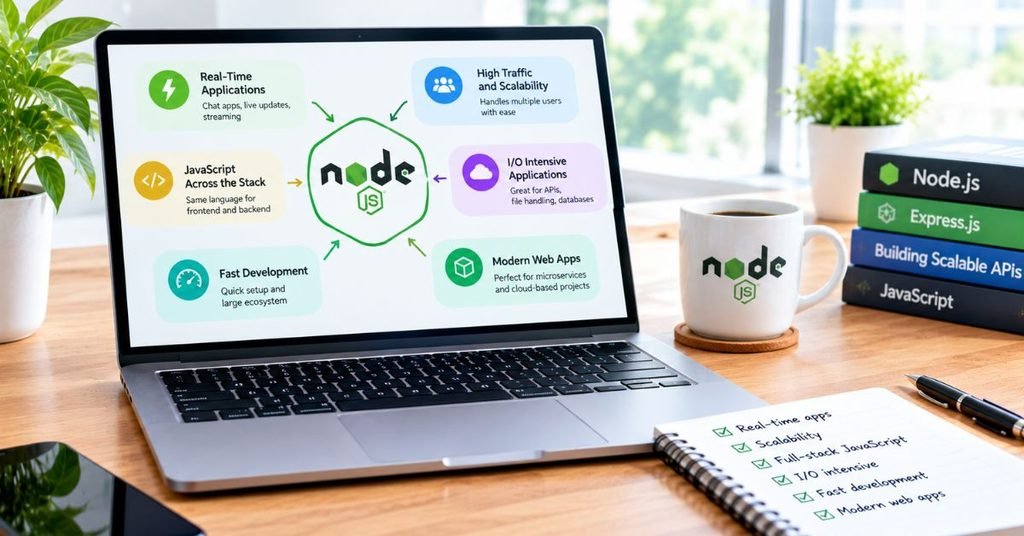
Node.js is a strong option when an application needs API communication, real-time features, external service integrations, or many concurrent network operations. It can also be convenient when the development team already works heavily with JavaScript or TypeScript.
Common use cases include:
- REST APIs
- SaaS applications
- Real-time dashboards
- Chat applications
- E-commerce backends
- Streaming-related services
- Microservices
- Mobile application backends
- Internal business APIs
Node.js is not automatically the best choice for every workload. Applications dominated by heavy CPU computation may require a different architecture or technology that is better suited to that specific workload.
Real-Life Example: Building an E-Commerce Backend
Consider an online store where customers can register, browse products, add items to a cart, and place orders. The frontend could be built with a modern JavaScript framework while the Node.js backend provides the API that connects the user interface with the application’s data and services.
A simplified architecture could look like this:
Frontend → Node.js API → Authentication → Business Logic → Database → External Services
After a customer logs in, the backend verifies their credentials and creates the required authentication state. For product requests, the API checks the request, retrieves relevant records from the database, and sends structured data back to the client.
During checkout, the backend should not simply save whatever information arrives from the browser. It should verify the user’s identity, check product availability, validate quantities and prices, calculate the order correctly, create the order record, and then handle the appropriate payment or fulfillment workflow.
This example shows why production node js backend development involves more than creating API endpoints. Security, validation, business rules, database consistency, error handling, and external-service communication all need to work together.
Common Mistakes in Node.js Backend Development
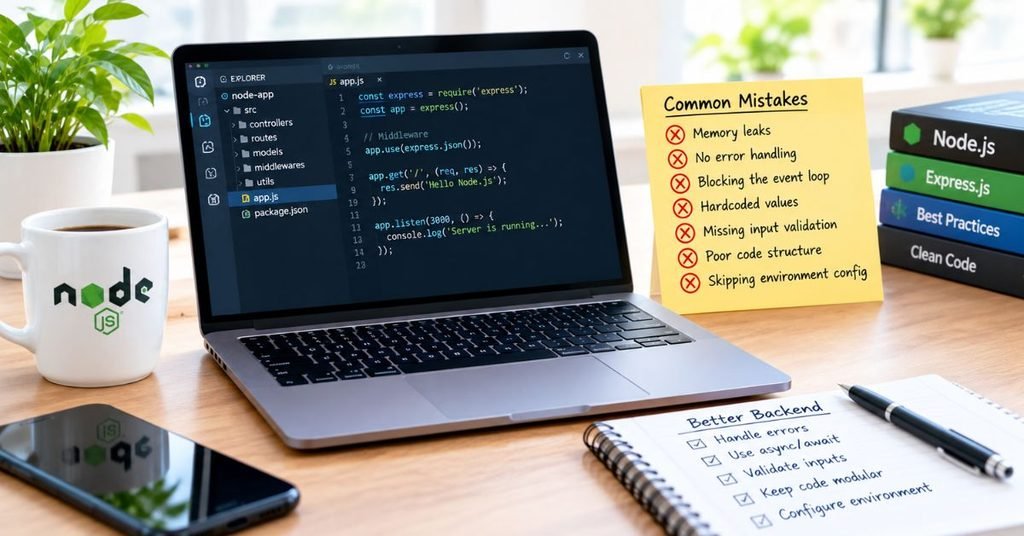
Even experienced developers can create backend problems when they focus only on getting an application to work. A production backend also needs good structure, security, reliable data handling, and monitoring. Avoiding common mistakes early can save significant debugging and maintenance time later.
Putting Everything in One File
Keeping routes, database queries, authentication, and business logic in one large file may seem convenient for a small project. As features increase, however, that approach becomes difficult to maintain.
A better approach is to separate responsibilities into routes, controllers, services, database modules, middleware, and configuration. The structure can remain simple while still making individual components easier to understand and test.
Blocking the Event Loop
Node.js is designed around an event-driven model, so blocking operations can hurt application responsiveness.
Common examples include:
- Unnecessary synchronous file operations
- Large CPU-intensive calculations
- Inefficient loops over very large datasets
- Heavy processing inside request handlers
Move CPU-heavy work to an appropriate architecture instead of assuming that Node.js will automatically handle every workload efficiently.
Skipping Input Validation
A backend should never trust data simply because it came from your own frontend. Users, automated clients, and malicious requests can send unexpected values directly to an API.
Validate data at the server boundary before using it in business logic or database operations. This improves both application reliability and security.
Exposing Secrets in Source Code
Database passwords, private API keys, and authentication secrets should not be hard-coded into application files.
Use environment configuration or a suitable secrets-management solution and make sure sensitive files are not committed to public repositories.
Using Weak Error Handling
An application that returns unclear errors is harder to debug and harder for clients to use correctly.
Create consistent error responses while keeping internal details private. Production responses should not expose stack traces, database credentials, file paths, or other sensitive implementation information.
Ignoring Database Performance
Developers sometimes optimize JavaScript code while overlooking inefficient database operations.
A backend can become slow because of:
- Missing indexes
- Excessive database queries
- Retrieving unnecessary fields
- Loading huge datasets at once
- Poor pagination
- Inefficient joins or filters
Measure database performance before assuming that Node.js itself is responsible for the slowdown.
Installing Too Many npm Packages
The npm ecosystem is one of Node.js’s major strengths, but every dependency adds maintenance and security considerations.
Before adding a package, check whether it is necessary, maintained, appropriate for the project, and trustworthy. A smaller set of well-chosen dependencies can make a backend easier to maintain.
How to Improve Node.js Backend Development for Production
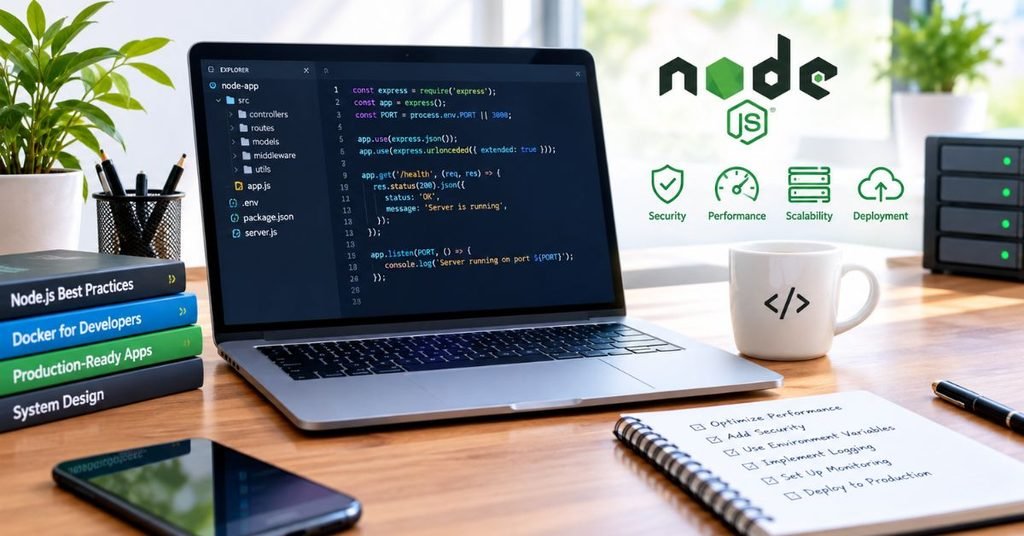
A development server and a production system have very different requirements. Local development may work perfectly even when the application lacks monitoring, reliable error handling, security controls, or recovery strategies.
A production-focused approach should consider what happens when traffic increases, a database becomes unavailable, an external API fails, or a user sends an unexpected request.
Use Environment-Based Configuration
Keep development, testing, and production settings separate.
For example, database connection details, API endpoints, logging levels, and application secrets may differ between environments. Configuration should be managed systematically rather than scattered throughout the source code.
Add Automated Testing
Testing helps catch problems before they reach production.
A useful testing strategy can include:
- Unit tests for individual functions
- Integration tests for database and service interactions
- API tests for important endpoints
- Authentication and authorization tests
- Validation and error-case tests
Focus first on business-critical behavior and areas where failures could cause serious problems.
Document Important APIs
API documentation helps frontend developers, mobile developers, testers, and future team members understand how the backend works.
Document important details such as:
- Available endpoints
- HTTP methods
- Required parameters
- Authentication requirements
- Request formats
- Response formats
- Common error responses
Clear documentation can reduce unnecessary communication and integration mistakes.
What Should You Learn for Node.js Backend Development?
If you are starting your backend journey, learning Node.js syntax alone is not enough. You should gradually build knowledge of HTTP, APIs, databases, authentication, testing, security, and deployment.
A practical learning path is:
- Learn modern JavaScript fundamentals.
- Understand Node.js and the event loop.
- Build basic HTTP servers.
- Learn Express.js or another suitable framework.
- Create REST APIs.
- Learn SQL and at least one database system.
- Add authentication and authorization.
- Learn validation and error handling.
- Write API and integration tests.
- Learn Git and deployment basics.
- Study logging, monitoring, and performance.
- Build a complete production-style project.
The goal should not be to memorize every Node.js package. Instead, learn how the different parts of a backend fit together and why a particular tool is appropriate for a specific problem.
Author Note
This guide focuses on practical node js backend development concepts that matter when moving from simple tutorials to real applications. The goal is to explain the architecture, security, performance, and development decisions behind a reliable backend rather than simply listing Node.js features.
Disclaimer
Node.js, frameworks, packages, cloud services, and security practices continue to change. Always verify current package documentation, security advisories, and deployment requirements before using any technology in a production application.
Conclusion
Node.js backend development remains a practical choice in 2026 for APIs, real-time applications, SaaS products, e-commerce systems, and many other network-heavy workloads. Its asynchronous architecture and broad ecosystem can help developers build responsive services, but successful backend development depends on much more than the runtime itself. Clean architecture, reliable databases, strong validation, authentication, testing, and monitoring all contribute to a dependable application.
The best Node.js backend is not necessarily the one with the most packages or the most complicated architecture. It is the one that matches the application’s needs and remains secure, understandable, testable, and scalable as those needs change. Start with a clear structure, measure real performance, protect every external input, and add complexity only when the project genuinely requires it.
FAQs About Node.js Backend Development
What is node js backend development?
Node.js backend development is the process of using Node.js to build server-side applications, APIs, and services. It allows JavaScript to handle requests, business logic, database operations, authentication, and communication with other services.
Is Node.js good for backend development in 2026?
Yes. Node.js remains useful for API-driven applications, real-time systems, SaaS products, and applications that handle many network operations. Its suitability still depends on the application’s workload and architecture.
Is Node.js better than traditional backend technologies?
Not in every situation. Node.js can be an excellent choice for I/O-heavy applications, while other technologies may be more suitable for particular CPU-intensive or specialized workloads.
Should I use Express.js or NestJS?
Express.js is useful when you want a lightweight and flexible framework. NestJS provides more built-in structure and can be attractive for larger applications that benefit from modular architecture and TypeScript.
Can Node.js handle large scale applications?
Yes. Node.js can be used in large-scale systems when the application is designed properly. Database optimization, caching, load balancing, efficient services, monitoring, and appropriate scaling strategies are important factors.
Is Node.js secure for backend development?
Node.js can be used to build secure backends, but security depends on how the application is designed and maintained. Input validation, secure authentication, dependency management, access control, rate limiting, and proper secret handling are essential.
What should I learn before Node.js backend development?
A good foundation includes JavaScript, HTTP, APIs, Git, basic databases, and web development concepts. After that, you can learn Node.js, a backend framework, authentication, testing, security, and deployment step by step.