


Quick Takeaway:
A blockchain smart contracts guide becomes much easier to understand when you stop thinking of a smart contract as a normal legal document. It is software stored on a blockchain that follows rules written in code. When the required conditions are satisfied, the program can perform a defined action without someone manually approving every step.
This blockchain smart contracts guide explains the complete concept in simple English. You will learn what smart contracts are, how they work, what happens during execution, where they are used, which technologies support them, what they can and cannot do, how developers build them, and what security risks users should understand before interacting with one.
Introduction
A blockchain smart contracts guide is useful for anyone who wants to understand how blockchain applications actually work. Smart contracts are programs stored on a blockchain that follow predefined rules and can automatically perform actions when specific conditions are met. They support many modern blockchain applications, including decentralized finance, digital assets, gaming, governance, and automated payments.
In this blockchain smart contracts guide, you will learn how smart contracts work from start to finish, what happens when a contract is deployed, how users interact with it, and why gas, storage, functions, events, and access control matter. We will also cover smart contract development, testing, deployment, security risks, oracles, real-world use cases, and common mistakes beginners should avoid.
Understanding Smart Contracts on Blockchain Networks

A smart contract is a piece of blockchain-based code that automatically carries out programmed instructions when the required conditions are met.
It contains functions, rules, and stored data that determine how the program behaves when someone interacts with it.
Unlike a traditional contract, the main operating instructions are written as software. The blockchain records the contract and its transactions, while the network executes the programmed logic according to the rules.
A simple way to understand it is:
Condition → Verification → Code execution → Blockchain state update
For example, imagine a digital marketplace. A buyer sends payment, the system checks that the payment is valid, and the smart contract releases a digital asset to the buyer. The process can happen automatically once the required conditions are satisfied.
However, a smart contract does not understand human intentions. It follows code. If the code contains a mistake, the contract can still execute that mistake.
Smart Contract vs Traditional Contract
A traditional contract normally depends on people, organizations, legal systems, or other intermediaries to interpret and enforce its terms.
A smart contract turns specific rules into executable code.
That does not mean smart contracts completely replace legal contracts. A blockchain program and a legal agreement can serve different purposes.A smart contract executes programmed instructions, whereas a legal contract establishes rights, duties, and responsibilities that apply in the real world.
This distinction matters because many beginners assume that every smart contract is automatically a legally enforceable agreement. That is not always true.
How Do Blockchain Smart Contracts Work?
The easiest way to understand a blockchain smart contracts guide is to follow one transaction from beginning to end.
A smart contract normally begins as source code. A developer writes rules and functions using a supported programming language. On Ethereum, Solidity and Vyper are among the main languages used for smart contract development.
The source code is then compiled into a form that the blockchain’s execution environment can process. After deployment, the contract receives a blockchain address.
Users or other applications can then interact with that address.
Step 1: The Rules Are Written
The developer first decides what the contract should do.
For example:
- Accept a payment
- Check a condition
- Transfer tokens
- Record ownership
- Allow voting
- Release funds
- Update a permitted value
The quality of this stage is extremely important because blockchain code can be difficult to change after deployment.
Step 2: The Code Is Compiled
The source code cannot simply be placed on a blockchain as ordinary text.
It must be compiled into executable bytecode. The compiler checks the program and produces the format required by the target blockchain environment.
For Ethereum-based development, this means code eventually runs inside the Ethereum Virtual Machine, commonly called the EVM.
Step 3: The Contract Is Deployed
Deployment places the compiled contract on the blockchain.
Deployment requires a blockchain transaction and normally involves a network fee. Once deployed, the contract receives an address that users and applications can use to interact with it.
Step 4: A User or Application Calls It
A wallet, website, backend system, or another smart contract can interact with the deployed program.
Some interactions only read information. Others change blockchain state.
Reading something such as a token balance generally does not require a state-changing transaction. Writing information or performing an action normally requires a transaction and network fee.
Step 5: The Network Executes the Requested Function
The blockchain network processes the transaction according to its rules.
If the transaction satisfies the required conditions, the requested function can execute.
The result becomes part of the blockchain’s updated state.
This is why smart contracts are powerful: the network does not need a manager sitting in the middle to manually perform every programmed action.
What Are the Main Parts of a Smart Contract?
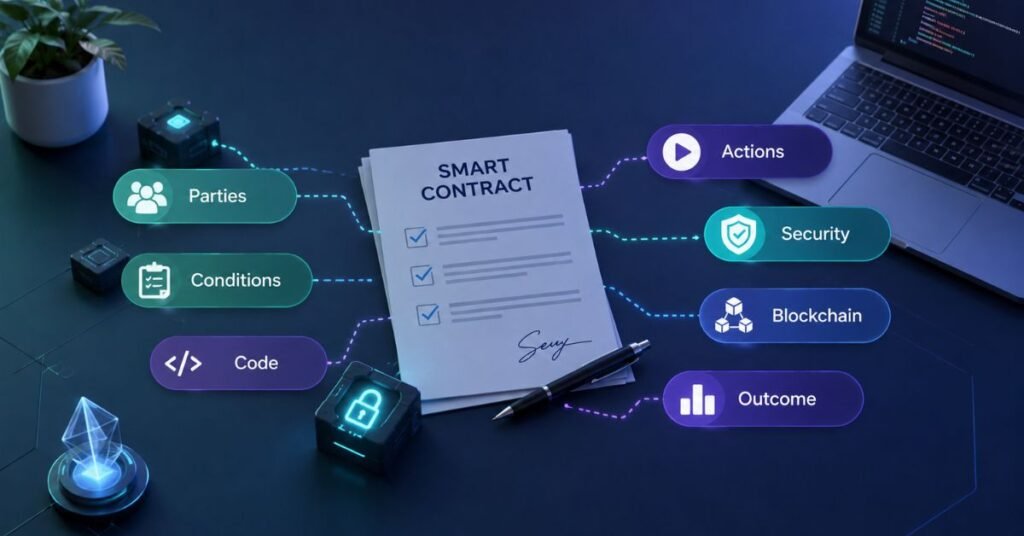
Understanding the internal structure makes a blockchain smart contracts guide much more useful for beginners who want to move beyond definitions.
A smart contract can contain several important elements.
State Variables
State variables hold information that the contract needs to remember.
Examples include:
- Token balances
- Owner addresses
- Voting results
- Product records
- Contract settings
- User permissions
Persistent blockchain storage can be expensive, so developers need to think carefully about what information actually needs to remain on-chain.
Functions
Functions define what users or other contracts can ask the program to do.
A token contract might contain functions for transferring tokens, checking balances, or approving another address to spend tokens.
Events
Events allow contracts to record activity in blockchain logs.
A front-end application can use these events to detect actions such as transfers, purchases, votes, or other important changes.
Modifiers and Access Rules
Not every function should be available to everyone.
Access controls can restrict certain operations to an owner, administrator, approved account, or group of authorized users.
Poor access control is one of the areas developers must examine carefully during security testing.
What Makes Smart Contracts Different From Normal Software?
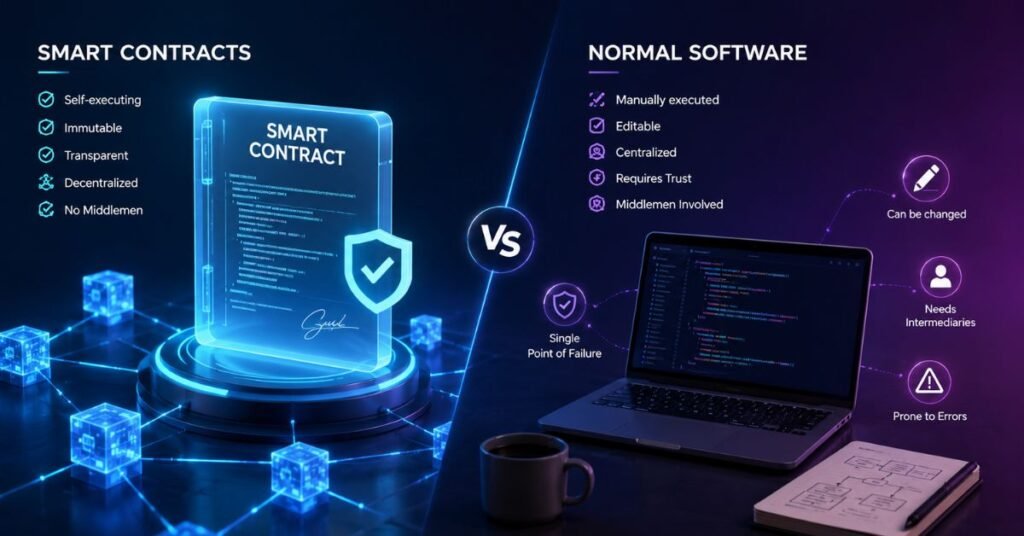
Smart contracts look like software, but blockchain changes the environment in which that software operates.
A normal web application may run on a server controlled by a company. Developers can often update its database or deploy a new version when they discover a problem.
A blockchain smart contract can be much harder to modify.
Transparency
On many public blockchain networks, contract addresses, transactions, and relevant activity can be inspected publicly.
This creates a different model of trust. Instead of trusting one organization to maintain a private database, users can verify blockchain activity through public network data.
Deterministic Execution
The same contract logic should produce predictable results when given the same valid conditions and blockchain state.
This predictability is one reason smart contracts are useful for automated financial and digital systems.
Composability
Smart contracts can interact with other smart contracts.
This creates a building-block model for decentralized applications. One contract can provide a service that another contract uses as part of a larger application.
That is a major reason Web3 applications can become complex systems built from multiple independent components.
What Can Smart Contracts Be Used For?
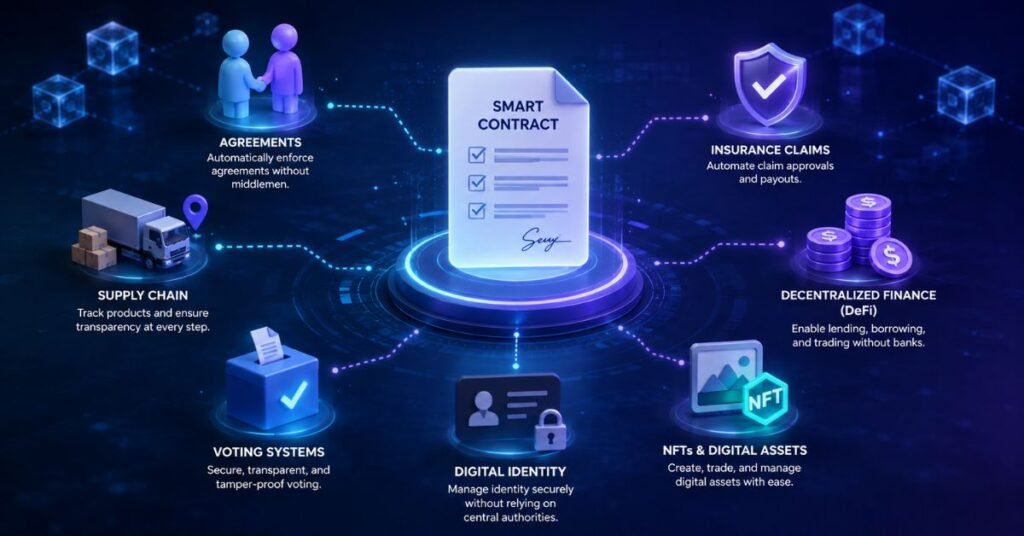
Smart contracts are not limited to cryptocurrency transfers. Their ability to execute predefined rules makes them useful for many digital workflows.
Decentralized Finance
DeFi applications use smart contracts for activities such as token swaps, lending, borrowing, liquidity systems, and other financial operations.
Instead of relying entirely on a traditional financial institution, the application can use programmed blockchain logic.
Token Creation
Smart contracts can define how digital tokens behave.
Fungible token standards can establish common functions for balances, transfers, and approvals. Other standards can support unique digital assets.
Digital Ownership
Blockchain applications can use smart contracts to represent ownership or control over digital assets.
The contract can define who owns an asset and how ownership can be transferred.
Gaming
Blockchain games can use contracts for digital items, rewards, marketplaces, ownership records, and player interactions.
The blockchain component does not need to run the entire game. Developers can keep high-speed game logic off-chain while using blockchain where verifiable ownership or transactions are valuable.
Business Automation
Companies can use blockchain programs to automate selected parts of a workflow.
For example, a supply chain system could record a verified milestone and trigger another programmed action when the required information becomes available.
The important point is that smart contracts work best when the business rule can be expressed clearly in software.
What Are the Benefits of Smart Contracts?
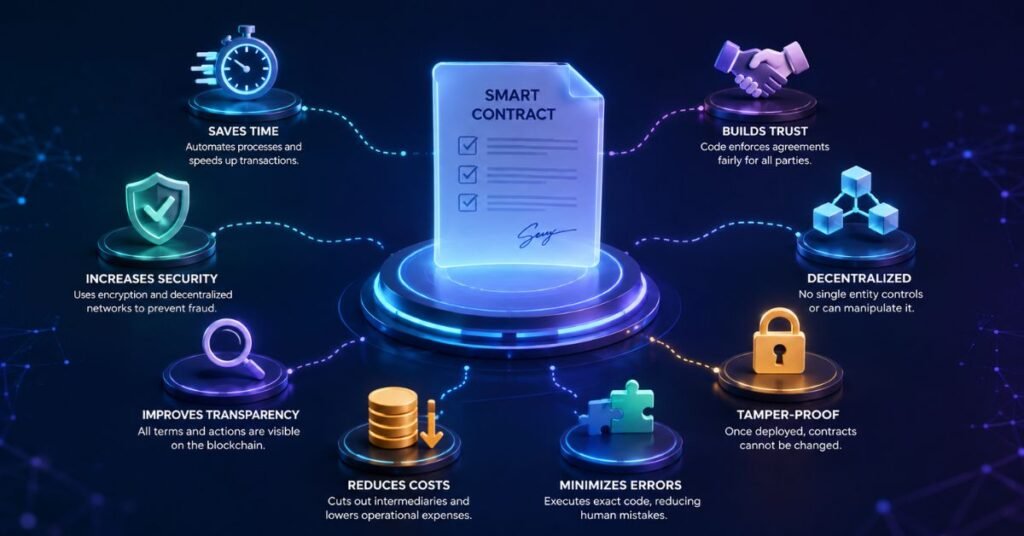
A strong blockchain smart contracts guide should not only explain what the technology does. It should also explain when it makes sense to use it.
Automation
Automation is one of the biggest advantages.
Once the necessary conditions are satisfied, the programmed action can occur without someone manually processing the same step every time.
Fewer Manual Steps
A blockchain application can reduce repetitive processes such as checking records, approving routine actions, or updating shared transaction data.
This can make some workflows faster and easier to audit.
Transparent Records
Public blockchain networks can provide visible transaction histories.
Participants can independently inspect relevant activity instead of depending entirely on a private database controlled by one organization.
Predictable Rules
A well-designed contract follows defined rules rather than changing its behavior because an employee interprets a condition differently.
That can be useful when the process requires consistent execution.
Programmable Assets
Smart contracts allow developers to combine assets with rules.
For example, an asset can be transferred only when a certain function is called or when an approved condition is satisfied.
What Are the Limitations and Risks?
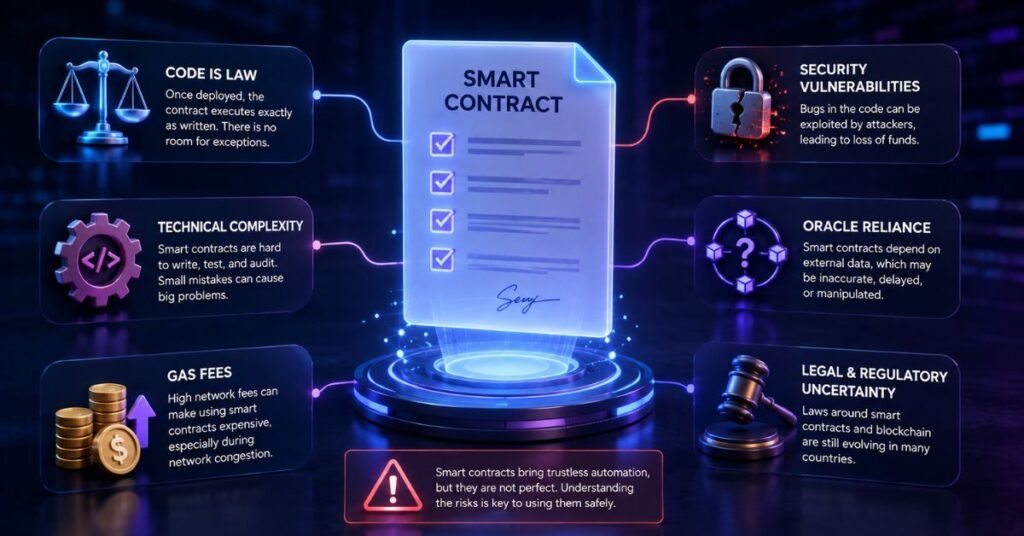
Smart contracts are powerful, but they are not automatically safe.
This is one of the most important lessons in any blockchain smart contracts guide.
Code Bugs
A coding error can produce unexpected behavior.
Traditional software can often be patched quickly. A deployed blockchain contract may require a carefully designed upgrade mechanism, migration, or replacement system.
Private Key Risk
Users normally interact with blockchain applications through wallets and cryptographic signatures.
If a user signs a malicious transaction, the smart contract may receive authorization to perform an action that the user did not fully understand.
Oracle Dependence
Smart contracts cannot automatically know everything happening outside their blockchain.
If a contract needs real world information such as a price, weather result, shipment status, or sports result, it needs a trusted data mechanism such as an oracle.
The oracle itself then becomes an important part of the system’s security model.
Transaction Fees
Blockchain execution requires network resources.
State-changing transactions can therefore involve fees. During network congestion, costs may rise or transactions may take longer than expected.
Irreversible Actions
Once confirmed on the blockchain, a transaction may be very difficult to undo or cancel.
This creates strong benefits for finality, but it also means mistakes can be expensive.
A user should never assume that blockchain transactions have the same cancellation process as an online bank transfer.
Blockchain Smart Contracts Guide: Which Platforms Support Them?

Smart contracts exist across several blockchain ecosystems, but their development environments are not identical.
Ethereum
Ethereum is one of the most established ecosystems for programmable blockchain applications.
Its developer environment includes the EVM, Solidity, Vyper, testing tools, deployment systems, libraries, and extensive documentation.
It is also important to understand that Ethereum is not the only blockchain capable of supporting smart contracts.
Other Smart Contract Networks
Several blockchain networks use their own methods for supporting programmable applications. Each ecosystem offers different features, development tools, and approaches for running decentralized applications.
The right platform depends on factors such as:
- Execution environment
- Developer tooling
- Transaction costs
- Security model
- Ecosystem size
- Programming language
- Application requirements
- Scalability needs
The cheapest network is not automatically the best network. Developers should evaluate the complete technical and security environment before choosing where to deploy.
Which Programming Languages Are Used?

Developers have several choices, depending on the blockchain environment.
Solidity
Solidity is widely associated with Ethereum smart contract development.
Its syntax will feel familiar to developers who have worked with languages that use curly braces. It supports complex contract structures and is widely supported by development tools.
Vyper
Vyper is another language used for Ethereum smart contracts.
Its Python like syntax and more restrictive design can make certain contracts easier to review.
The best language depends on the project, developer experience, available libraries, and security requirements.
How to Build and Deploy a Smart Contract Step by Step

If you want to move from learning to development, follow a controlled workflow rather than immediately deploying code to a public network.
Step 1: Define the Problem
Start with the business or technical problem.
Do not start by writing Solidity code.
Ask:
What needs to happen automatically?
What data must be stored?
Who can perform each action?
What happens when something goes wrong?
Step 2: Design the Contract
Create the functions, data structure, permissions, and expected outcomes.
At this stage, write the logic in plain English first.
If you cannot explain the rule clearly in simple language, coding it will probably create confusion.
Step 3: Write the Code
Use the selected smart contract language and follow established development practices.
Avoid creating everything from scratch when reliable, reviewed libraries can provide standard functionality.
Step 4: Test Before Deployment
Testing should cover normal and abnormal situations.
Try incorrect inputs, unauthorized users, unusual transaction sequences, and edge cases.
A contract that works in one successful test is not necessarily secure.
Step 5: Review and Audit
Security review becomes especially important when the contract controls valuable assets.
Developers can use automated testing, static analysis, peer review, and professional auditing depending on the project’s risk.
Step 6: Deploy Carefully
Start with a suitable development or test environment.
Only move to a production network after the team understands the contract’s behavior, permissions, dependencies, and upgrade strategy.
Step 7: Monitor After Launch
Deployment is not the end of the process.
Monitor contract activity, unusual transactions, external dependencies, and application behavior.
A live contract operates in a changing environment, so ongoing observation remains important.
A Real-Life Example: Automated Digital Escrow
Imagine an online marketplace where a buyer wants to purchase a digital service from a seller.
In a traditional process, a platform might manually hold payment and release it after receiving confirmation.
A smart-contract-based design could automate part of this workflow.
The buyer sends funds into the contract. The contract records the payment. When the required condition is satisfied, the programmed release function sends the funds to the seller.
If the condition is not satisfied, the contract follows the alternative rule defined by its code.
This example shows both the strength and weakness of the technology.
The strength is automation.
The weakness is that the contract needs precise rules. If the system cannot correctly determine whether the condition has been satisfied, automation alone cannot solve the problem.
Common Smart Contract Mistakes Beginners Make
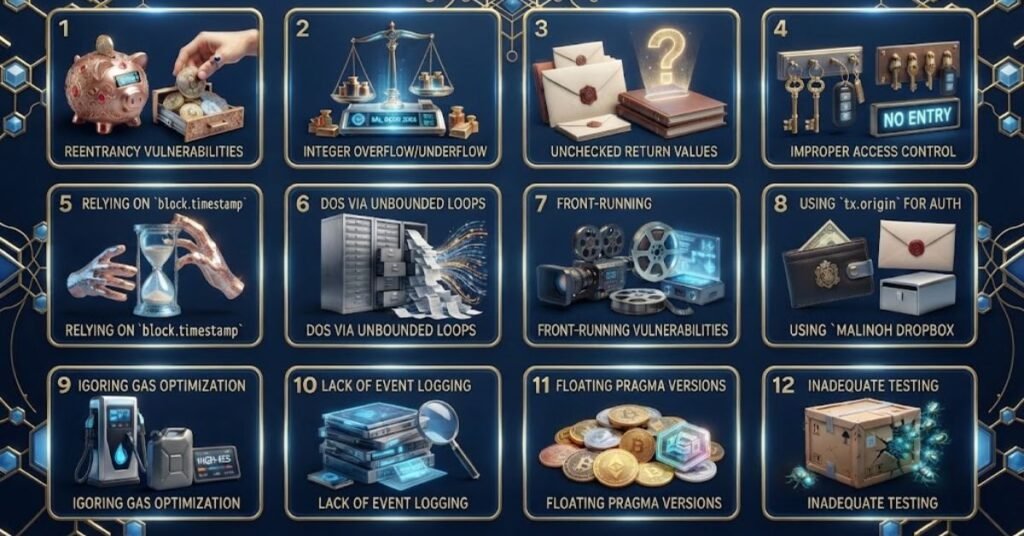
Even a detailed blockchain smart contracts guide cannot replace careful development. These mistakes are especially important to avoid.
Mistake 1: Treating Smart Contracts Like Normal Legal Contracts
A smart contract is software.
Do not assume that putting an agreement on a blockchain automatically gives it the same legal status as a traditional contract.
Mistake 2: Deploying Before Testing
Public deployment should not be the first serious test.
Use controlled environments and test different user behaviors before putting valuable assets at risk.
Mistake 3: Ignoring Access Control
Every sensitive function should have clear permission rules.
Ask who can call it, when they can call it, and what happens if an unauthorized account attempts access.
Mistake 4: Assuming Blockchain Means Bug-Proof
Blockchain can protect the integrity of recorded data, but it does not automatically make application code correct.
A flawed smart contract can still contain flawed logic.
Mistake 5: Ignoring External Data
If a contract depends on real world information, developers must examine how that information reaches the blockchain.
An insecure data source can weaken an otherwise well-designed contract.
Mistake 6: Signing Transactions Without Understanding Them
Users should inspect what a wallet request is asking them to approve.
Blindly signing transactions can expose users to serious financial risk.
Smart Contracts vs Traditional Software: Quick Comparison
| Feature | Smart Contract | Traditional Software |
| Execution | Runs through blockchain infrastructure | Usually runs on servers or devices |
| Data model | Blockchain state and records | Private or centralized databases |
| Updates | Can be difficult depending on design | Usually easier to deploy updates |
| Transparency | Often publicly verifiable on public chains | Usually controlled by the owner |
| Fees | Blockchain operations can require fees | Costs depend on the application |
| Control | Rules can be distributed across network participants | Often controlled by a company or administrator |
| Automation | Strong for predefined blockchain actions | Also highly programmable |
| Error recovery | Can be difficult after finalized transactions | Usually easier to patch or reverse |
| External data | Often needs oracle or external data mechanism | Can directly access APIs and databases |
Who Should Learn Smart Contracts?
Smart contracts are useful to more than blockchain developers.
For Developers
Developers can learn Solidity, Vyper, EVM concepts, testing, deployment, and contract security.
For Business Owners
Business owners can focus on whether blockchain automation actually solves a real process problem.
For SEO and Technology Writers
Writers should understand the difference between blockchain, smart contracts, cryptocurrencies, tokens, dApps, and oracles before explaining these topics to readers.
For Students
Students can use smart contracts as a practical way to understand programming, distributed systems, cryptography, digital assets, and decentralized applications.
How to Decide If You Actually Need a Smart Contract

Not every application needs blockchain.
Before building one, ask five questions:
- Do multiple parties need to share a trusted record?
- Is removing or reducing a central intermediary valuable?
- Does the process contain clear rules that software can execute?
- Is blockchain transaction cost acceptable?
- Is the value of transparency or verifiability greater than the added complexity?
If most answers are no, a conventional database may be simpler and cheaper.
If several answers are yes, a blockchain-based design may deserve further evaluation.
Author Note
This guide is written from a practical technology learning perspective. The goal is not to present smart contracts as a solution for every problem. Good technology decisions start with the problem, not the trend.
The most important lesson is simple: smart contracts provide programmable rules on blockchain networks, but their value depends on good design, correct code, secure execution, and a clear reason for using blockchain in the first place.
Disclaimer
This article is provided for general educational and informational purposes. Blockchain technology, smart contracts, digital assets, regulations, fees, and security practices can change over time. This guide does not provide legal, financial, investment, or security audit advice. Before deploying a smart contract or interacting with one involving real assets, consult qualified technical and professional experts.
Conclusion
A blockchain smart contracts guide should go beyond the simple idea of “self-executing contracts.” Smart contracts are programmable blockchain systems that can store data, enforce coded rules, interact with other contracts, and automate specific actions when defined conditions are met. Their biggest strengths include automation, transparency, predictable execution, and programmable digital assets.
At the same time, smart contracts introduce real risks. Bugs, poor access controls, unsafe external data, transaction costs, private-key mistakes, and irreversible transactions can create serious problems. The best approach is therefore not to use smart contracts simply because blockchain is popular. First identify the problem, then determine whether programmable blockchain logic provides a genuine advantage.
Frequently Asked Questions
1. What is a blockchain smart contract?
A blockchain smart contract is a program deployed on a blockchain that follows predefined rules. It can perform specific actions when the required conditions are satisfied.
2. How does a smart contract work?
A smart contract receives an interaction or transaction, checks the programmed conditions, executes the relevant function, and updates blockchain state when the transaction is successfully processed.
3. Are smart contracts legally binding?
Not automatically. A smart contract is software, while legal enforceability depends on the applicable laws, jurisdiction, agreement structure, and specific circumstances.
4. Can a smart contract be changed after deployment?
It depends on its architecture. Some contracts are designed to be immutable, while others use upgrade patterns that allow specific parts of the system to change through controlled mechanisms.
5. What programming language is commonly used for smart contracts?
Solidity is one of the most widely used languages for Ethereum smart contract development. Vyper is another important option in the Ethereum ecosystem.
6. Are smart contracts completely secure?
No. Blockchain infrastructure can provide strong security properties, but smart contract code can still contain vulnerabilities. Testing, review, secure development practices, and auditing are important for higher-risk applications.
7. Do all blockchain applications need smart contracts?
No. Some blockchain applications can work without complex smart contract systems. The right choice depends on the application’s requirements, data model, trust assumptions, cost, and desired automation.