

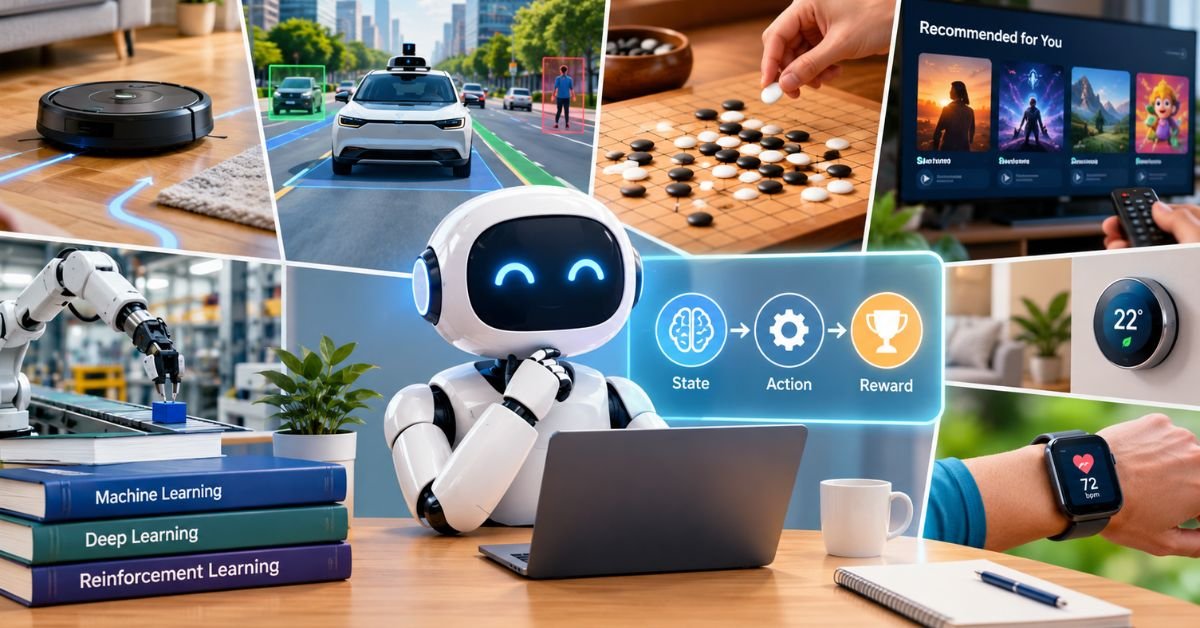
Quick Summary / Snapshot
Reinforcement learning examples become much easier to understand when you stop thinking about complex formulas and look at what the AI actually does. An agent observes a situation, chooses an action, receives feedback, and adjusts its future decisions. That simple loop can power game-playing systems, robots, recommendation engines, traffic control, energy management, and many other applications.
This reinforcement learning examples guide explains the idea from the ground up. You will learn how an RL agent works, what makes a problem suitable for reinforcement learning, and how common examples map to states, actions, rewards, and policies. You will also see practical examples, a step by step workflow, common mistakes, tools, and a simple comparison table.
Introduction
Reinforcement learning examples show how AI systems learn better decisions through trial and error. An agent observes a situation, chooses an action, receives feedback, and uses that feedback to improve future decisions.
The idea sounds advanced, but the basic pattern is simple. Imagine an AI learning to control a robot. The robot observes its position, chooses a movement, and receives a positive signal when it moves toward its goal. If it crashes or moves in the wrong direction, the reward becomes lower. After many attempts, the agent learns a policy that favors better decisions.
The most important point is that reinforcement learning does not simply memorize answers. It learns a strategy for choosing actions. That difference makes RL useful for dynamic tasks where one decision can affect many later decisions.
What Is Reinforcement Learning?
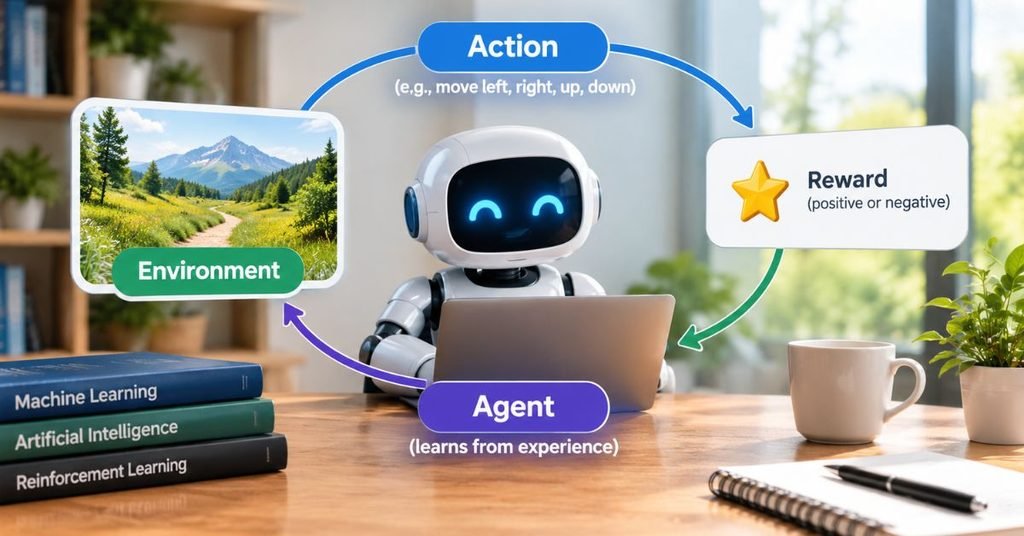
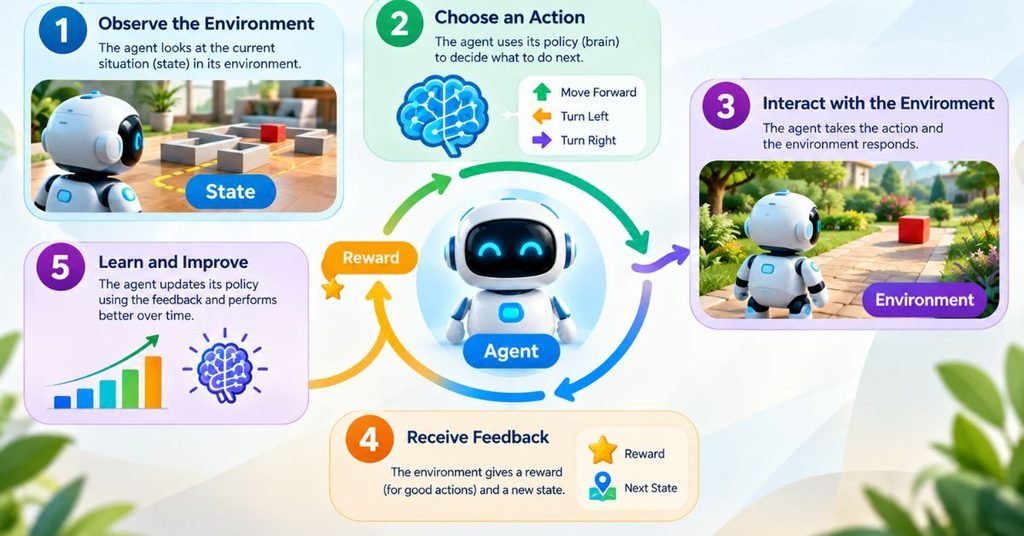
Reinforcement learning is a machine learning approach in which an agent learns how to make decisions by interacting with an environment. The agent receives information about the current situation, selects an action, and gets feedback from the environment.
The feedback normally comes as a numerical reward. A useful action can increase the reward, while a poor action can reduce it. Over many interactions, the agent attempts to learn a policy that produces higher long-term returns.
The Five Core Parts
- Agent: The system that makes decisions.
- Environment: The world or simulation where the agent operates.
- State: The information describing the current situation.
- Action: A choice available to the agent.
- Reward: Feedback showing how useful the action was.
A sixth concept is also important: the policy. The policy describes how the agent chooses actions based on what it observes.
For example, in a simple driving simulation, the car can be the agent. The road and traffic form the environment. Vehicle speed and position describe the state. Steering, braking, and acceleration are actions. Safe progress toward the destination can produce positive rewards.
Why Trial and Error Matters
The agent usually does not know the best action at the beginning. It must explore different possibilities.
This creates the famous exploration versus exploitation problem. Exploration means testing actions that the agent does not fully understand yet. Exploitation means using an action that already appears to work well.
A good RL system needs a balance between both. Too much exploration wastes time. Too much exploitation can prevent the agent from discovering a better strategy.
12 Reinforcement Learning Examples in the Real World
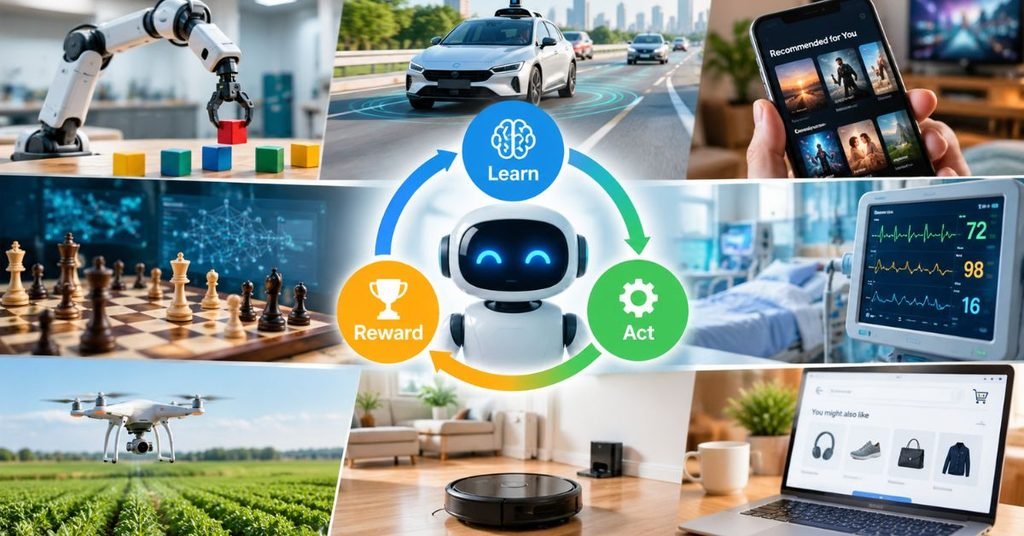
The best way to understand RL is to connect the theory to practical situations. Each example below follows the same basic pattern: observe a situation, choose an action, receive feedback, and improve future decisions.
1. Game Playing
Games are one of the clearest reinforcement learning examples because the objective is easy to measure.
Consider a racing game. The agent observes the track, vehicle speed, nearby obstacles, and position. It can accelerate, brake, steer, or change direction. Reaching checkpoints quickly can produce positive rewards, while crashing can create a penalty.
The agent can play thousands of simulated races and gradually discover useful driving behavior. It does not need a programmer to specify every steering decision.
Board games provide another useful example. In chess or Go, an action may not produce an immediate reward. A move that looks weak now could create a winning position several moves later. RL therefore needs to consider long-term outcomes.
2. Robotics and Robot Control
Robotics is another major area for reinforcement learning.
A robot may need to learn how to walk, balance, pick up an object, or move through a room. Writing a fixed rule for every possible situation can become extremely difficult.
With RL, the robot can practice inside a simulator before moving to physical hardware. The agent can receive rewards for stable movement, successful object handling, accurate positioning, or reaching a target.
This approach also allows thousands of training attempts without damaging expensive equipment.
3. Autonomous Driving and Navigation
Autonomous navigation creates a decision-making problem that changes continuously.
The system may observe road position, speed, nearby vehicles, obstacles, and traffic conditions. Possible actions can include steering, braking, accelerating, or changing lanes.
A reward function could combine safety, smooth movement, progress, and adherence to driving rules.
However, real world autonomous driving is a safety critical problem. RL should therefore be tested extensively in simulation and controlled environments before deployment.
4. Recommendation Systems
Recommendation systems can also be viewed through the RL lens.
Imagine a platform deciding which article, video, or product to show next. The system observes user behavior and chooses an item. The user’s response then provides feedback.
A short term click is not always the best outcome. A system may also care about longer term engagement, satisfaction, or return visits.
This makes sequential decision making important.Rather than focusing only on whether a user clicks, the system can consider how each recommendation affects future engagement.
an RL based approach can ask, “Which choice is likely to produce a better sequence of future interactions?”
5. Traffic Signal Optimization
Traffic lights normally follow predefined schedules, but traffic conditions change throughout the day.
An RL agent can observe traffic density, waiting times, queue lengths, and vehicle flow. It can then choose how long a signal should remain green or when to switch phases.
The reward could be based on lower waiting time and smoother traffic flow.
The interesting part is that one signal decision affects later traffic conditions. This makes traffic management a natural sequential decision problem.
6. Warehouse Robots and Logistics
Modern warehouses often need to move products quickly while avoiding congestion.
An RL agent can help optimize robot routes, task assignments, or movement patterns. The state might include robot locations, available tasks, battery levels, and blocked paths.
Actions could include selecting a destination or choosing the next task.
A reward can encourage shorter routes, faster delivery, fewer collisions, and better use of available robots.
7. Energy and Building Management
Buildings continuously consume energy for cooling, heating, lighting, and ventilation.
An RL system can observe temperature, occupancy, weather conditions, electricity demand, and equipment status. It can then adjust control settings.
The reward can combine comfort and energy efficiency.
For example, a system should not simply reduce cooling as much as possible. That might save energy but create an uncomfortable indoor environment. A better reward design balances both goals.
8. Financial Decision-Making
Financial markets are another area where sequential decisions matter.
An agent can observe market information and decide whether to buy, sell, or hold an asset. Its reward can be linked to risk-adjusted performance rather than raw profit alone.
This is a challenging RL problem because markets are noisy and constantly changing.
It also demonstrates an important lesson: reinforcement learning is not automatically better simply because a problem involves decisions. Financial applications require careful testing, realistic simulations, transaction costs, risk limits, and strong validation.
9. Healthcare Decision Support
Healthcare can involve a sequence of decisions rather than one isolated prediction.
For example, a treatment-planning system could consider patient information, previous responses, and possible future outcomes when evaluating treatment strategies.
In a safe research setting, RL can help study which sequence of decisions may improve a defined objective.
However, healthcare is highly sensitive. A model should not replace qualified medical professionals, and any practical system requires strict validation, safety controls, privacy protection, and appropriate clinical oversight.
10. Advertising and Marketing
Advertising platforms can make repeated decisions about where to place content and how to allocate limited attention or budget.
An RL agent could evaluate user context, campaign performance, previous actions, and available options.
The reward might consider conversions, revenue, customer value, or another carefully defined business objective.
The key advantage is adaptation. Instead of relying on one fixed strategy, the system can learn how different actions perform under changing conditions.
11. Industrial Automation
Factories contain many systems that must operate under changing conditions.
An RL agent can potentially optimize machine settings, production schedules, maintenance decisions, or process control.
For example, an industrial simulator can allow an agent to test different control strategies without interrupting a real production line.
Simulation is particularly valuable here because poor actions can be expensive or dangerous in the physical world.
12. Drone and Robotic Navigation
A drone needs to make fast decisions about movement, direction, altitude, and obstacle avoidance.
The environment can include buildings, trees, wind, restricted areas, and moving objects.
An RL agent can learn navigation behavior inside a simulator by receiving rewards for reaching targets efficiently while avoiding collisions.
Modern simulation tools make it possible to train many virtual agents or environments before transferring a learned policy to physical hardware.
Reinforcement Learning Examples: What Changes From One Problem to Another?
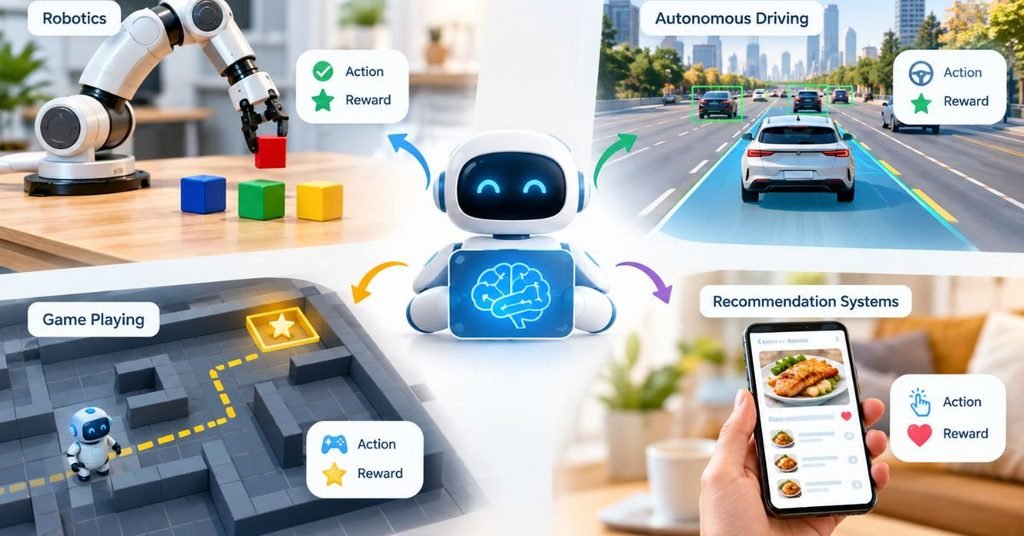
Although the applications look different, the underlying structure remains similar.
| Application | State | Action | Reward | Main Goal |
| Game AI | Game position | Move | Score / win | Improve gameplay |
| Robot control | Position, velocity | Motor command | Stability / progress | Complete task |
| Autonomous driving | Road and traffic data | Steering, braking | Safety / progress | Navigate safely |
| Recommendations | User context | Select content | Engagement | Improve future choices |
| Traffic control | Vehicle flow | Signal timing | Lower waiting | Reduce congestion |
| Warehouse | Robot and task data | Route / task | Faster delivery | Improve logistics |
| Energy management | Temperature, demand | Control settings | Efficiency + comfort | Reduce energy use |
| Finance | Market signals | Buy / sell / hold | Risk adjusted return | Improve strategy |
| Healthcare research | Patient state | Treatment option | Defined outcome | Improve decisions |
| Advertising | User and campaign data | Placement / allocation | Business result | Optimize campaigns |
| Industrial control | Machine state | Control setting | Performance | Improve production |
| Drone navigation | Position and obstacles | Movement | Safe progress | Reach destination |
The table reveals an important pattern. RL is not defined by the industry. It is defined by the decision loop.
How Reinforcement Learning Works Step by Step
Step 1: Define the Problem
Start by identifying what the agent needs to accomplish.
Avoid vague goals such as “make the system smarter.” Instead, define a measurable objective.
For example:
- Reach a destination safely.
- Reduce average waiting time.
- Maintain stable robot movement.
- Reduce energy use while maintaining comfort.
Step 2: Define the Environment
Next, describe what the agent can observe and what can change around it.
A simulator is often a good starting point because it allows repeated testing without putting real equipment or people at risk.
Step 3: Define States and Actions
List the information available to the agent.
Then define the actions it can control.
A poorly designed action space can make learning unnecessarily difficult. Keep it focused on decisions the agent genuinely needs to make.
Step 4: Design the Reward
Reward design is one of the most important parts of an RL project.
The reward should encourage the behavior you actually want.
Suppose you are training a delivery robot. Rewarding only speed could cause unsafe movement. A better design can reward successful deliveries while penalizing collisions and excessive delays.
Step 5: Choose an Algorithm
Simple problems may work well with methods such as Q learning.
More complex environments may require deep reinforcement learning approaches such as DQN or policy-based methods such as PPO.
The algorithm should match the problem rather than being selected simply because it is popular.
Step 6: Train and Evaluate
During training, the agent interacts with the environment repeatedly.
Do not judge the model only by its training reward. Evaluate it on separate scenarios and monitor whether performance remains stable.
Step 7: Improve the System
If the agent performs poorly, investigate the entire setup.
The issue may come from the reward function, observations, action space, environment, algorithm, or training settings.
RL is often an iterative engineering process rather than a one-click solution.
Which Algorithms Appear in Practical RL Examples?
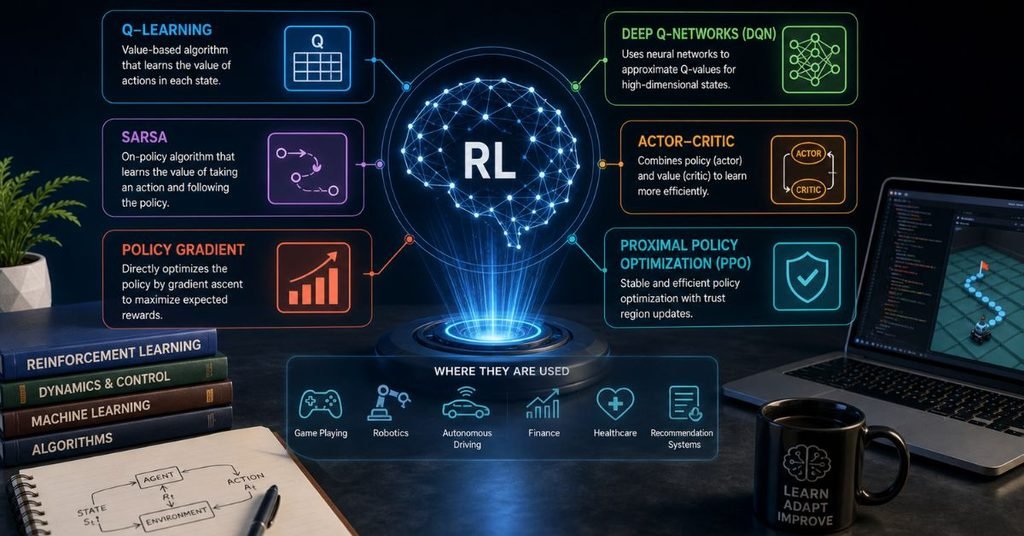
Different problems need different learning methods.
Q Learning
Q learning is useful for understanding the basic idea behind action values. It works especially well for smaller problems with manageable state and action spaces.
Deep Q Networks
DQN extends value-based learning with neural networks. It can handle much larger input spaces than a simple Q table.
PPO
Proximal Policy Optimization is a popular policy learning method used in many practical and simulated environments.
Actor Critic Methods
Actor-critic approaches combine ideas from policy learning and value estimation. They are useful for more complex decision problems.
For beginners, it is better to understand the decision loop first and then learn algorithms one at a time.
A Simple Practical Example: Training a Delivery Robot
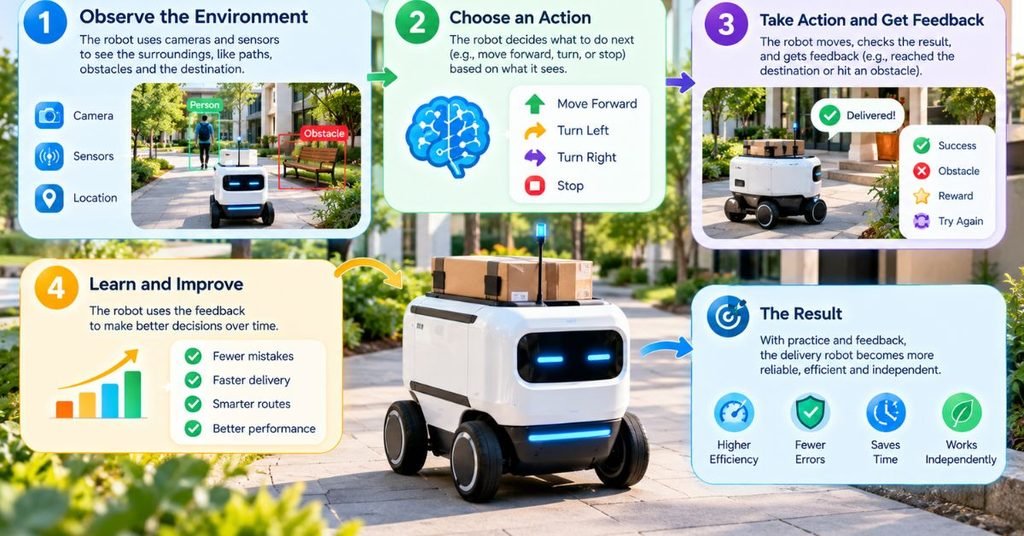
Consider a small warehouse with a robot that needs to deliver packages.
The robot starts at a charging station. Several package locations exist around the warehouse.
The state can include:
- Robot position
- Target position
- Battery level
- Nearby obstacles
- Current route information
The robot can choose actions such as moving forward, turning left, turning right, or stopping.
The reward can work like this:
- Successful delivery: strong positive reward
- Reaching the target: positive reward
- Short useful movement: small positive reward
- Collision: strong negative reward
- Unnecessary movement: small penalty
The robot then repeats the task.
At first, its behavior may look random. After enough training, it can learn routes that are safer and more efficient.
This example demonstrates why reward design matters. If the system rewards only speed, it may learn to move aggressively. If it rewards only safety, it may stop too often. A useful reward combines the outcomes that actually matter.
Real-Life Example and Practical Experience
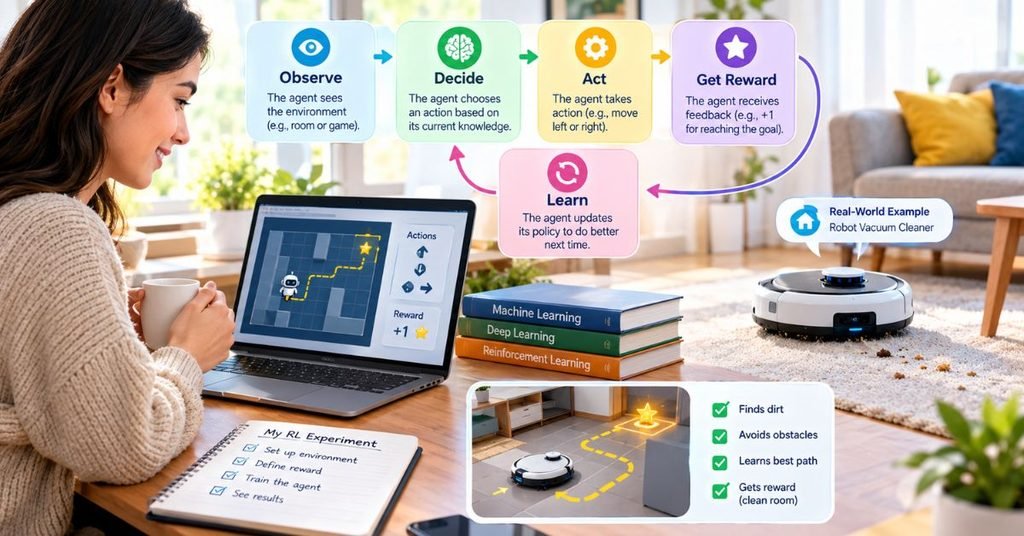
A practical way to understand RL is to begin with a simulator instead of a physical machine.
For example, a beginner can create a small grid-world where an agent must reach a target while avoiding obstacles. The first version can use a simple Q-table. Once the basic behavior works, the same problem can be moved into a Gymnasium environment and trained with a modern RL library.
This progression is useful because it separates two problems: understanding reinforcement learning and learning the software stack.
Modern tools such as Gymnasium and Stable-Baselines3 make it easier to experiment with standard environments and algorithms. Beginners can start with a small environment such as CartPole before attempting robotics or more complex simulations.
The practical lesson is simple: start small, measure the result, then increase complexity.
Common Mistakes in Reinforcement Learning
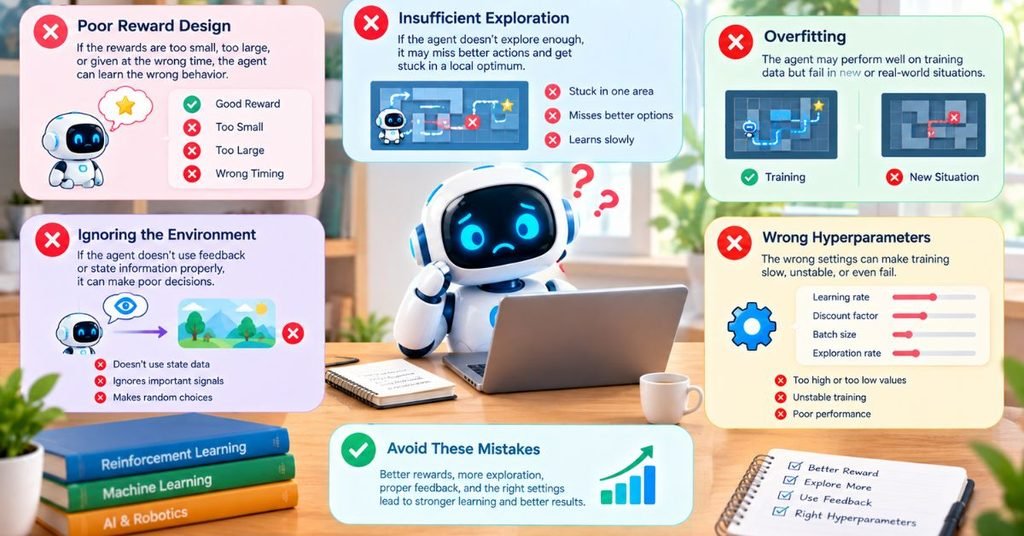
Mistake 1: Creating a Bad Reward Function
A reward that does not match the real goal can teach the agent unwanted behavior.
Always ask what behavior your reward encourages.
Mistake 2: Starting With a Huge Problem
Do not begin with autonomous driving, humanoid robots, or financial markets.
Start with a small environment where you can understand every part of the learning loop.
Mistake 3: Ignoring Exploration
If the agent always chooses its current best action, it may never discover better strategies.
Exploration needs to be controlled rather than removed.
Mistake 4: Using RL When a Simpler Method Works
Not every prediction or automation problem needs reinforcement learning.
If a fixed rule, classification model, regression model, or optimization method solves the problem reliably, it may be the better choice.
Mistake 5: Testing Only in Training
A model can perform well in familiar training conditions but fail when the environment changes.
Use separate evaluation scenarios and test unusual conditions.
Mistake 6: Ignoring Safety
Real-world RL can produce unexpected actions.
Use simulation, constraints, monitoring, fallback controls, and human oversight when the system affects physical equipment or important decisions.
E-E-A-T: What Makes an RL Guide Trustworthy?
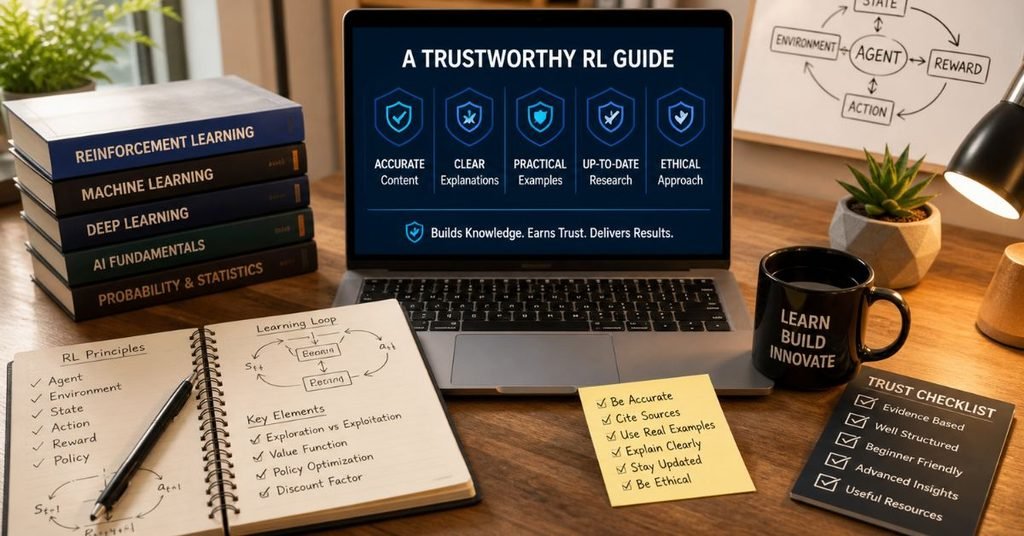
A useful technical guide should not simply list buzzwords.
It should explain how each concept works, show practical examples, identify limitations, and avoid claiming that RL is the answer to every AI problem.
For learners, the strongest approach is to connect theory with small experiments. Build a basic environment, define the reward, train an agent, evaluate it, and then change one part of the system at a time.
For professionals, evaluation should go further. Test performance, stability, cost, safety, generalization, and behavior under unusual conditions.
This practical mindset makes technical content more useful because readers can understand not only what reinforcement learning can do, but also when it should not be used.
Author Note
This guide is written to make reinforcement learning easier to understand without hiding the important technical ideas.
If you are new to RL, do not try to memorize every algorithm at once. First understand the agent, environment, state, action, reward, and policy. Then build a tiny project and observe how the agent changes through training.
Once that foundation is clear, algorithms such as Q learning, DQN, PPO, and actor critic methods become much easier to understand.
Disclaimer
This article is provided for educational and informational purposes only. Reinforcement learning systems can behave unpredictably, especially when they interact with real world environments. Examples involving healthcare, finance, autonomous systems, transportation, or industrial equipment should not be treated as professional, medical, financial, engineering, or safety advice.
Always test AI systems in suitable controlled environments and use qualified professionals where real world risks are involved.
Conclusion
The most useful reinforcement learning examples are not simply lists of famous AI projects. They show a repeatable decision pattern: an agent observes a state, takes an action, receives feedback, and improves its future choices. That pattern can appear in games, robotics, traffic systems, recommendations, energy management, logistics, industrial automation, and navigation.
If you want to learn reinforcement learning, start with a small simulated problem. Define a clear goal, create simple states and actions, design a meaningful reward, train the agent, and evaluate the result. Once you understand that loop, you can move toward larger environments and more advanced algorithms with much more confidence.
FAQs
1. What are reinforcement learning examples?
Reinforcement learning examples include game playing AI, robot control, recommendation systems, traffic optimization, warehouse robots, energy management, autonomous navigation, and simulated industrial control. These systems learn decisions through interaction and feedback.
2. What is a simple example of reinforcement learning?
A simple example is a robot learning to reach a target in a grid. Moving closer to the target earns a positive reward, while hitting an obstacle creates a penalty. After many attempts, the robot learns a better route.
3. What Are the Practical Applications of Reinforcement Learning?
RL can be used in areas such as robotics, gaming, logistics, recommendation systems, energy optimization, traffic management, industrial automation, and autonomous navigation. The suitability depends on whether the problem requires repeated decisions and measurable feedback.
4. What is the difference between reinforcement learning and supervised learning?
Supervised learning normally learns from labeled examples where the expected answer is known. Reinforcement learning learns through interaction, where the system receives feedback about the quality of its actions.
5. Is reinforcement learning difficult to learn?
The basic concept is not difficult, but advanced RL can become mathematically and technically challenging. Beginners should start with small environments and simple algorithms before moving to deep reinforcement learning.
6. What are common reinforcement learning algorithms?
Common approaches include Q learning, Deep Q Networks, PPO, actor critic methods, and other value based or policy based algorithms. The right method depends on the environment, action space, observations, and training goal.
7. Can beginners practice reinforcement learning with Python?
Yes. Beginners can use Python with environments such as Gymnasium and libraries such as Stable Baselines3. Starting with a small environment makes it easier to understand training, rewards, actions, and evaluation before moving to complex projects.