


Advanced Protection Technologies are becoming essential for organizations facing increasingly sophisticated cyber threats. Traditional security solutions can no longer keep pace with modern ransomware, phishing attacks, and AI-driven malware. This guide explains how Advanced Protection Technologies help businesses detect, prevent, and respond to cyber risks in real time.
In an increasingly hostile digital environment, businesses need to transform their approach to cybersecurity and risk management.This is where advanced protection technologies come into play. These systems do not just wait for a known virus signature to trigger an alert. Instead, they constantly analyze behavior, predict hacker movements, and isolate threats in milliseconds. Whether you are safeguarding sensitive patient files or protecting an e-commerce platform from a crippling outage, these tools provide the continuous, adaptive shield needed to stay ahead of fast-evolving threat actors.
Picture this: You lock your front door, turn on the porch light, and head to bed feeling entirely safe. But outside, a thief isn’t trying to pick your lock they are using a cloaking device, cloning your biometric digital key, or tricking your house into thinking they belong there. Traditional cybersecurity like basic antivirus and standard firewalls are that simple front door lock. They work against yesterday’s predictable neighborhood burglars, but modern cybercriminals use stealthy, automated scripts that slip past standard defenses without ringing a single alarm.
Quick Summary: Advanced Protection Technologies at a Glance
| Aspect | Summary |
| What Are They? | Next generation cybersecurity tools using AI, automation, and behavioral analysis to predict and stop sophisticated cyber threats in real time. |
| Why They Matter | Legacy systems fail against modern polymorphing malware and coordinated ransomware attacks. |
| Main Benefits | Instant threat containment, reduced human error, deep visibility across networks, and minimized downtime. |
| Industries Using Them | Healthcare, Finance, Government, E-commerce, Higher Education, and Smart Manufacturing. |
| Biggest Challenge | Managing high volumes of alerts and integrating new platforms with older, legacy software. |
| Future Outlook | Deeply automated self healing networks driven by predictive AI and quantum-resistant encryption. |
What Are Advanced Protection Technologies?

At its core, the term refers to an integrated ecosystem of security tools that look beyond static, signature based rules. Traditional antivirus programs operate like a digital.No Fly List if a virus’s unique signature isn’t on the list, it flies right through. Advanced protection systems focus instead on intent and behavior.
Core Components
An advanced defense framework links your endpoints (laptops, mobile devices), cloud environments, and internal networks into a single, cohesive brain. Instead of keeping security data in isolated silos, it shares data instantly across your entire digital footprint.
How They Work
These systems monitor the daily habits of your network. They establish a baseline of what normal behavior looks like for your users and devices. If an account suddenly attempts to download 4,000 files at 3:00 AM from an unrecognized IP address, the system identifies the anomaly, flags the threat, and locks down the account automatically.
Main Technologies Behind Them
This modern security architecture relies on three primary pillars:
- Predictive Analytics: Forecasting where vulnerabilities lie before they are exploited.
- Automated Orchestration: Allowing software to isolate an infected laptop instantly without waiting for a human technician to wake up.
- Centralized Telemetry: Gathering rich security data from every corner of the enterprise to spot subtle, distributed attack patterns.
Why Advanced Protection Technologies Are Important
The digital playground has changed, and the stakes have never been higher. Relying on basic security tools today is a massive operational risk.
Rising Cyber Threats
Cybercriminals now operate like well-funded corporations. They use automated bots to probe thousands of corporate networks simultaneously, looking for a single unpatched vulnerability. Ransomware as a Service (RaaS) allows even low skilled attackers to buy devastating malware off the shelf.
Data Security Challenges
Data is no longer locked safely inside an office building. It lives on personal laptops, public cloud applications, and mobile devices worldwide. Protecting this scattered data requires security that follows the data wherever it travels, rather than just guarding the office perimeter.
Business Continuity
A major cyberattack is not just an IT headache; it is an existential threat to your operations. When systems go offline, factories stop running, sales halt, and customer trust evaporates. Advanced cyber protection acts as an operational insurance policy, keeping your digital doors open even during an active attack.
Risk Reduction
By replacing manual security checks with rapid, automated detection, organizations significantly reduce their dwell time the amount of time a hacker sneaks around inside a network unnoticed before launching an attack.
Types of Advanced Protection Technologies
Modern enterprise security requires an interconnected defense in depth model. Here are the core layers driving modern intelligent security technologies:
Artificial Intelligence Security & Machine Learning Protection
AI and Machine Learning (ML) form the brain of modern defense. These algorithms ingest billions of data points from global threat feeds to learn attacker tactics. This allows the system to recognize a bran new strain of ransomware based on its behavior like unauthorized background file encryption even if that specific virus version has never been seen before.
Behavioral Analytics
Instead of checking what a file is, behavioral analytics watches what the file does. If a harmless-looking PDF document suddenly tries to modify core system registry files or open a hidden command terminal, behavioral monitors flag and terminate the process immediately.
Cloud Security
As applications shift to platforms like AWS, Azure, and Google Cloud, traditional perimeter defenses become obsolete. Cloud security posture management tools continuously scan cloud environments for misconfigurations, exposed databases, and unsecured access points.
Endpoint Protection
Modern Endpoint Detection and Response (EDR) goes far beyond old-school antivirus. It sits directly on user laptops, servers, and smartphones, acting as a flight data recorder. It continuously tracks system activity, giving security teams the power to isolate compromised devices from the network with a single click.
Identity and Access Management (IAM)
Identity is the new perimeter. Advanced IAM systems use contextual clues to grant access. For example, if you log in from your office in Chicago, and then try to log in from Berlin 20 minutes later, the system detects the impossible travel time and demands multi factor authentication (MFA) step ups or blocks access entirely.
Zero Trust Security
The foundational rule of Zero Trust is simple: Never trust, always verify. Traditional networks assumed anyone inside the corporate Wi-Fi was safe. Zero Trust treats every user and device as hostile until proven otherwise, continuously validating permissions at every single step of a digital session.
Key Benefits of Advanced Protection Technologies
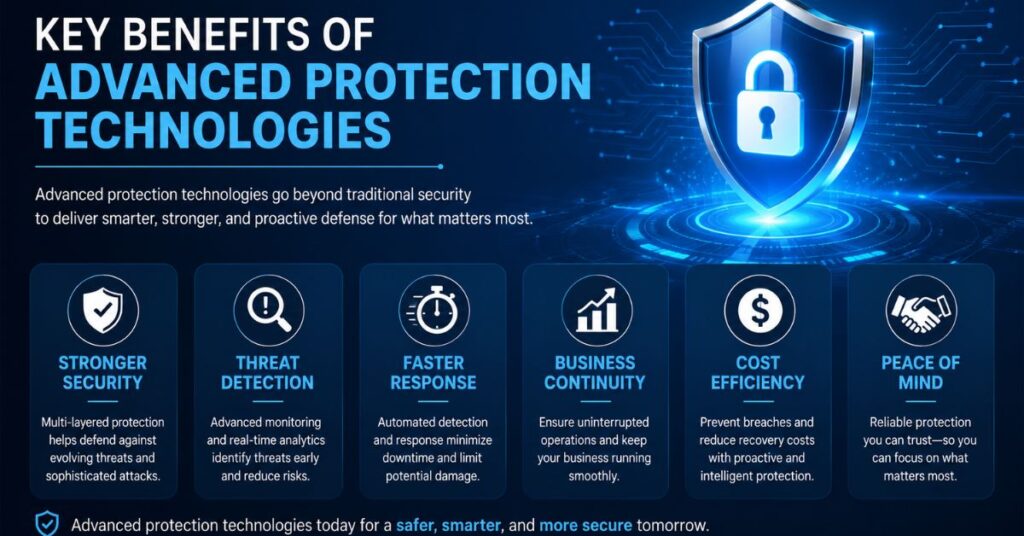
- Real-Time Threat Detection: Traditional systems might tell you that you were hacked yesterday. Advanced systems catch the hacker as they try to open the digital window.
- Proactive Vulnerability Management: These tools act like a continuous home inspection, finding structural weaknesses, unpatched software, and configuration blind spots before bad actors do.
- Reduced Mitigation Costs: Cleaning up a massive data breach can cost millions in fines, forensic teams, and public relations damage. Catching an intrusion early keeps remediation costs to a minimum.
- Automated Incident Response: When a threat is identified, automation handles the fast-moving triage work isolating malware, blocking malicious traffic, and rolling back altered files saving precious minutes.
Multimedia Implementation Suggestions
To maximize audience engagement and simplify these technical concepts, consider integrating the following visual resources into your layout:
- Protection Layer Illustration: A visual diagram showing a user at the center, surrounded by concentric rings representing Endpoint Protection, Identity/IAM, Cloud Security, and Behavioral AI layers.
- Security Workflow Diagram: A flowchart contrasting the slow timeline of a manual security response against the instant timeline of an automated, AI-driven reaction.
- Interactive Security Checklist: A simple clickable self assessment module embedded in your page allowing businesses to track their transition from legacy to advanced defense models.
Comparing Core Security Infrastructures
| Technology | Purpose | Advantages | Best For | Challenges |
| Endpoint Detection & Response (EDR) | Monitors and protects individual devices like laptops and servers. | Deep visibility into device activity; isolates threats instantly at the source. | Remote workforces and distributed devices. | Requires lightweight agent software installed on every single device. |
| Zero Trust Architecture | Eliminates implicit trust; strictly verifies every access request. | Prevents hackers from moving sideways through your network if they compromise one account. | Hybrid cloud networks and third party vendor access. | Complex initial setup and cultural adjustment for users. |
| Cloud Security Posture (CSPM) | Scans cloud environments for misconfigurations and vulnerabilities. | Automated compliance checks; flags exposed databases in real time. | Multi-cloud infrastructures (AWS, Azure, Google Cloud). | Can generate high volumes of alerts if not tuned properly. |
| AI Behavioral Analytics | Analyzes network patterns to spot strange user or application behavior. | Catches zero day (unlisted) attacks based purely on malicious intent. | Detecting stealthy insider threats and stolen credentials. | Requires a baseline learning period to avoid false alarms. |
Common Mistakes Businesses Make with Advanced Protection Technologies
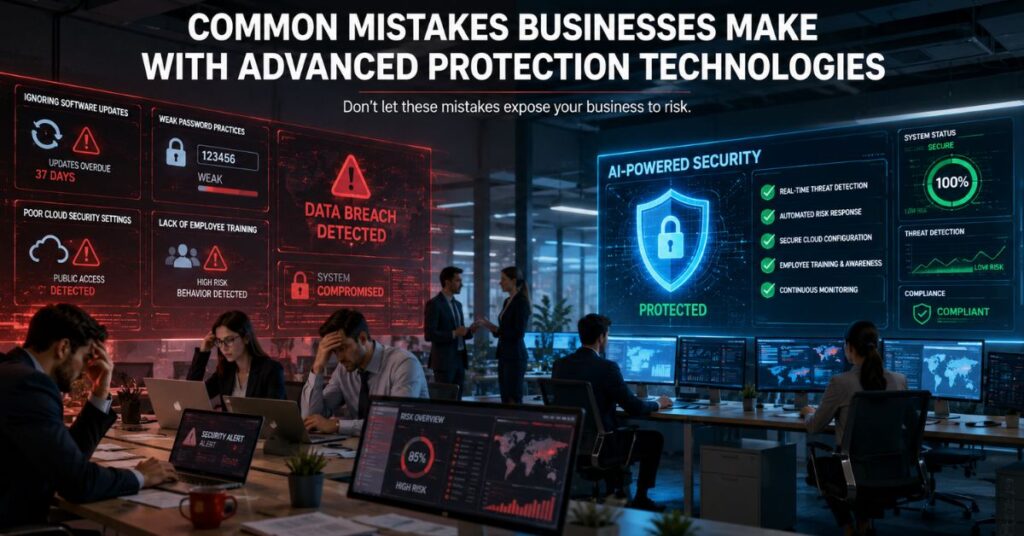
- Treating AI as a “Set It and Forget It” Tool: AI is incredibly powerful, but it still requires human analysts to tune its parameters, investigate nuanced alerts, and adjust policies.
- Neglecting Regular Employee Training: The most advanced defense system in the world cannot save you if an executive bypasses alerts to open a malicious attachment. Technology and human training must go hand-in-hand.
- Ignoring Legacy System Integration: Buying shiny new cloud security tools without connecting them to your older, core legacy databases creates a dangerous blind spot.
- Overlooking Vendor Risk Management: You might have ironclad security, but if your third-party billing vendor has weak access controls, hackers can use them as a backdoor into your systems.
- Chasing Compliance Instead of Security: Passing a basic security audit does not mean your organization is safe. Compliance is a bare minimum floor; active protection is the actual ceiling.
- Failing to Test Response Plans: Having an automated response playbook looks great on paper. If your team has never run a simulated live-fire drill, confusion will slow down your response during a real crisis.
How to Choose the Right Advanced Protection Technology
Selecting the right platform requires a balanced look at your unique business architecture.
[Assess Budget & ROI] ➔ [Evaluate Scalability] ➔ [Verify Integration Capabilities] ➔ [Prioritize User Experience] ➔ [Check Vendor Reputation]
- Budget & Actual ROI: Look past the initial subscription cost. Evaluate how much money the platform saves you by consolidating multiple old tools and reducing hours spent manual-hunting for threats.
- Scalability: Ensure the security platform grows with you. It should easily handle new cloud workloads, additional remote employees, and global offices without requiring a complete redesign.
- Integration Capabilities: Avoid adding another isolated tool. Choose open platforms that feature robust APIs to share threat intelligence smoothly with your existing IT software ecosystem.
- Ease of Use & Dashboard Clarity: If a security platform is overly complicated, your IT team will create workarounds or miss critical warnings amid thousands of confusing menus. Clear dashboards save lives.
- Vendor Reputation & Support: Research real-world reviews, third-party laboratory tests, and the vendor’s track record for patching vulnerabilities in their own products.
The Future of Advanced Protection Technologies
Looking ahead, cybersecurity is turning into a battle of algorithm versus algorithm. As attackers begin utilizing generative AI to create highly customized phishing scams and mutating malware, our defense frameworks must evolve just as quickly.
We are shifting toward predictive security models that patch software bugs automatically before developers even publish the vulnerability. Real-time threat detection will soon operate entirely on the edge, meaning individual devices will neutralize complex attacks locally without needing to check in with a central server. Furthermore, as quantum computing draws closer to reality, advanced security vendors are already testing quantum-resistant encryption algorithms to secure data long into the future.
Real-Life Example: Advanced Protection Technologies Stopping a Ransomware Crisis

Consider the experience of a mid sized regional logistics provider handling hundreds of shipping routes daily. The company relied on a traditional firewall and standard endpoint antivirus protection.
During a holiday weekend, an employee fell victim to a highly targeted phishing email. The email downloaded an advanced, fileless ransomware script that slipped right past their signature-based antivirus. Once inside, the script spent hours silently mapping out the network, looking for the main backup servers.
Fortunately, the company’s IT director had deployed a modern Endpoint Detection and Response (EDR) tool alongside an AI-driven behavioral monitoring system just three weeks prior.
[Malicious Script Executes] ➔ [AI Detects High-Speed Encryption Attempt] ➔ [EDR Isolates Laptop Instantly] ➔ [Logistics Network Saves Millions]
As the ransomware began its high-speed encryption routine on the employee’s laptop, the behavioral engine recognized the rapid, abnormal file modifications. Within 40 milliseconds, the system automatically flagged the activity, terminated the malicious process, and completely isolated the laptop from the company network.
While the individual employee’s laptop required a clean re-image, the rest of the company’s network, servers, and supply chain applications remained completely untouched. The advanced protection platform turned what could have been a multi million dollar business shutdown into a minor Monday morning IT ticket.
Author Note
Over my years analyzing security infrastructures, I have watched the cybersecurity landscape transition from a game of cat and mouse into a highstakes digital arms race. Hackers no longer target specific systems manually; they deploy automated code designed to find and exploit weaknesses at scale. Understanding and adopting advanced protection technologies is no longer a luxury reserved for multi billion dollar tech companies. Today, it is a foundational survival requirement for any organization that values its operational integrity, its data, and its customer trust.
Disclaimer
This content is provided solely for educational and informational purposes. Technology needs and compliance landscapes vary significantly by organization. Readers should thoroughly evaluate individual software solutions according to their unique security requirements and consult qualified cybersecurity professionals before making major architecture or purchasing decisions.
Conclusion
The digital transformation era brings incredible efficiency, but it also opens up new paths for exploitation. Relying entirely on traditional, reactive tools like basic firewalls leaves your organization exposed to modern automated cyber threats. Advanced protection technologies give your IT teams the continuous visibility, behavioral analysis, and automated speed necessary to intercept attacks before they disrupt your business operations.
Protecting your enterprise is a continuous journey, not a final destination. By investing in smart, adaptable defense platforms and building a strong organizational culture around security you protect your proprietary data, maintain operational uptime, and secure your long-term business growth.
FAQs
What are advanced protection technologies?
They are a next generation ecosystem of cybersecurity tools that use artificial intelligence, machine learning, and automated behavioral analytics to find, isolate, and neutralize complex cyberattacks in real time.
How do they improve cybersecurity?
Unlike older software that only flags threats matched to a list of known viruses, advanced systems analyze active behavior. This allows them to spot brand new attack techniques, insider threats, and compromised user accounts before damage occurs.
Are they expensive to implement?
While the upfront software subscription costs are typically higher than basic antivirus tools, they save companies massive amounts of money over time by avoiding costly data breaches, preventing operational downtime, and consolidating multiple outdated platforms.
Which industries use them most?
Any industry handling sensitive data or relying heavily on constant uptime uses them. This includes healthcare, banking, government agencies, e-commerce networks, higher education institutions, and automated manufacturing.
Are they suitable for small businesses?
Yes. Modern cybercriminals target small businesses frequently because they assume their defenses are weak. Many advanced vendors now offer scaled down, cloud hosted security solutions tailored specifically for smaller IT budgets.
What is the future of these technologies?
The future focuses heavily on autonomous, self-healing networks. Security systems will leverage predictive AI to patch flaws before hackers exploit them, along with advanced cryptography designed to withstand quantum computing threats.
How do I choose the right solution for my business?
Start by analyzing your specific network vulnerabilities and compliance needs. Look for a platform that integrates smoothly with your current software tools, scales effortlessly as you grow, and provides a clear, understandable dashboard for your internal team.