


Palantir Technologies competitors are gaining significant attention as businesses look for powerful alternatives in artificial intelligence, big data analytics, and enterprise intelligence platforms. While Palantir remains a major player in the industry, several companies now offer advanced analytics, cloud-based data solutions, machine learning capabilities, and AI-powered business intelligence tools.
Organizations, investors, and technology professionals often compare these platforms to determine which solution best meets their operational and strategic needs. Understanding the strengths and weaknesses of different competitors can help businesses make more informed technology decisions.
In this guide, we will explore the leading Palantir Technologies competitors, compare their key features, examine real world use cases, and help you identify the best alternative for your specific requirements.
What Is Palantir Technologies?

Palantir Technologies is a software company that specializes in data integration, artificial intelligence, and analytics solutions. The company is best known for platforms such as Gotham, Foundry, Apollo, and its growing Artificial Intelligence Platform (AIP).
Organizations use Palantir to collect information from multiple sources, organize complex datasets, and generate actionable insights. This capability has made the company popular among government agencies, defense organizations, healthcare providers, financial institutions, and large enterprises.
As demand for AI-powered decision making tools continues to increase, many organizations are also exploring Palantir Technologies competitors that offer similar capabilities at different price points and deployment models.
Why Has Palantir Become So Popular?
Several factors have contributed to Palantir’s growth:
- Advanced AI-powered analytics
- Strong government contracts
- Large scale data integration
- Enterprise intelligence capabilities
- Secure infrastructure
- Growing commercial business segment
Despite these advantages, businesses often compare Palantir with other technology providers before making long term investments.
Why Businesses Look for Palantir Technologies Competitors
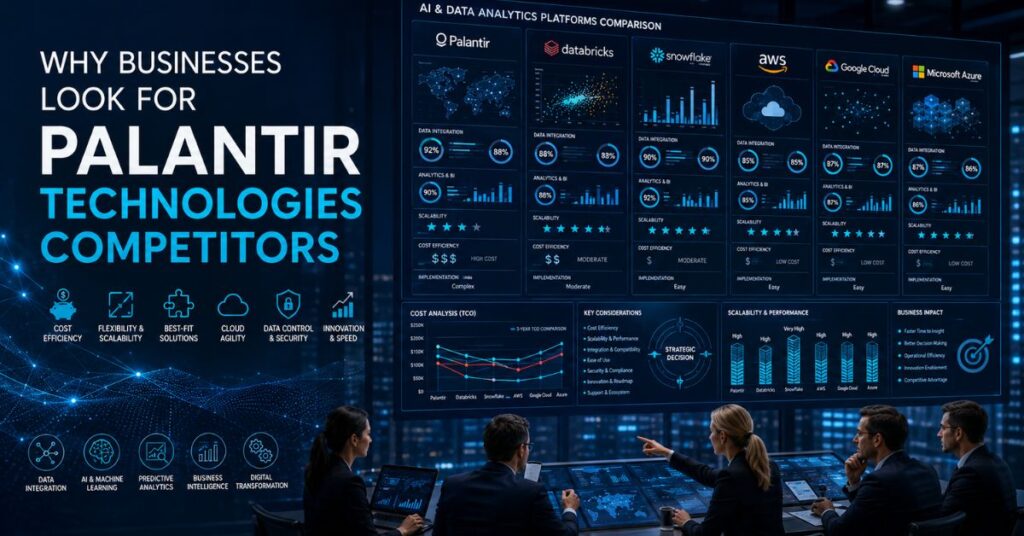
Companies search for alternatives for several reasons. While Palantir provides powerful solutions, it may not be the perfect fit for every organization.
Cost Considerations
Many organizations, especially mid sized businesses, look for platforms that provide similar analytics capabilities with lower implementation costs.
Different Deployment Needs
Some businesses prefer cloud native solutions that can be deployed quickly without extensive customization.
Industry Specific Requirements
Healthcare, finance, manufacturing, and retail companies often need specialized features that certain competitors provide more effectively.
Vendor Diversification
Large enterprises frequently avoid depending on a single technology vendor and evaluate multiple options before selecting a platform.
Top Palantir Technologies Competitors
The enterprise analytics market has become highly competitive. Below are the companies most frequently compared with Palantir.
Databricks
Databricks has emerged as one of the strongest competitors in the data and AI market.
Key Strengths
- Unified data analytics platform
- Strong machine learning capabilities
- Lakehouse architecture
- Scalable cloud infrastructure
- Popular among data scientists
Databricks helps organizations process large datasets while building AI and machine learning applications on a single platform.
Best For
Businesses that require advanced data engineering and machine learning workflows.
Snowflake
Snowflake has transformed cloud data warehousing and enterprise analytics.
Key Strengths
- Cloud native architecture
- Multi cloud support
- Fast performance
- Easy scalability
- Strong data sharing capabilities
Snowflake focuses on helping organizations store, manage, and analyze large amounts of information across multiple cloud environments.
Best For
Companies seeking flexible cloud-based analytics without extensive infrastructure management.
Microsoft Fabric
Microsoft Fabric is becoming an increasingly important competitor due to Microsoft’s ecosystem.
Key Strengths
- Integration with Microsoft products
- AI-powered analytics
- Centralized data management
- Built-in business intelligence
- Enterprise-grade security
Organizations already using Microsoft services often find Fabric attractive because it simplifies data management and reporting.
Best For
Businesses invested in the Microsoft ecosystem.
Oracle Analytics Cloud
Oracle continues to compete aggressively in enterprise analytics.
Key Strengths
- Advanced reporting tools
- AI-driven insights
- Enterprise integration
- Strong database capabilities
- Scalable architecture
Oracle Analytics Cloud helps organizations turn large datasets into meaningful business intelligence.
Best For
Large enterprises with existing Oracle infrastructure.
Palantir vs Competitors Comparison Table
| Feature | Palantir | Databricks | Snowflake | Microsoft Fabric | Oracle Analytics |
| AI Integration | Excellent | Excellent | Very Good | Excellent | Very Good |
| Data Analytics | Excellent | Excellent | Very Good | Very Good | Very Good |
| Cloud Support | Strong | Strong | Excellent | Excellent | Strong |
| Enterprise Adoption | High | High | High | Growing Fast | High |
| Government Usage | Excellent | Limited | Limited | Moderate | Moderate |
| Scalability | Excellent | Excellent | Excellent | Excellent | Strong |
| Ease of Use | Moderate | Moderate | Good | Good | Moderate |
Real-Life Example
A global manufacturing company may use Palantir to combine supply chain, production, and logistics data into a single intelligence platform.
Meanwhile, another company with a strong cloud strategy may choose Snowflake because it offers easier cloud integration and lower operational complexity.
This example shows that the best solution often depends on business goals rather than brand popularity alone.
IBM Watsonx
IBM has expanded its artificial intelligence portfolio through Watson, making it one of the most notable Palantir Technologies competitors.
Watsonx combines AI development, machine learning, data management, and governance tools into a single ecosystem. Many enterprises choose IBM because of its long history in the technology sector and its focus on responsible AI.
Key Strengths of IBM Watsonx
- Enterprise grade AI solutions
- Strong governance and compliance tools
- Advanced machine learning capabilities
- Hybrid cloud support
- Trusted enterprise reputation
Best For
Large organizations that need strong AI governance, compliance controls, and enterprise-level security.
C3 AI
C3 AI focuses on enterprise artificial intelligence applications across multiple industries. The company provides AI-driven solutions for manufacturing, energy, defense, healthcare, and financial services.
Unlike some competitors that mainly focus on data storage and analytics, C3 AI emphasizes predictive insights and operational intelligence.
Key Strengths of C3 AI
- Industry specific AI applications
- Predictive analytics
- Operational intelligence
- Enterprise scale deployment
- Strong government and defense presence
Best For
Organizations looking for ready made AI applications rather than building custom systems from scratch.
Leidos
Leidos is a major technology and defense contractor that competes with Palantir in government and defense related projects.
The company provides data analytics, cybersecurity, intelligence solutions, and digital modernization services for government agencies and military organizations.
Key Strengths of Leidos
- Strong defense sector expertise
- Government contracts
- Cybersecurity capabilities
- Advanced intelligence systems
- Long-term public sector experience
Best For
Government agencies and defense organizations require secure intelligence solutions.
MongoDB Atlas
MongoDB Atlas may not directly mirror every Palantir feature, but it has become an important player in modern data infrastructure.
Its cloud database platform helps businesses manage large volumes of structured and unstructured data while supporting modern application development.
Key Strengths of MongoDB Atlas
- Flexible database architecture
- Cloud native deployment
- Easy scalability
- Developer-friendly ecosystem
- Real-time data processing
Best For
Organizations building modern applications that require flexible and scalable data management.
Which Palantir Competitor Is Best for Your Business?

Choosing among Palantir Technologies competitors depends on your organization’s goals, budget, and technical requirements.
When Palantir Is the Right Choice:
- Advanced intelligence and analytics are essential for your operations.
- Highly complex datasets need to be processed and analyzed.
- Strong security standards are a top concern.
- Government-grade capabilities are necessary.
Best Situations for Using Databricks:
- Data science plays a major role in your organization.
- Machine learning initiatives are a key priority.
- A modern data lakehouse architecture is required.
Where Snowflake Performs Best:
- Cloud scalability is important for future growth.
- Simple and efficient data sharing is needed.
- Quick deployment is a priority.
Choose Microsoft Fabric If:
- Existing workflows rely heavily on Microsoft products.
- Integrated business intelligence tools are required.
- A unified analytics environment would benefit your team.
Choose IBM Watsonx If:
- AI governance is a critical requirement.
- Strict compliance standards must be maintained.
- Enterprise level security is a primary concern.
Common Mistakes When Choosing a Data Analytics Platform
Many organizations focus only on features and ignore other important factors. This often leads to expensive implementation problems later.
Mistake #1: Ignoring Total Cost
Some platforms appear affordable initially but become costly after implementation, training, and maintenance expenses.
Mistake #2: Choosing Based on Brand Name Alone
A popular platform is not always the best solution for every business.
Mistake #3: Ignoring Scalability
Organizations should consider future growth before selecting a platform.
Mistake #4: Underestimating Employee Training
Advanced analytics tools often require significant staff training.
Mistake #5: Not Defining Business Goals
Without clear objectives, companies struggle to measure success and ROI.
Expert Opinion: The Future of Enterprise AI Platforms

The enterprise analytics industry is evolving rapidly. Artificial intelligence is becoming the foundation of modern decision-making systems.
Over the next few years, competition among Palantir Technologies competitors will likely focus on:
- Generative AI integration
- Real time analytics
- Autonomous decision systems
- Improved data governance
- Industry specific AI solutions
- Lower implementation costs
Organizations that successfully combine AI, analytics, and secure data management will have a significant competitive advantage.
Real-World Experience
While researching enterprise analytics platforms, one common trend becomes clear: businesses rarely select a platform solely because it is the most powerful.
Instead, successful organizations choose solutions that match their workflows, technical capabilities, and long term objectives.
For example, a government agency handling sensitive intelligence data may prefer Palantir because of its security and integration capabilities. On the other hand, a growing technology startup may choose Snowflake or Databricks because of flexibility and lower operational complexity.
This demonstrates that the best platform is not necessarily the most expensive or most famous one. The best platform is the one that solves specific business challenges effectively.
Author Note
This guide was created after analyzing the current enterprise analytics and artificial intelligence landscape. The goal is to help readers understand how Palantir compares with other leading platforms in the market.
Technology changes rapidly, and organizations should always evaluate the latest features, pricing structures, and deployment options before making investment decisions.
Disclaimer
This publication is meant for informational and learning purposes only and should not be considered professional guidance.It should not be considered financial, investment, legal, or business advice. Readers should conduct independent research and consult qualified professionals before making technology purchasing or investment decisions.
Conclusion
Palantir remains one of the most influential companies in the data analytics and artificial intelligence industry. Its platforms help organizations transform complex data into actionable intelligence, making it a preferred choice for governments and large enterprises worldwide.
However, the market has become increasingly competitive. Databricks, Snowflake, Microsoft Fabric, IBM Watson, C3 AI, Leidos, Oracle Analytics Cloud, and MongoDB Atlas each offer unique strengths that appeal to different types of organizations. Understanding these alternatives helps businesses choose the platform that best aligns with their goals, budget, and technical requirements.
As demand for AI-powered platforms rises, companies competing with Palantir are expected to accelerate innovation and growth.Organizations that carefully evaluate their needs and select the right platform will be better positioned to gain value from their data and stay ahead in an increasingly data driven world.
Frequently Asked Questions
Who is Palantir’s biggest competitor?
Databricks and Snowflake are often considered Palantir’s strongest competitors because they offer advanced data analytics and AI capabilities for enterprise customers.
Is Snowflake better than Palantir?
Neither platform is universally better. Snowflake excels in cloud data management, while Palantir focuses more on intelligence, analytics, and operational decision making.
Does Microsoft compete with Palantir?
Yes. Microsoft Fabric and other Microsoft analytics solutions compete with Palantir in enterprise data and AI markets.
What industries use Palantir?
Palantir serves government, defense, healthcare, manufacturing, finance, energy, and logistics industries.
Is Databricks a direct competitor to Palantir?
Yes. Databricks competes with Palantir in AI, machine learning, data analytics, and large-scale data processing.
Why do companies look for Palantir alternatives?
Organizations may seek alternatives because of cost considerations, deployment preferences, cloud requirements, or industry-specific needs.
Which Palantir competitor is best for small businesses?
Many smaller organizations prefer Snowflake or Microsoft Fabric because of easier deployment and cloud based flexibility.