

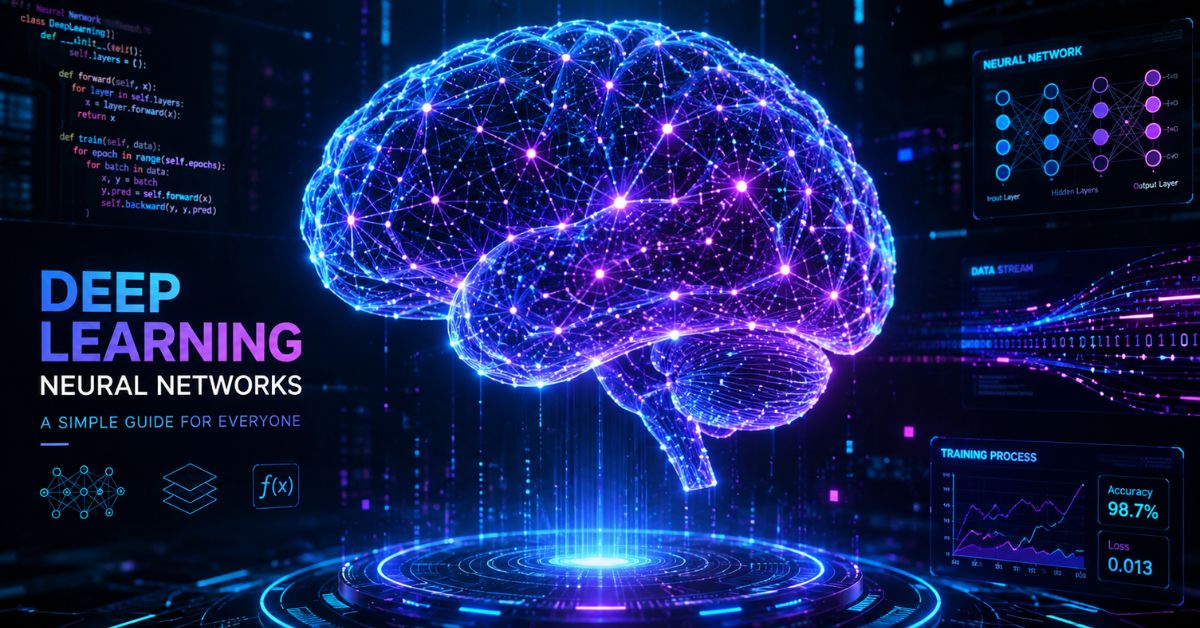
Deep learning neural networks represent a powerful branch of artificial intelligence that mimics the human brain. These systems use layers of interconnected nodes to process complex data patterns.
Most modern technology, from voice assistants to self driving cars, relies heavily on deep learning neural networks to function accurately. When you provide data to these networks, they learn to identify features without human intervention. This capability makes them superior to traditional machine learning for tasks involving massive datasets.
Experts design deep learning neural networks to solve problems that are too difficult for standard computer programs. For example, recognizing a face in a crowded photo requires analyzing millions of pixels. Deep learning neural networks break down this task into smaller steps across multiple layers.
Each layer focuses on a specific detail, like edges, shapes, or textures. By the time the data reaches the final layer, the network can make a highly accurate prediction. This process ensures that AI systems become smarter the more data they consume.
| Feature | Description |
| Brain Mimicry | Uses neurons and synapses logic. |
| Layered Structure | Consists of Input, Hidden, and Output layers. |
| Data Type | Works best with unstructured data like images and audio. |
| Learning Style | Self-adjusts through a process called backpropagation. |
The Core Structure of Deep Learning Neural Networks
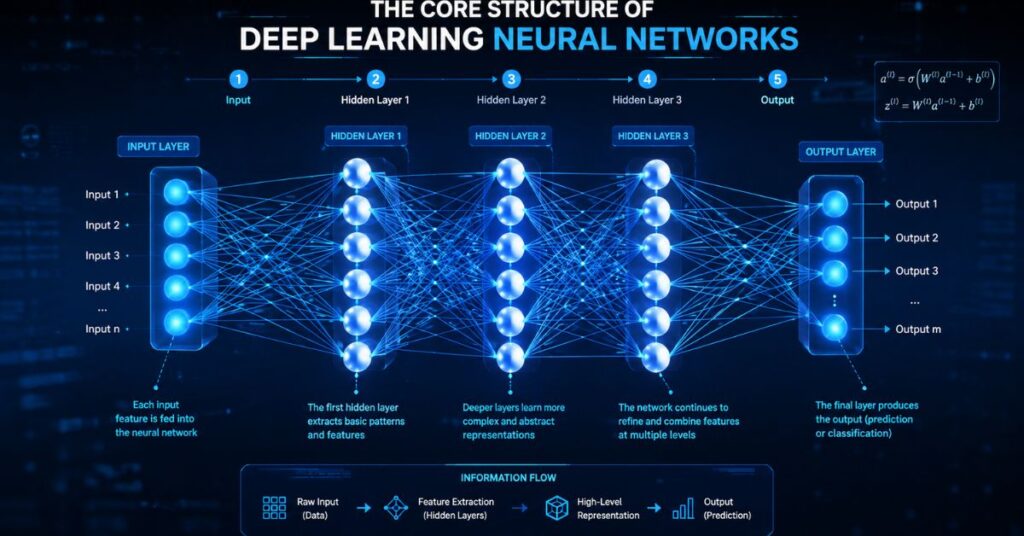
When we look at the architecture of deep learning neural networks, we see a complex but organized system. Every network starts with an input layer where the raw data enters the system. From there, the data moves through several hidden layers.These hidden layers are the deep part of deep learning neural networks.
Each layer contains mathematical functions that weight the importance of different data points. If a specific piece of information helps reach the correct answer, the network increases its weight. This constant adjustment allows the system to learn from its own successes and failures.
In deep learning neural networks, the nodes or neurons communicate by sending signals to one another. Each signal has a numerical value. If the sum of the signals exceeds a certain threshold, the neuron activates and passes information to the next layer. This flow is called forward propagation.
To improve accuracy, the network compares its final output to the actual correct answer. It then sends an error signal back through the layers to fix the weights. This feedback loop is essential for the growth of neural network systems.Without it, the machine would never learn from its mistakes.
Key Components of the Architecture
- Input Layer: This is the entry point for all raw data like text or pixels.
- Weights and Biases: These are the internal knobs the network turns to improve accuracy.
- Activation Functions: These decide if a neuron should fire based on the input it receives.
- Hidden Layers: These layers perform the heavy lifting of feature extraction and analysis.
- Output Layer: This layer provides the final decision or classification result.
- Loss Function: This calculates how far the prediction was from the actual truth.
How Deep Learning Neural Networks Process Data
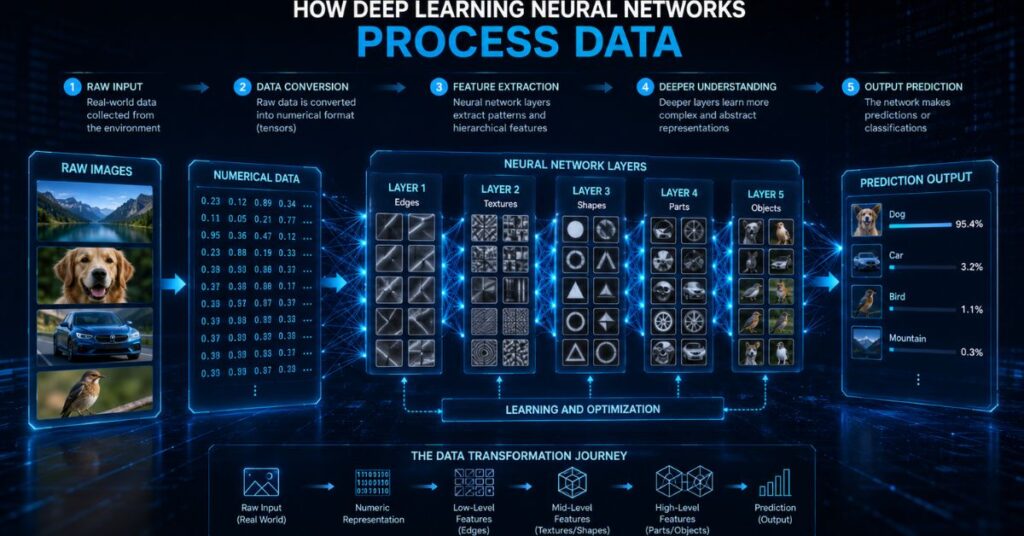
The way neural network systems handle information is truly fascinating and systematic. First, the network converts raw data, like a digital image, into a format it understands, usually numbers. If you feed an image into deep learning neural networks, the first layer might only see light and dark spots.
As the data travels deeper, the next layers identify lines and curves. Eventually, the deeper layers recognize complex structures like eyes, noses, or ears. This hierarchical approach allows deep learning neural networks to handle vast amounts of unstructured information with incredible speed.
Efficiency is a major benefit of using deep learning neural networks for big data projects. Traditional programs require humans to tell the computer what features to look for. However, neural network systems discover these features automatically through training.
During training, the system looks at thousands of examples to find commonalities. If it sees enough pictures of cats, it builds its own internal template of what a cat looks like. This automated feature engineering is why deep learning neural networks dominate fields like medical diagnosis and financial forecasting today.
| Process Step | Action Taken by the Network |
| Data Input | Converts files into numerical tensors or matrices. |
| Feature Extraction | Identifies patterns automatically in hidden layers. |
| Weight Adjustment | Tweaks internal parameters to reduce errors. |
| Final Prediction | Outputs a probability score for the result. |
Common Mistakes in Deep Learning Neural Networks Development
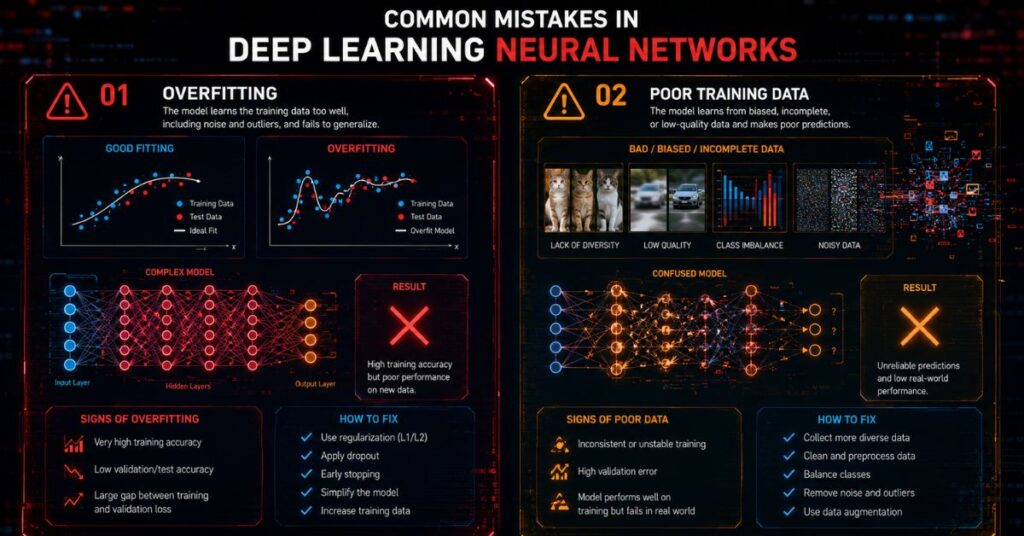
Many beginners face hurdles when they first start building neural network systems. One of the biggest errors is overfitting,where the model learns the training data too well. In this case, the neural network systems perform perfectly on old data but fail on new data. Another mistake is using too little data. Because these networks have millions of parameters, they need massive amounts of information to learn properly. If you give a network only ten photos, it will never understand the variety of the real world.
Another frequent mistake is selecting the wrong system design for the job. Not all deep learning neural networks are the same; some are better for images, while others excel at text. Developers often ignore the importance of data cleaning as well.
If your input data is messy or biased, your neural network systems will produce biased results. Finally, many people set the learning rate too high. This causes the model to skip over the best solution, leading to poor performance. Paying attention to these details is crucial for creating a reliable AI model.
Frequent Developer Errors to Avoid
- Overfitting: Training the model for too long on a small dataset.
- Underfitting: Using a model that is too simple for a complex problem.
- Poor Data Quality: Feeding the network “noisy” or incorrect information.
- Ignoring Hardware: Trying to train deep models without a proper GPU.
- Vanishing Gradients: Using activation functions that make the network stop learning.
- Wrong Batch Size: Processing too much or too little data at once during training.
Real World Applications of Deep Learning Neural Networks

We see the impact of neural network systems in almost every industry today. In the medical field, doctors use these networks to spot tumors in X-rays faster than the human eye. In the world of entertainment, streaming services use deep learning neural networks to suggest movies you might enjoy.
Even your email filter uses this technology to keep spam out of your inbox. The versatility of neural network systems makes them an essential tool for modern business and science.
The automotive industry is another area where deep learning models shine brightly. Self driving cars must process visual data from cameras in real-time to avoid obstacles. By using deep learning models these cars can distinguish between a pedestrian and a lamppost in milliseconds.
Similarly, banks use these systems to detect credit card fraud by spotting unusual spending patterns. As the technology improves, we will see deep learning neural networks solving even more complex global challenges in the near future.
| Industry | Primary Use Case |
| Healthcare | Analyzing MRIs and discovering new drug formulas. |
| Finance | Predicting stock market trends and detecting fraud. |
| Retail | Visual search and personalized shopping ads. |
| Safety | Real time surveillance and facial recognition systems. |
Future Trends in Deep Learning Neural Networks Technology
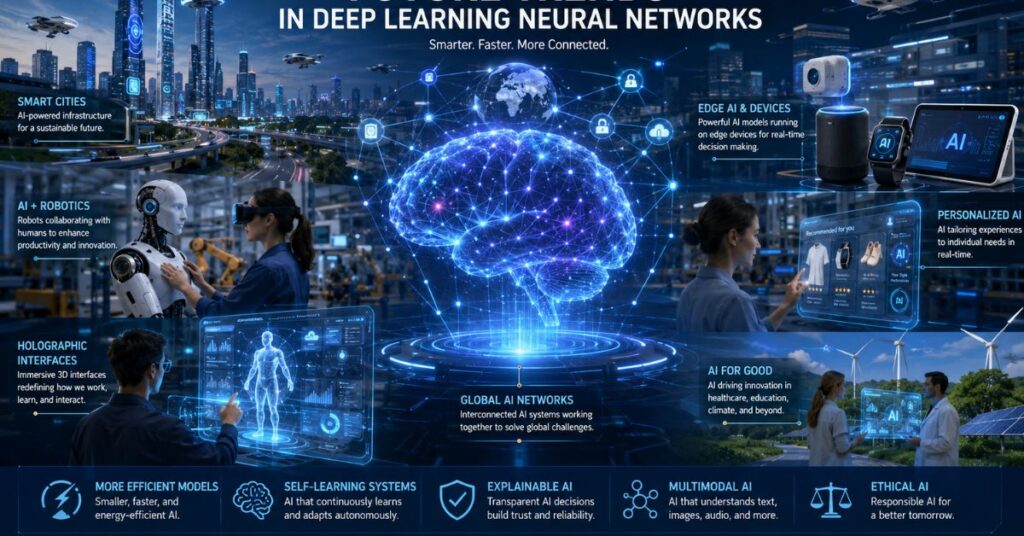
The evolution of deep learning neural networks is moving toward more efficient and greener AI. Currently, training these models requires a lot of electricity and high end hardware. Researchers are now developing deep learning models that can run on smaller devices like smartphones.
This shift will make AI more accessible to people everywhere. We are also seeing a move toward Explainable AI.This means experts want to understand exactly why deep learning neural networks make certain decisions, which builds trust with users.
Another exciting trend is the combination of deep learning neural networks with other technologies like robotics. This allows robots to learn physical tasks through observation rather than manual coding. In the future,deep learning models might even help us communicate across languages instantly with perfect grammar.
The focus is shifting from just making models bigger to making them smarter and more ethical. As we refine these systems,deep learning models will become a standard part of our daily lives, hidden behind the scenes of our favorite gadgets.
Emerging Tech Innovations
- Edge AI: Running complex networks directly on mobile chips.
- Synthetic Data: Using AI to create training data for other AI.
- Transfer Learning: Taking a pre trained network and applying it to a new task.
- Transformer Models: Advanced architectures that understand context in language.
- Automated ML: Using computers to design the best neural network structure.
Final Thoughts on Deep Learning Neural Networks
In summary, deep learning neural networks stand as the backbone of modern artificial intelligence. These systems have changed how we interact with technology by allowing machines to learn from experience. By mimicking the structure of the human brain, deep learning neural networks can solve problems that were once thought impossible for computers.
From identifying diseases in medical scans to powering the voice in your smartphone, their impact is visible everywhere. As long as we have large amounts of data, these networks will continue to grow in power and accuracy.
Understanding the mechanics of deep learning neural networks is the first step toward mastering the future of tech. While the math behind them is complex, the core idea remains simple: layers of neurons working together to find patterns.
As developers and researchers fix common mistakes like overfitting, these models become more reliable for daily use. Embracing deep learning neural networks means embracing a world where technology understands and assists us better than ever before. This journey into AI is just beginning, and the potential for innovation is truly limitless.
Summary of Key Takeaways
- Deep learning models use multiple layers to process and analyze complex information.
- The system learns by adjusting internal weights based on errors it makes during training.
- Data quality is the most important factor for building successful deep learning models.
- Automation of feature extraction saves time and reduces the need for human experts to label every detail.
- Future progress focuses on making deep learning models faster, smaller, and more transparent.
- Avoiding common pitfalls like poor data cleaning ensures your model remains accurate and unbiased.
FAQs
What are deep learning models?
They are computer systems modeled after the human brain that learn from large amounts of data. They use layers to identify patterns and make predictions.
How do they differ from basic machine learning?
Deep learning is a sub field that uses many layers (deep) and can handle unstructured data like images without human help. Basic machine learning often requires more human guidance.
Do I need a powerful computer for these networks?
Yes, training deep learning modelsusually requires a Graphics Processing Unit (GPU) because they perform millions of mathematical calculations at once.
Can these networks make mistakes?
Yes, they can suffer from hallucinations or errors if the training data is poor or if the model is overfitted to a specific set of examples.
Is deep learning the same as artificial intelligence?
Not exactly. Artificial intelligence is a broad concept. Machine learning is a part of AI, and deep learning is a specific, advanced technique within machine learning.
Why is it called Deep learning?
Deep describes how many layers are stacked within the network. A network with many hidden layers is considered deep.
How much data is needed for a neural network?
Generally, more is better. Most professional deep learning models require thousands or even millions of examples to reach high accuracy levels.