

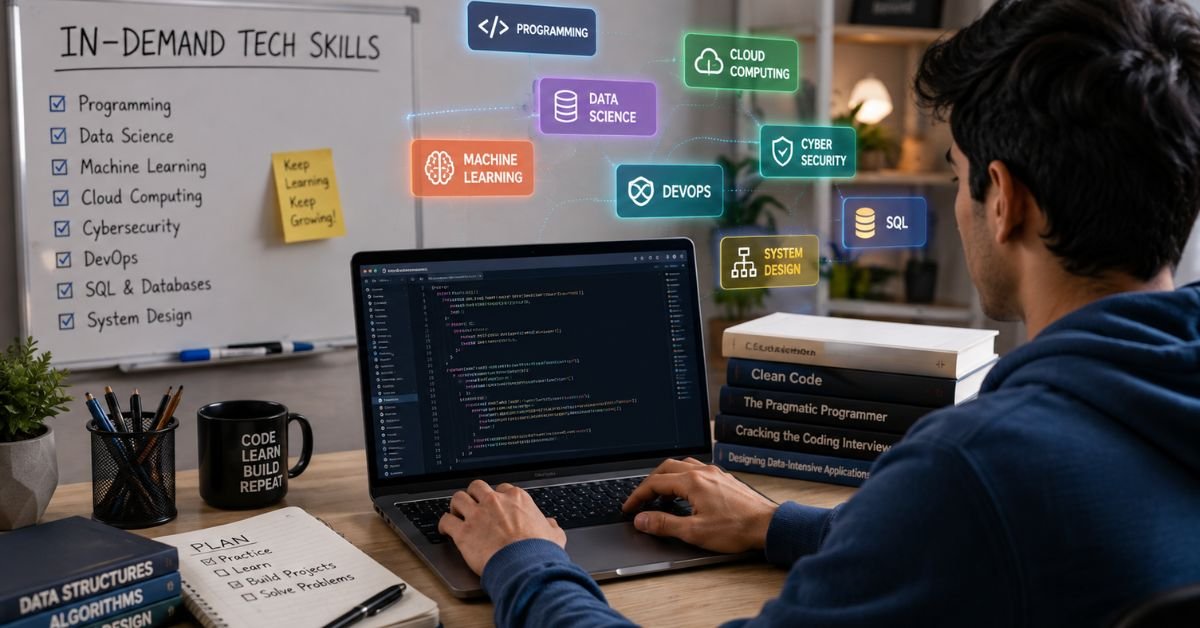
coding practice websites free can help you build programming skills without joining every platform available online. The right website should offer useful problems, clear difficulty levels, practical coding exercises, and progress tracking. Some platforms suit beginners, while others focus on interview questions, algorithms, or specific programming languages.
I compared three strong options: CodeChef, HackerRank, and Exercism. Each platform takes a different approach to coding practice. This guide explains what each one does well, who should use it, where it may fall short, and how you can build a simple practice routine without wasting time.
Quick Takeaway: Which Coding Practice Website Should You Choose?
| Platform | Best For | Main Strength | Good Starting Point |
| CodeChef | Beginners, DSA, competitive programming | Large problem library and difficulty paths | Beginner problems |
| HackerRank | Structured learning and skill practice | Tutorials, domains, and coding challenges | Language basics |
| Exercism | Language fluency | Practice exercises and mentoring | One language track |
Quick answer: If you want a broad problem library, CodeChef is a strong starting point. If you want guided challenges around specific programming skills, HackerRank is useful. If your main goal is to become comfortable writing clean code in one programming language, Exercism offers a different learning style.
The best choice depends on your goal, not just the number of problems available.
What Makes Coding Practice Websites Free Worth Using?
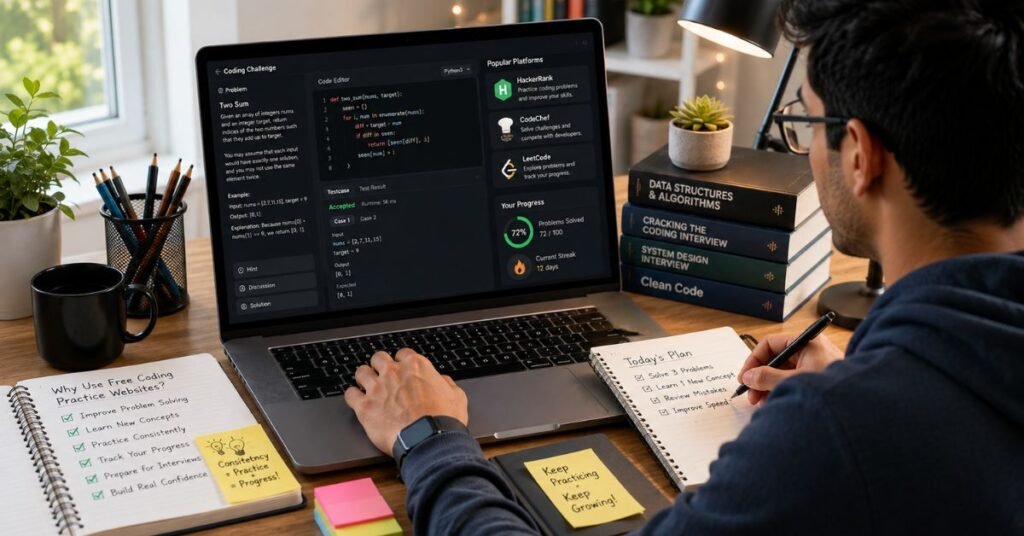
Free coding platforms can give you something tutorials cannot: repeated practice. Watching a Python lesson may help you understand loops, but writing ten small programs forces you to use those loops yourself.
A good platform should also make it easy to move from simple questions to harder ones. You should not spend most of your time searching for suitable problems.
Look for These Features
A useful coding practice platform should offer:
- Problems at different difficulty levels
- Multiple programming languages
- Online code execution
- Immediate results or feedback
- Topic based practice
- Data structures and algorithm questions
- Progress tracking where available
- Beginner friendly problems
- Interview or real world practice
- A large enough problem library for regular use
One important point often gets missed: more problems do not automatically mean better learning. Solving 100 easy questions without understanding your mistakes may teach less than solving 30 carefully selected problems.
Your goal should be to improve your thinking, coding speed, debugging skills, and ability to choose the right approach.
CodeChef: A Strong Choice for Broad Coding Practice
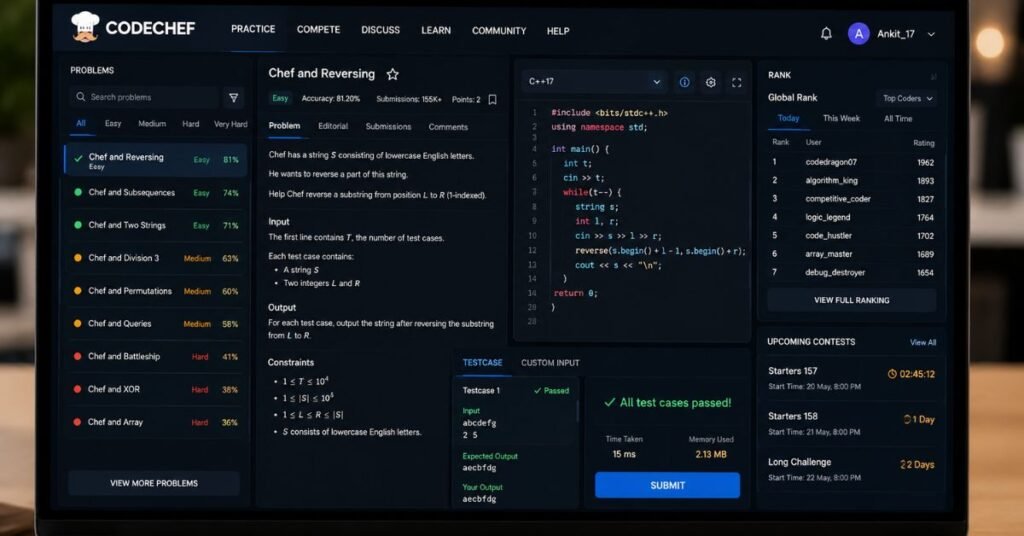
CodeChef is one of the most useful choices when you want a mixture of beginner practice, data structures, algorithms, and competitive programming. Its practice section organizes problems around programming languages, topics, and difficulty levels.
The platform currently lists thousands of practice problems and includes paths for languages such as Python, Java, C, and C++. It also separates practice into areas such as arrays, strings, sorting, linked lists, stacks, queues, and other data-structure topics.
Why CodeChef Stands Out
The biggest advantage is variety. A beginner can start with basic programming questions and gradually move toward more complex algorithmic problems.If you are just starting out, coding practice websites free can give you a simple way to practice without paying for expensive courses or tools.
This makes CodeChef useful if you do not want to change platforms every time your skill level improves.
Its difficulty based structure can also help you avoid a common mistake: jumping directly into advanced DSA problems before learning the basics.
Who Should Use CodeChef?
CodeChef works especially well for:
- Programming beginners
- Students learning DSA
- Python, C++, Java, or C learners
- Competitive programming beginners
- Developers who want regular problem solving practice
- Students preparing for coding tests
If you are completely new to programming, start with simple language and logic problems. Do not rush toward high difficulty questions because they look impressive.
How to Use CodeChef Properly
Do not randomly open problems and solve whatever appears first.
Choose one language and one topic. For example, if you are learning Python, begin with variables, conditions, loops, functions, arrays, and strings. After that, move into basic data structures and algorithms.
A simple progression can look like this:
Basics → Logic → Arrays → Strings → Sorting → Searching → Data Structures → Algorithms
This approach gives your practice a clear direction.
HackerRank: Better for Structured Skill Practice

HackerRank takes a more structured approach to coding practice. It offers challenges across programming languages and technical areas, including JavaScript, Python, SQL, algorithms, and other skills.
One useful feature is that many challenges are grouped into learning paths or domains. This can help beginners who feel lost when they see hundreds of unrelated coding problems.
What Makes HackerRank Useful?
HackerRank is strong when you want to practice a particular skill instead of simply solving random questions.
For example, you may want to improve JavaScript functions, data types, classes, or other programming concepts. You can work through related challenges and test your code directly.
This creates a useful learning cycle:
Learn → Write Code → Test → Find Mistakes → Fix → Repeat
That cycle matters because coding improves through active problem solving.
Who Should Choose HackerRank?
HackerRank can be a good option for:
- Beginners who want structured practice
- Students learning a programming language
- People practicing SQL
- Developers improving specific coding skills
- Candidates preparing for coding assessments
- Learners who prefer guided challenge categories
It is especially useful when you already know the basics but need more hands-on work.
One Limitation to Remember
A challenge platform can improve your problem-solving ability, but it cannot replace building real projects.
If you only solve small coding questions, you may become comfortable with isolated problems without learning how different parts of an application work together.
After regular challenge practice, build something simple such as a calculator, task manager, quiz app, weather interface, or small API project.
That combination gives you both problem-solving practice and practical development experience.
Exercism: A Different Way to Build Coding Fluency
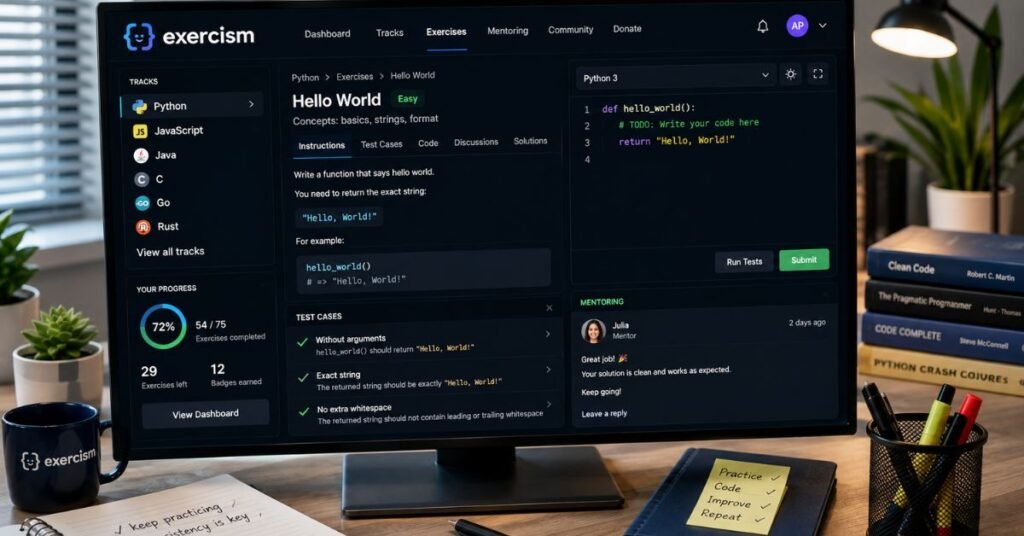
Exercism takes a different approach from a traditional competitive programming website. Its focus is strongly connected to becoming more fluent in a programming language through exercises.
The platform currently supports a very large number of programming languages and provides thousands of coding exercises. It also includes mentoring as part of its learning model.The biggest benefit of coding practice websites free is that you can practice regularly and test your skills through real coding problems.
Why Exercism Is Different
Instead of making your entire learning journey about rankings or difficult algorithm questions, Exercism focuses on writing code and improving your understanding of a language.
This can be valuable when you know basic syntax but still feel uncomfortable writing programs without following a tutorial.
For example, you might know how Python loops and functions work but still find it difficult to use them to build a complete working solution.Repeated exercises can help close that gap.
Who Should Use Exercism?
Exercism is a strong fit for:
- People focusing on one programming language
- Beginners who learn through exercises
- Developers improving language fluency
- Learners who want feedback
- Programmers who want to write cleaner code
It is less about proving that you can solve the hardest algorithm problem and more about becoming comfortable with the language you use.
CodeChef vs HackerRank vs Exercism
The three platforms overlap, but they serve different learning needs.
CodeChef gives you a broad practice environment with strong coverage of problem solving, DSA, and competitive programming. HackerRank works well when you want structured challenges around specific skills. Exercism focuses more heavily on language practice and improving coding fluency.
Instead of choosing a platform based on how many challenges it offers, select one that directly helps you build the skills you want to improve.
Pick a Platform That Fits Your Learning Needs
| Your Goal | Best Starting Choice | Why |
| Learn basic programming | HackerRank | Structured skill based challenges |
| Practice DSA | CodeChef | Topic and difficulty based problems |
| Improve Python skills | CodeChef or Exercism | Both provide hands on practice |
| Improve JavaScript | HackerRank | Strong language focused challenges |
| Practice competitive programming | CodeChef | Strong problem solving focus |
| Improve language fluency | Exercism | Exercise based learning |
| Prepare for coding tests | CodeChef or HackerRank | Problem solving and assessment style practice |
| Build consistency | Any one platform | Regular practice matters more than switching |
You do not need to use all three at the same time.
How to Start Coding Practice If You Are a Beginner

Many beginners make the same mistake: they open a coding website, see a difficult problem, fail to solve it, and assume they are bad at programming.
The problem is usually not the person. The problem is the practice level.
Start with problems that you can solve with some effort. You should feel challenged, but the problem should not feel impossible.
Step 1: Pick One Language
Choose Python, JavaScript, Java, C++, or another language based on your goals.
Do not switch languages every few days.
If you want to learn web development, JavaScript can make sense. If you want an easy entry into programming, Python can be a practical choice.
Step 2: Master Basic Logic
Before advanced algorithms, become comfortable with:
- Variables
- Conditions
- Loops
- Functions
- Arrays or lists
- Strings
- Basic input and output
- Simple debugging
These concepts appear again and again in harder problems.
Step 3: Solve Problems Without Copying
Read the problem carefully.
Write down what the input contains. Then decide what output you need.
Try your own solution before looking at an answer.
If you get stuck, do not immediately copy the complete code. Find the part you do not understand and learn that concept first. code. Find the part you do not understand and learn that concept first.
Step 4: Review Your Mistakes
Your wrong answers are valuable.
Ask yourself:
- Did I misunderstand the question?
- Did I choose the wrong data structure?
- Did I miss an edge case?
- Did my loop run too many times?
- Did I use too much memory?
- Did I understand the algorithm but write it incorrectly?
Keep a small mistake log. After several weeks, you may notice the same mistakes repeating.
That is exactly what you need to fix.
A Simple 30-Day Coding Practice Method
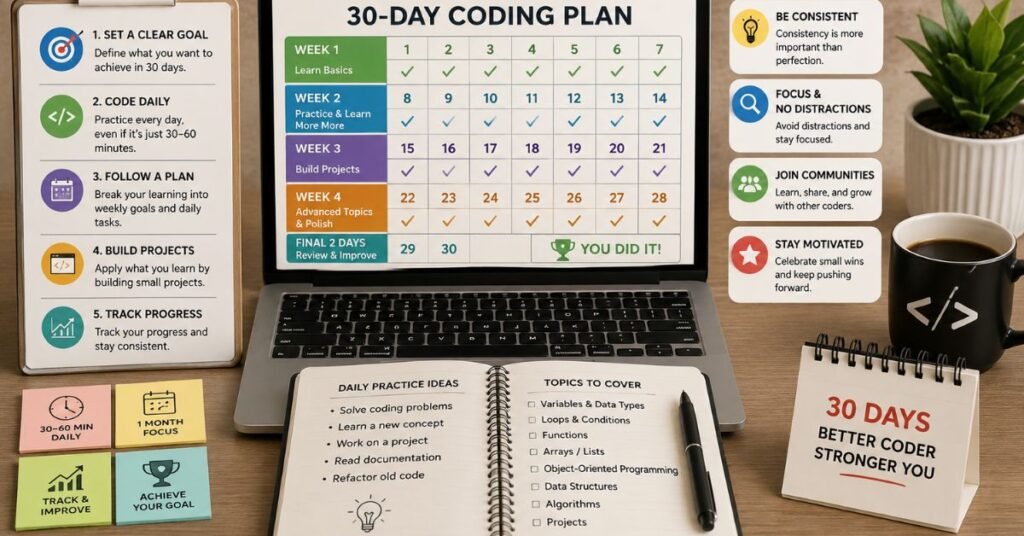
You do not need to solve dozens of problems every day.
A better method is consistent practice.
Week 1: Build the Basics
Solve simple problems involving variables, conditions, loops, and basic functions.
Focus on understanding the code instead of speed.
Week 2: Work With Common Data
Move into strings, arrays, lists, basic searching, and simple sorting.
Try to explain your solution in your own words after solving each problem.
Week 3: Start DSA
Begin with basic data structures such as stacks, queues, linked lists, and hash based structures.
Do not worry about advanced problems yet.
Week 4: Mix Topics
Now solve problems without knowing the topic beforehand.
This is important because real coding tests do not always tell you which algorithm to use.
Try to identify the problem pattern yourself.
Real-Life Example: Why Random Practice Can Waste Time

Imagine a student who solves five coding problems every day.
On Monday, they practice Python.
On Monday, they practice Python.
The next day, they move into advanced graph problems.
By Wednesday, they are working on SQL exercises.
Thursday brings a shift to JavaScript.
Finally, they spend Friday solving random competitive programming questions.
After one month, they may have solved many problems but still struggle to write a simple program independently.
Now consider a learner who sticks with a single programming language and follows a structured learning plan.
They spend the first week on fundamentals, the second week on arrays and strings, the third week on basic DSA, and the fourth week solving mixed problems.
The second learner may solve fewer problems, but their practice has a clear purpose.
Consistency plus the right difficulty is more useful than simply chasing problem counts.
Common Mistakes When Using Coding Practice Websites
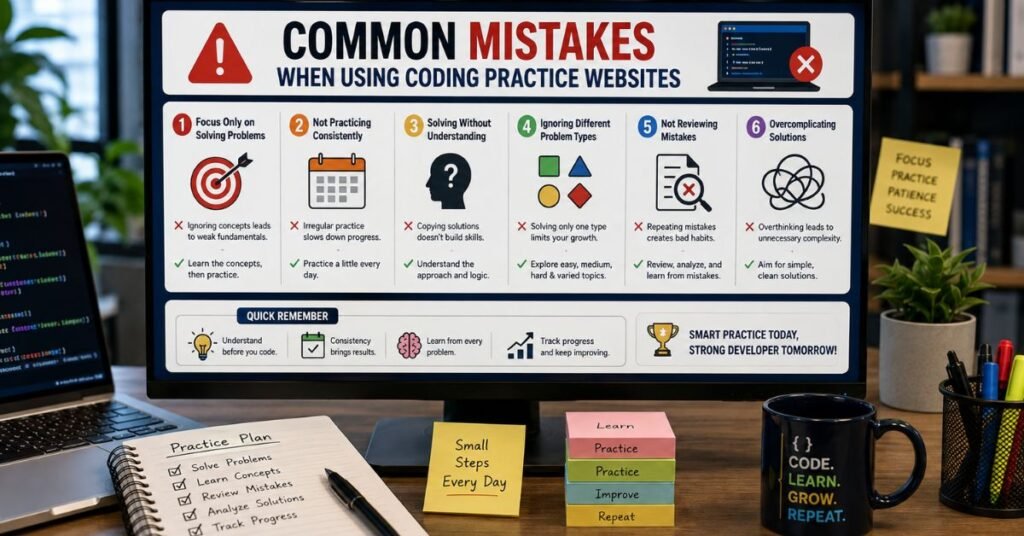
Starting With Hard Problems
Advanced questions can be useful later, but they can discourage beginners.
Start with easy problems and increase the difficulty gradually.
Copying Solutions Too Quickly
Seeing a solution can create the feeling that you understand the problem.
But reading code and producing code are different skills.
Try first. Then study the solution. Finally, close it and write the solution again yourself.
Using Too Many Platforms
Joining five coding websites does not automatically make you better.
You may spend more time deciding what to practice than actually practicing.
Choose one main platform and use another only when it fills a specific gap.
Ignoring Failed Attempts
A failed submission can teach you more than an easy success.
Find out why your code failed and record the lesson.
Practicing Without a Goal
“Today I will practice coding” is too general.
A better goal is:
“Today I will complete three beginner array exercises and carefully review the mistakes I make.”
Specific goals make progress easier to measure.
How to Measure Your Coding Progress
Problem count is only one measurement.
You should also track whether you can solve problems without help, understand your mistakes, and write cleaner solutions.For beginners, coding practice websites free are especially useful because they let you build confidence gradually while learning how to solve programming problems independently.
A simple weekly review can include:
| Metric | Question to Ask |
| Problems solved | How many did I complete? |
| Independent solutions | How many did I solve without copying? |
| Failed attempts | What caused the failures? |
| Time | Am I solving similar problems faster? |
| Concepts | Which topic still feels weak? |
| Code quality | Can I explain my solution clearly? |
If your problem count increases but you still cannot explain your code, change your practice method.
How Coding Practice Helps With Interviews
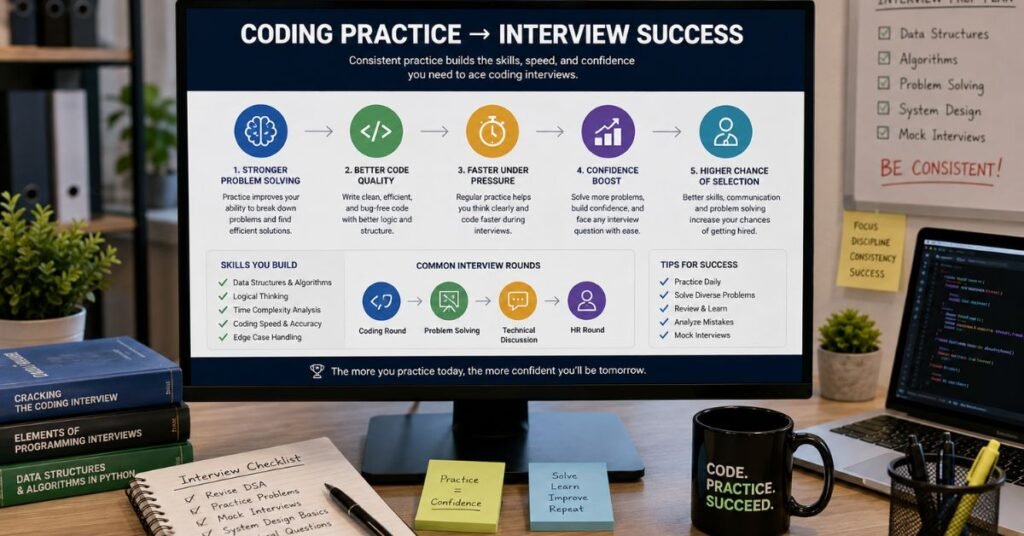
Coding practice can help you prepare for technical interviews because many interviews test how you think, not only whether your final code works.
You may need to explain your approach, discuss complexity, handle edge cases, and improve an initial solution.
Practice this while solving problems.
After writing your solution, ask:
“Can I explain why this solution works?”
Then ask:
“Can I make it faster or use less memory?”
This habit prepares you for a more realistic interview situation.
Author Note
This guide focuses on practical coding practice rather than simply listing popular websites.
The main recommendation is simple: choose a platform based on your current skill and goal. Start at the right difficulty, solve problems yourself, review mistakes, and increase the challenge gradually.
A learner who practices consistently on one suitable platform can make better progress than someone who keeps switching between websites.
Disclaimer
Coding platforms change their features, problem libraries, pricing, and available content over time. Free access can also differ between sections or features. Always check the current platform before relying on a specific feature.
Conclusion
Finding the right coding practice websites free can make learning programming much easier, but the website itself will not do the work for you. CodeChef is a strong choice for broad problem-solving and DSA practice, HackerRank is useful for structured skill-based challenges, and Exercism is valuable for building fluency in a programming language.
You do not need to use every platform. Pick one that matches your goal, practice regularly, review your mistakes, and slowly increase the difficulty. The real benefit comes from writing code yourself and learning from each problem. That is how free online practice can turn into stronger programming skills.
FAQs
What are the best coding practice websites free?
CodeChef, HackerRank, and Exercism are strong options. The best choice depends on your goal. CodeChef suits broad problem-solving and DSA practice, HackerRank offers structured challenges, and Exercism focuses on programming-language fluency.
Can I practice coding for free online?
Yes. Many platforms provide free coding exercises and challenges. You can write code directly in the browser, test solutions, and practice different programming topics without installing a full development environment.
Which coding practice website is best for beginners?
Beginners should choose a platform with easy problems and clear learning paths. HackerRank can help with structured skill practice, while CodeChef provides beginner-level problems and gradual difficulty levels.
Is CodeChef good for coding practice?
Yes. CodeChef offers a large range of programming problems across languages, topics, and difficulty levels. It can work well for beginners as well as learners who want to move into DSA and competitive programming.
Is coding practice enough to become a developer?
No. Coding practice is important, but developers also need project experience, debugging skills, version control, and knowledge of development tools. Combine problem-solving practice with real projects.
How many coding problems should I solve every day?
There is no fixed number. For many beginners, one to three carefully solved problems can be more useful than solving ten questions without reviewing them. Focus on understanding and consistency.
Should I use multiple coding practice websites?
You can, but you do not need to. Start with one main platform. Add another when you have a specific reason, such as interview preparation, language practice, or competitive programming.