


Quick Summary (Snapshot)
Artificial intelligence is changing the way people work, learn, shop, and make decisions. As AI becomes part of daily life, AI Ethics has become more important than ever. Ethical AI helps prevent unfair decisions, protects personal data, improves transparency, and builds trust between people and technology.
In this guide, you will learn:
- What AI Ethics means in simple words
- Why ethical AI matters today
- The core principles of responsible AI
- Real-life examples of ethical and unethical AI
- Common challenges organizations face
- Best practices for building trustworthy AI
- Future trends and practical tips
Whether you are a student, business owner, developer, marketer, or simply curious about artificial intelligence, this guide will help you understand AI Ethics without confusing technical language.
Introduction
AI Ethics is becoming one of the most important topics in modern technology. Artificial intelligence now supports businesses, hospitals, schools, banks, and online platforms. As AI continues to influence decisions that affect people’s lives, organizations must ensure these systems work fairly, responsibly, and transparently.
The goal of AI Ethics is not to stop innovation. Instead, it helps people build AI that respects human rights, protects personal information, reduces unfair bias, and remains accountable for its decisions. Ethical AI creates trust between technology and society while encouraging long-term innovation.
Today, governments, researchers, and technology companies are working together to establish ethical guidelines for AI development. Businesses that follow ethical practices often gain stronger customer confidence, improve compliance, and reduce future risks.
What Is AI Ethics?

AI Ethics refers to the principles and values that guide the design, development, deployment, and use of artificial intelligence. These principles help ensure AI systems benefit people without causing unnecessary harm.
Ethical AI focuses on making technology fair, transparent, secure, and accountable. Instead of allowing AI to make unchecked decisions, ethical guidelines encourage human oversight and responsible development.
Unlike technical programming, AI ethics examines how technology affects individuals, communities, businesses, and society. It asks questions such as:
Why does AI need ethical rules?
AI can process huge amounts of data and make decisions within seconds. However, if the data contains bias or errors, AI may produce unfair outcomes. Ethical rules reduce these risks before they affect real people.
Who is responsible for AI decisions?
Even though AI performs automated tasks, humans remain responsible for designing, testing, monitoring, and improving these systems. Organizations cannot simply blame technology when problems occur.
Why trust matters
People only adopt AI when they believe it is safe, fair, and reliable. Ethical practices help organizations earn that trust over time.
Why AI Ethics Matters More Than Ever

Artificial intelligence now influences many important decisions. It recommends products, filters online content, detects fraud, supports medical diagnosis, and helps employers review job applications. Because AI affects real people, ethical responsibility has become more important than ever.
Without proper ethical standards, AI systems may unintentionally create discrimination, invade privacy, or make decisions that users cannot understand.
Protecting fairness
Fair AI reduces discrimination against individuals based on gender, age, race, or other personal characteristics. Developers should regularly test AI models for hidden bias before deployment.
Protecting privacy
AI often relies on large datasets. Organizations must collect, store, and process personal information responsibly while respecting user privacy and applicable regulations.
Improving transparency
Users deserve to understand how AI reaches important decisions. Clear explanations increase confidence and reduce confusion.
Building public trust
Businesses that prioritize ethical AI often strengthen their reputation. Customers feel more comfortable using products that respect fairness, privacy, and accountability.
Core Principles of AI Ethics
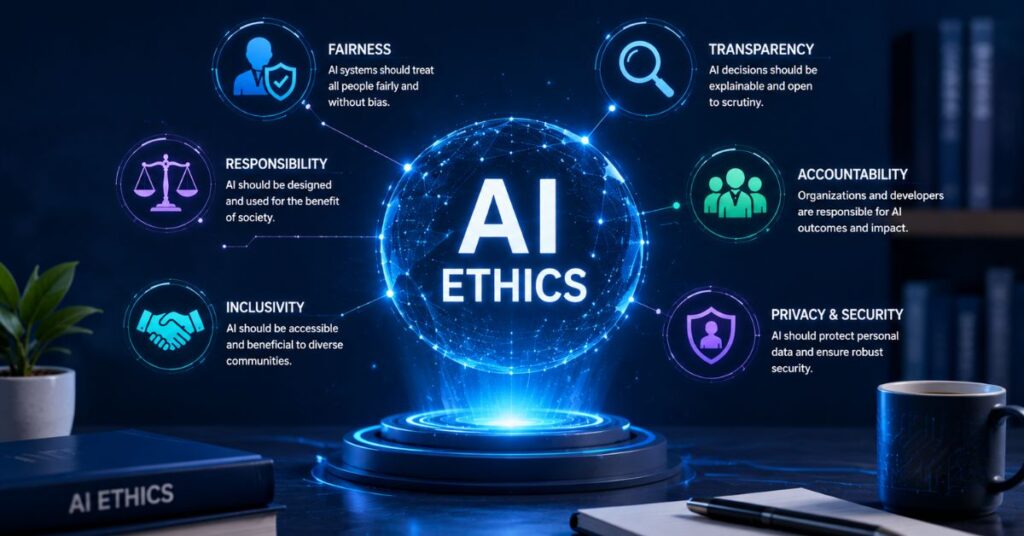
Although different organizations may define AI ethics differently, most ethical frameworks share several common principles. Together, these principles help developers create AI systems that people can trust.
| Principle | Why It Matters | Real-World Benefit |
| Fairness | Reduces discrimination | Equal opportunities for users |
| Transparency | Explains AI decisions | Higher user trust |
| Accountability | Keeps humans responsible | Better governance |
| Privacy | Protects personal information | Safer data handling |
| Security | Prevents cyber threats | Reliable AI systems |
| Human Oversight | Allows human review | Better decision quality |
Fairness
AI should treat people equally and avoid discrimination. Developers should use balanced datasets and continuously evaluate model performance across different user groups.
Transparency
Ethical AI should explain its decisions whenever possible. People should know why an AI system recommends, predicts, or rejects something.
Accountability
Organizations remain responsible for every AI system they create or use. They should monitor performance, investigate errors, and quickly correct unexpected behavior.
Privacy
Respecting personal information is one of the foundations of ethical AI. Companies should collect only necessary data and protect it using strong security practices.
Human Oversight
AI should assist human decision-making rather than completely replacing it in high-risk situations such as healthcare, finance, education, and law.
How AI Ethics Protects Different Industries
Ethical AI supports almost every industry. While the goals remain similar, the risks and responsibilities differ depending on how AI is used.
Healthcare
Doctors use AI to analyze medical images, detect diseases, and support diagnosis. Ethical practices help protect patient privacy and reduce diagnostic bias.
Banking and Finance
Banks rely on AI to identify suspicious transactions, assess loan eligibility, and provide faster support to customers. Ethical standards reduce unfair financial decisions and improve transparency.
Education
Educational platforms use AI to personalize learning experiences. Ethical guidelines help ensure every student receives fair recommendations regardless of background.
Business
Companies use AI for automation, customer support, and marketing. Responsible AI helps businesses improve productivity while maintaining customer trust.
Challenges and Risks of AI Ethics
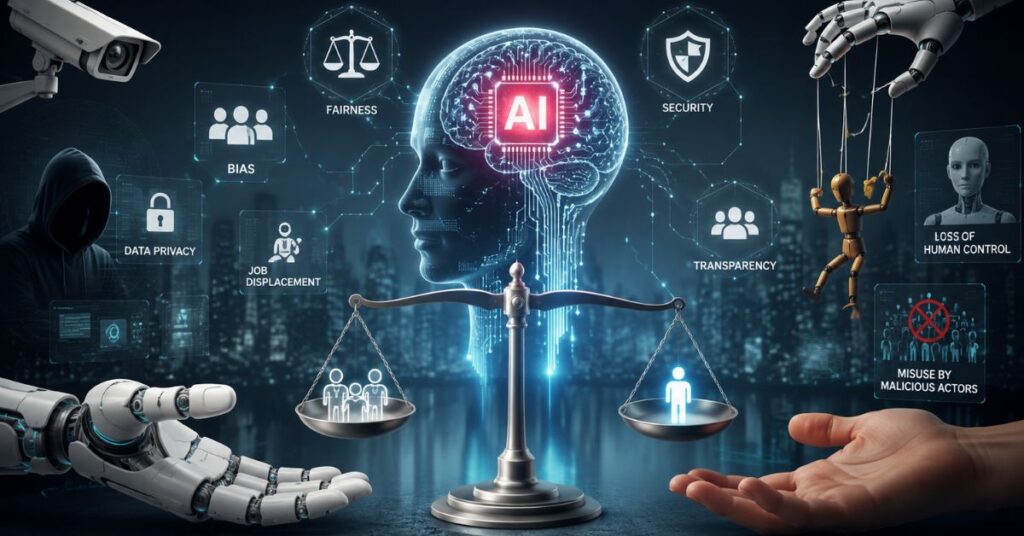
Building ethical AI is not always easy. Artificial intelligence learns from data, and the quality of that data directly affects its decisions. If organizations ignore ethical challenges, AI systems can create problems that harm users, damage trust, and even lead to legal issues.
Responsible organizations do not wait until problems appear. They identify risks early and continuously improve their AI systems.
Bias in Training Data
AI learns from historical data. If that data contains unfair patterns, the AI model may repeat those patterns in future decisions.
For example, if a hiring system learns mostly from past applications submitted by one group of people, it may unintentionally favor similar candidates. Developers should regularly review training data to remove hidden bias.
Lack of Transparency
Some AI systems make decisions without showing how they reached the final result. Users may receive a recommendation or rejection without understanding the reason behind it.
Organizations should explain AI decisions in simple language whenever possible. Transparent systems help users feel more confident and make it easier to identify mistakes.
Privacy and Data Protection
Many AI applications rely on large amounts of personal information. If organizations collect unnecessary data or fail to protect it, users may lose trust.
Companies should collect only the information they truly need, store it securely, and clearly explain how it will be used.
Security Risks
Cybercriminals may try to manipulate AI systems or steal valuable information. Weak security can lead to data breaches, financial losses, and damaged reputations.
Strong cybersecurity practices, regular updates, and continuous monitoring help protect AI systems from attacks.
Human Responsibility
AI can support decisions, but it should not completely replace human judgment in sensitive areas. People must always review important decisions that affect health, education, employment, finance, or legal matters.
Human oversight reduces the chance of harmful mistakes.
Understanding AI Bias and How to Reduce It
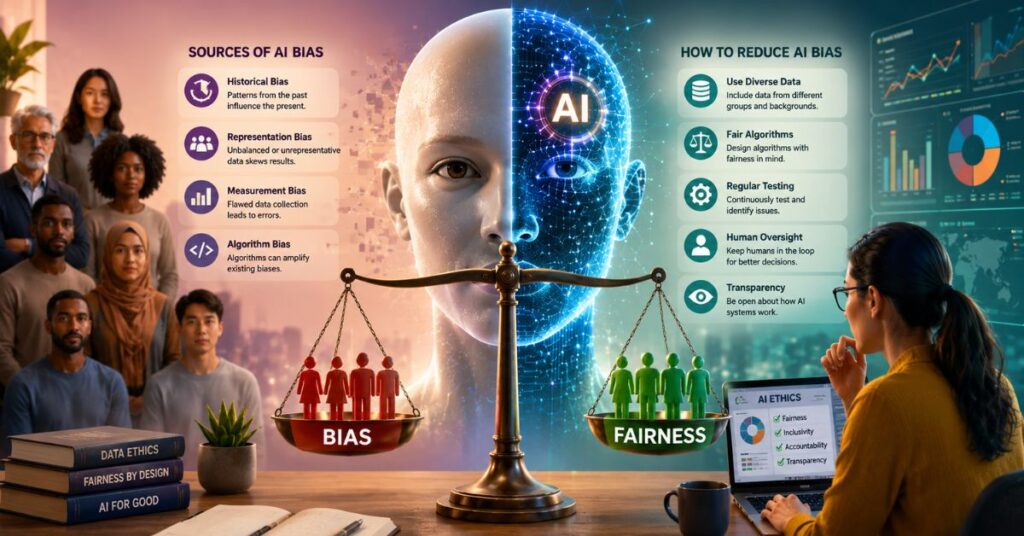
AI bias is one of the biggest concerns in AI Ethics. Bias happens when an AI system consistently produces unfair results for certain individuals or groups.
Bias does not always happen intentionally. It often comes from incomplete, outdated, or unbalanced data.
Where Does AI Bias Come From?
Several factors can introduce bias into AI systems.
- Poor-quality training data
- Missing information
- Human assumptions during development
- Limited testing
- Unequal representation of different groups
Developers should identify these issues before launching AI products.
Practical Ways to Reduce Bias
Organizations can lower bias by following responsible development practices.
- Use diverse and balanced datasets.
- Test models with different user groups.
- Review AI decisions regularly.
- Include experts from different backgrounds.
- Update models when new information becomes available.
Continuous improvement is more effective than treating fairness as a one-time task.
Step by Step Framework for Building Ethical AI
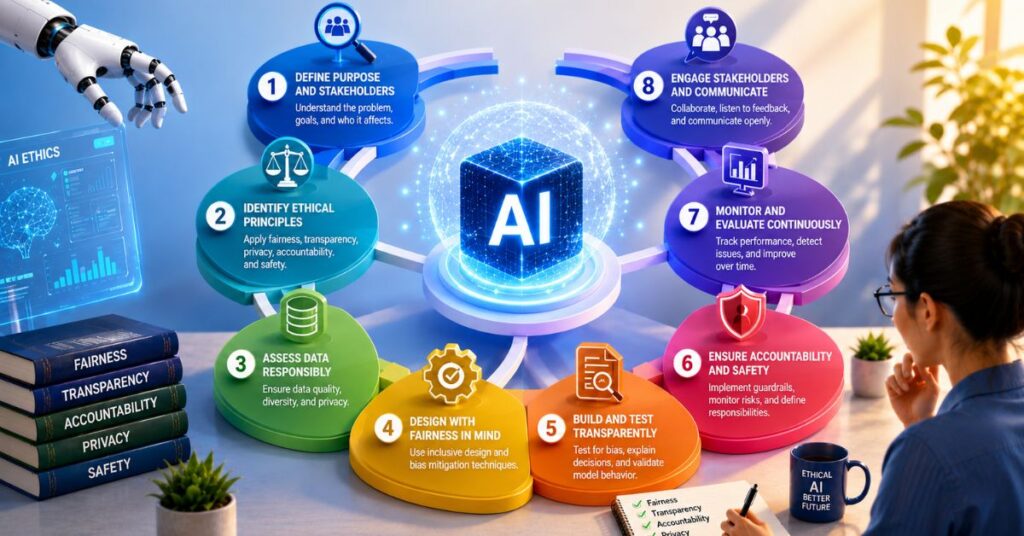
Organizations that successfully implement AI Ethics usually follow a structured process instead of relying on technology alone.
Step 1: Define the Purpose
Start by identifying the problem AI should solve.
Ask questions such as:
- What benefit will AI provide?
- Who will use it?
- Could anyone be negatively affected?
A clear purpose helps teams make responsible decisions throughout development.
Step 2: Collect Responsible Data
Data quality directly affects AI quality.
Teams should remove duplicate records, correct errors, and ensure the dataset represents different types of users fairly.
Good data creates more reliable AI models.
Step 3: Build Fair AI Models
Developers should create AI systems that focus on accuracy while also considering fairness.
Testing should measure more than performance. Teams should also evaluate whether AI treats different groups equally.
Step 4: Test Before Deployment
Organizations should test AI under different conditions before releasing it.
Testing helps discover:
- Hidden bias
- Security weaknesses
- Incorrect predictions
- Unexpected behavior
Early testing prevents costly problems later.
Step 5: Monitor AI Continuously
Ethical AI is not finished after launch.
Developers should monitor performance, collect user feedback, fix errors, and improve models over time.
Continuous monitoring helps maintain trust.
Best Practices for Applying AI Ethics in Organizations
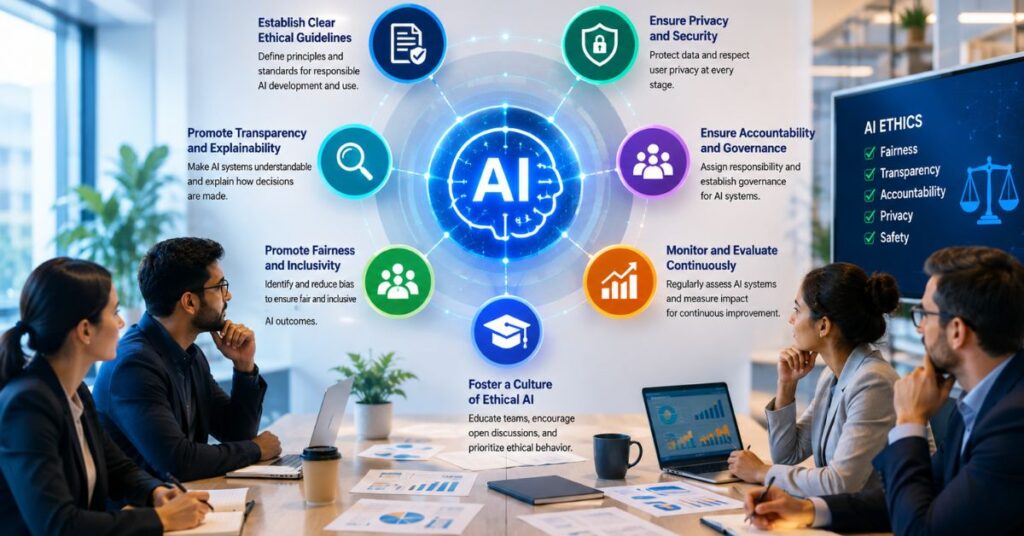
Every organization can improve responsible AI by following practical guidelines.
Create Ethical AI Policies
Clear internal policies help employees understand how AI should be developed and used.
These policies should explain fairness, privacy, accountability, and responsible data handling.
Train Employees
Technology alone cannot create ethical AI.
Developers, managers, and decision-makers should receive regular training on ethical principles and responsible AI practices.
An informed team makes better decisions.
Include Different Perspectives
People from different backgrounds often notice risks that others may miss.
Organizations should involve developers, legal experts, security professionals, business leaders, and end users during AI development.
Collaboration improves fairness.
Review AI Regularly
AI models change over time because data changes.
Regular audits help identify new risks, maintain accuracy, and ensure ethical standards remain effective.
Real Life Example: Ethical AI in Healthcare

Imagine a hospital using AI to detect early signs of lung disease from medical scans.
The AI analyzes thousands of images within seconds and highlights patients who may need further examination.
Doctors review every recommendation before making a final diagnosis.
The hospital also removes personal identifiers from patient data, regularly checks for bias, and monitors system performance.
Because humans remain involved throughout the process, patients receive faster support while maintaining safety, privacy, and fairness.
This example shows that AI Ethics is not about replacing people. It is about helping professionals make better and more responsible decisions.
Common Mistakes People Make When Applying AI Ethics
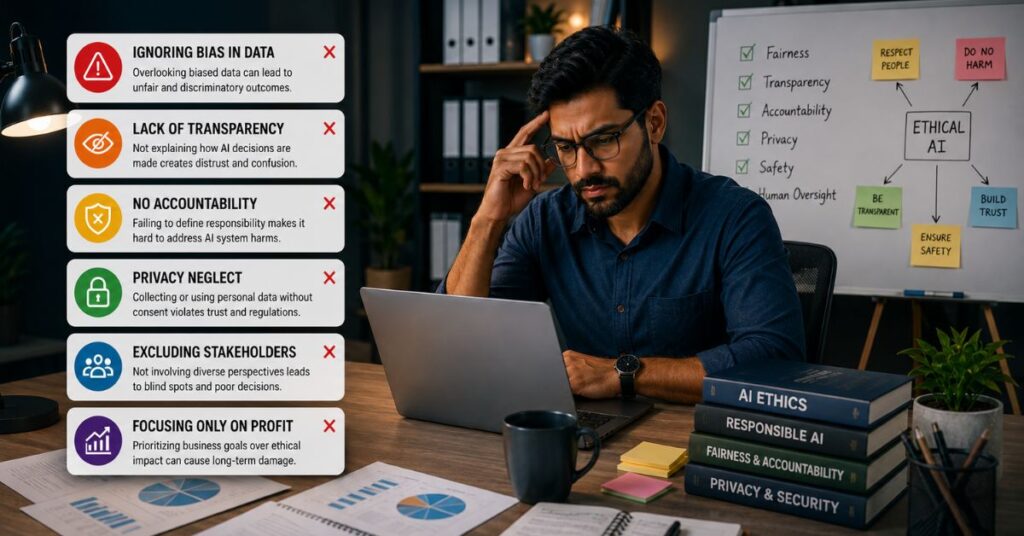
Many organizations invest heavily in AI but overlook ethical responsibilities.
Avoid these common mistakes.
| Mistake | Better Approach |
| Using poor-quality data | Clean and verify datasets regularly |
| Ignoring bias testing | Test AI with diverse users |
| Collecting unnecessary personal data | Gather only essential information |
| Trusting AI without human review | Keep humans involved in important decisions |
| Focusing only on accuracy | Balance accuracy with fairness and transparency |
| Skipping security updates | Monitor and update AI systems continuously |
The Future of AI Ethics

Artificial intelligence is improving every year. More businesses now use AI to automate tasks, improve customer service, analyze data, and support important decisions. As AI becomes more powerful, AI Ethics will become even more important.
Future AI systems will likely make decisions in transportation, education, healthcare, finance, manufacturing, and public services. Because these decisions can directly affect people’s lives, organizations must continue improving fairness, transparency, privacy, and accountability.
Governments around the world are also introducing new regulations for responsible AI. Businesses that prepare early will adapt more easily to changing legal requirements and customer expectations.
Human Centered AI Will Become the Standard
Future AI should work alongside people rather than replace them. Human judgment, empathy, and experience remain valuable in situations that require critical thinking.
Organizations that combine AI with human expertise often achieve better results while reducing ethical risks.
Responsible Innovation Will Build Long Term Trust
Technology changes quickly, but trust takes years to build.
Companies that follow ethical AI principles today are more likely to earn customer confidence, attract business partners, and strengthen their reputation in the future.
Why AI Ethics Gives Businesses a Competitive Advantage

Many people think AI Ethics is only about following rules. In reality, responsible AI also creates business value.
Organizations that build trustworthy AI often experience stronger customer relationships and lower operational risks.
Better Customer Trust
Customers prefer products and services that protect their privacy and explain how AI works.
Trust encourages long term customer loyalty.
Lower Business Risk
Ethical AI helps organizations identify problems before they become expensive legal or reputational issues.
Preventing mistakes is often more cost-effective than fixing them later.
Stronger Brand Reputation
Companies known for responsible technology often stand out from competitors.
A positive reputation attracts customers, investors, talented employees, and business partners.
Experience Based Insight

During AI projects, one lesson becomes clear: technology alone does not create responsible solutions. The quality of decisions depends on the people who design, test, and improve AI systems.
Successful organizations usually review their AI models regularly, listen to user feedback, and update their systems whenever risks appear. Ethical AI is an ongoing process rather than a one-time task.
Teams that focus on transparency and fairness often discover problems earlier and build stronger relationships with users.
Disclaimer
This article provides educational information about AI Ethics to help readers understand responsible artificial intelligence practices.
AI laws, regulations, and organizational policies may differ between countries and industries. Before implementing AI in sensitive areas such as healthcare, finance, education, or legal services, always follow applicable regulations and consult qualified professionals when necessary.
Conclusion
AI Ethics is no longer an optional topic. It has become an essential part of developing trustworthy artificial intelligence. Organizations that focus on fairness, transparency, privacy, accountability, and human oversight create AI systems that benefit both businesses and society.
As AI technology advances, following ethical practices will remain essential for creating reliable and long-lasting solutions.Businesses, developers, researchers, and policymakers all share the responsibility of building AI that respects people while solving real-world problems. By following ethical principles from the beginning, organizations can reduce risks, strengthen public trust, and create technology that delivers long-term value.
(FAQs)
1. What is AI Ethics in simple words?
AI Ethics is a set of principles that helps people develop and use artificial intelligence responsibly. It focuses on fairness, privacy, transparency, accountability, and safety.
2. Why is AI Ethics important?
AI influences many important decisions. Ethical guidelines reduce bias, protect personal information, improve transparency, and help organizations build public trust.
3. What are the main principles of AI Ethics?
The most common principles include fairness, transparency, accountability, privacy, security, and human oversight.
4. Can AI make biased decisions?
Yes. AI can produce biased results if it learns from incomplete or unfair data. Regular testing and balanced datasets help reduce this risk.
5. Which industries benefit from AI Ethics?
Healthcare, finance, education, manufacturing, retail, transportation, government services, and many other industries benefit from responsible AI practices.
6. Does AI Ethics slow innovation?
No. Ethical AI supports innovation by reducing risks, improving customer confidence, and helping organizations create more reliable technology.
7. Who is responsible for AI decisions?
Humans remain responsible for designing, testing, monitoring, and improving AI systems. AI supports decision-making, but accountability stays with people and organizations.